



Intent: demonstrate | A comprehensive video tour walkthrough showcasing how schools celebrate capital campaign and renovation donors with interactive digital recognition walls that honor philanthropic support while preserving institutional legacy and inspiring continued giving through engaging visual storytelling.
School renovation projects and capital campaigns represent transformational opportunities for educational institutions—new classroom wings, modernized science labs, upgraded athletic facilities, technology infrastructure improvements, and accessibility enhancements that directly impact student learning and community pride. These ambitious initiatives require substantial philanthropic support from dedicated donors who deserve lasting, prominent recognition befitting their generosity. Yet traditional donor recognition approaches—engraved plaques with limited space, static name lists, or physical walls that fill up completely—create frustrating constraints that compromise stewardship relationships and limit future fundraising capacity.
With digital recognition platforms like Rocket Alumni Solutions, schools can showcase unlimited renovation donors with comprehensive profiles, adapt displays throughout multi-year campaigns as new supporters contribute, preserve complete capital campaign history across decades, and create engaging experiences that inspire prospective donors through compelling visual storytelling impossible with conventional static installations.
This video tour guide demonstrates how interactive digital recognition walls transform school renovation donor acknowledgment from space-limited temporary displays into permanent, flexible celebration platforms that strengthen fundraising culture while honoring every supporter appropriately regardless of contribution size.
Modern digital recognition walls eliminate capacity constraints that force impossible decisions about which donors receive visible acknowledgment. Whether celebrating major benefactors funding entire building wings, corporate sponsors supporting specific spaces, alumni contributors honoring classmates, or community members giving at all levels, digital platforms provide unlimited recognition capacity ensuring everyone receives appropriate permanent celebration.
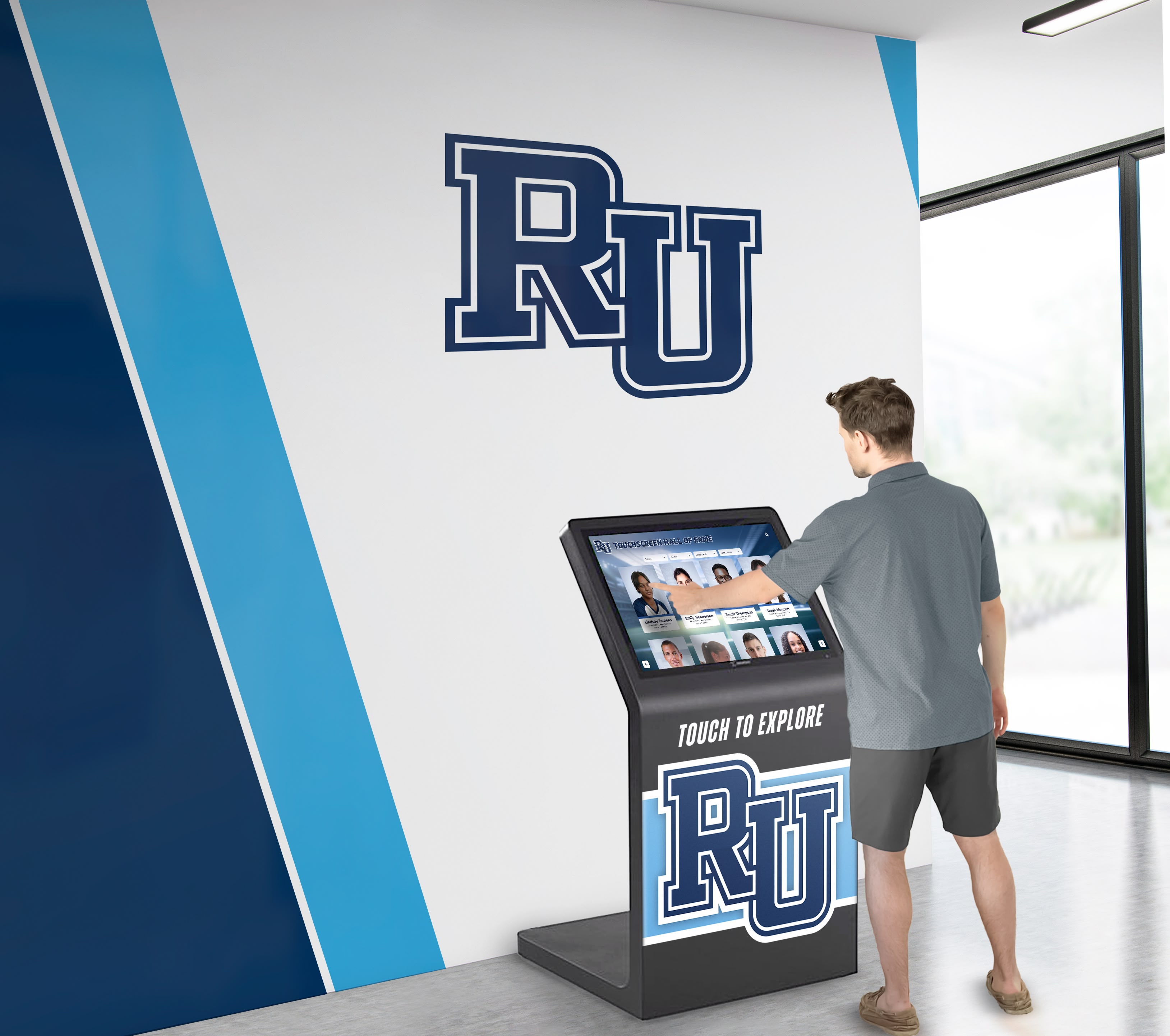
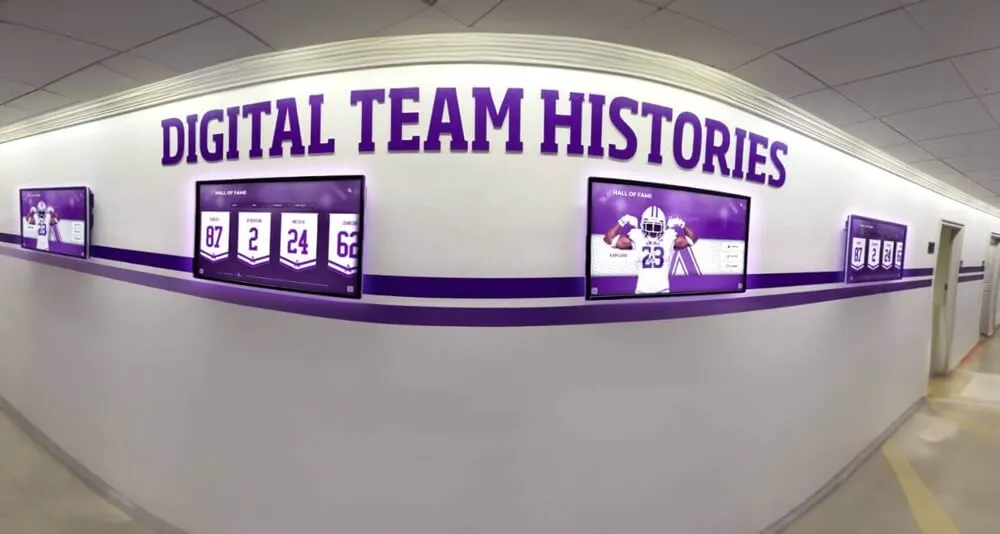
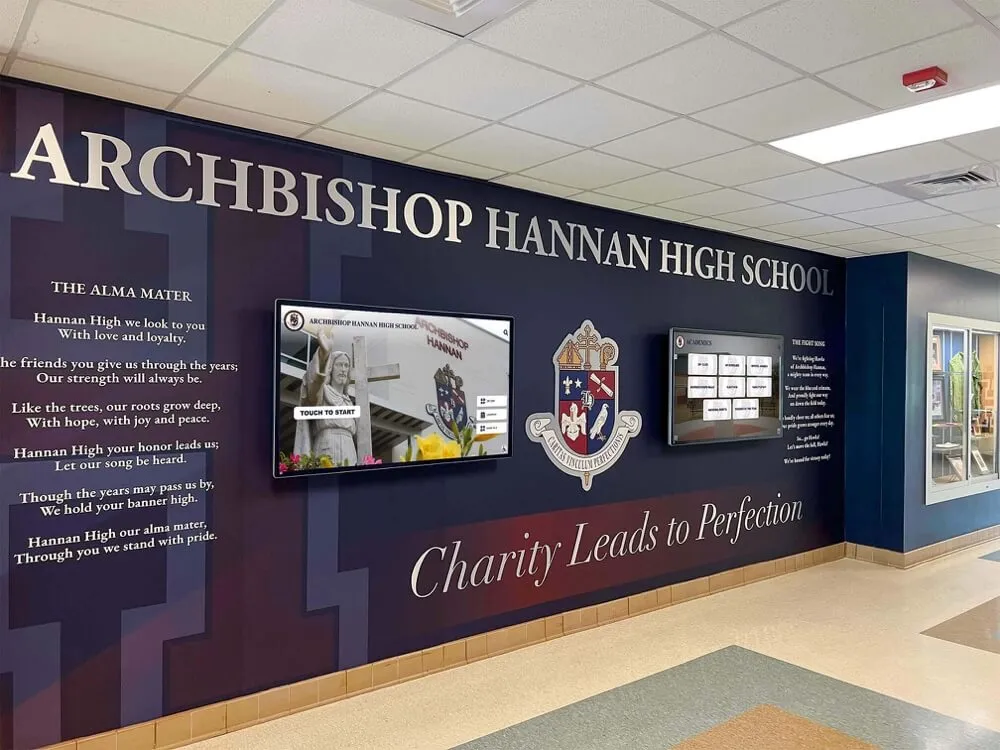
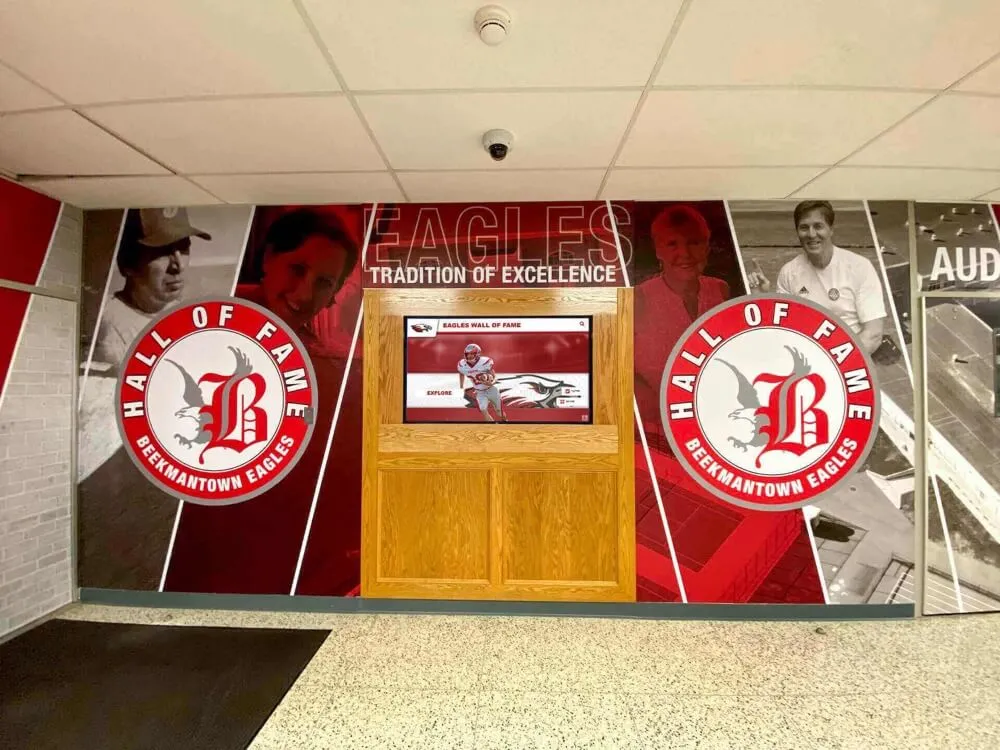
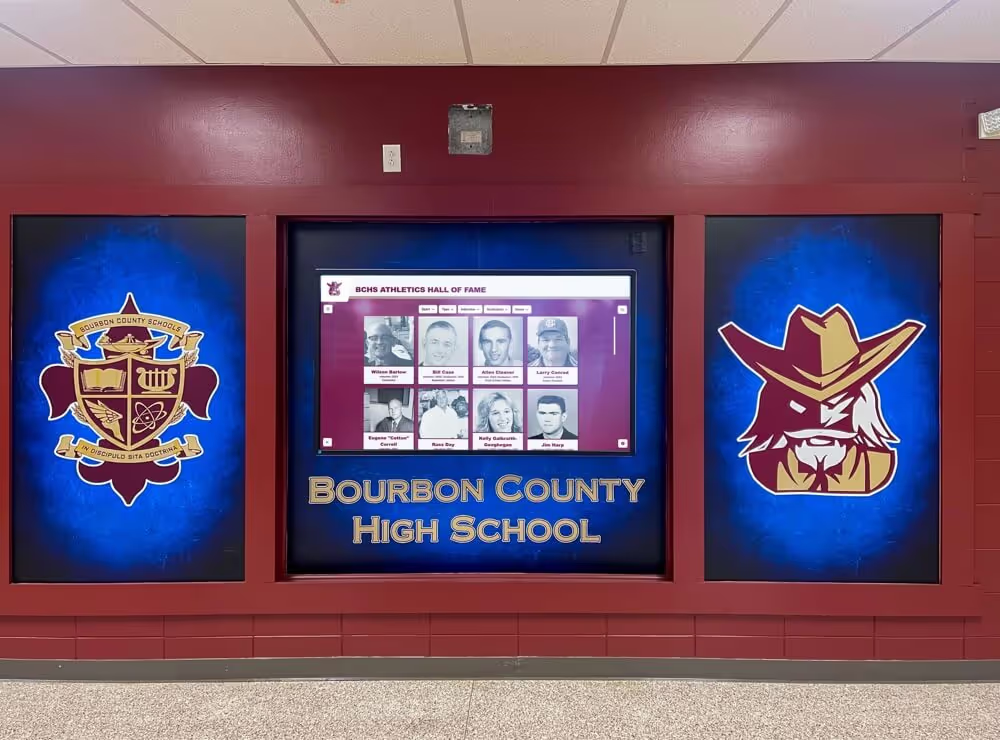
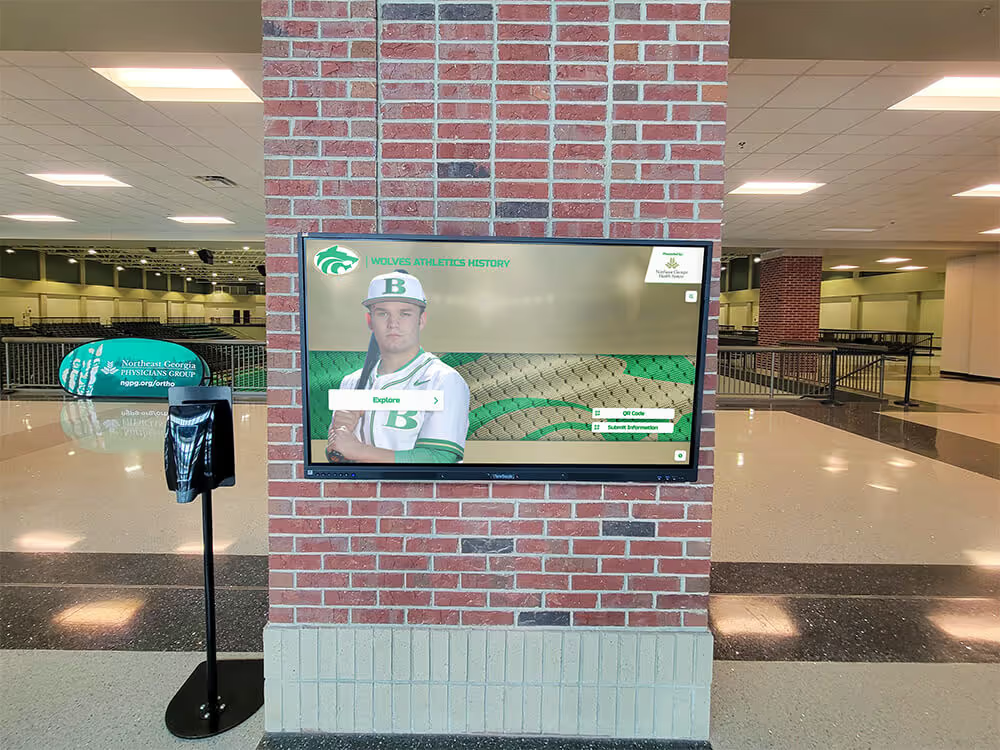
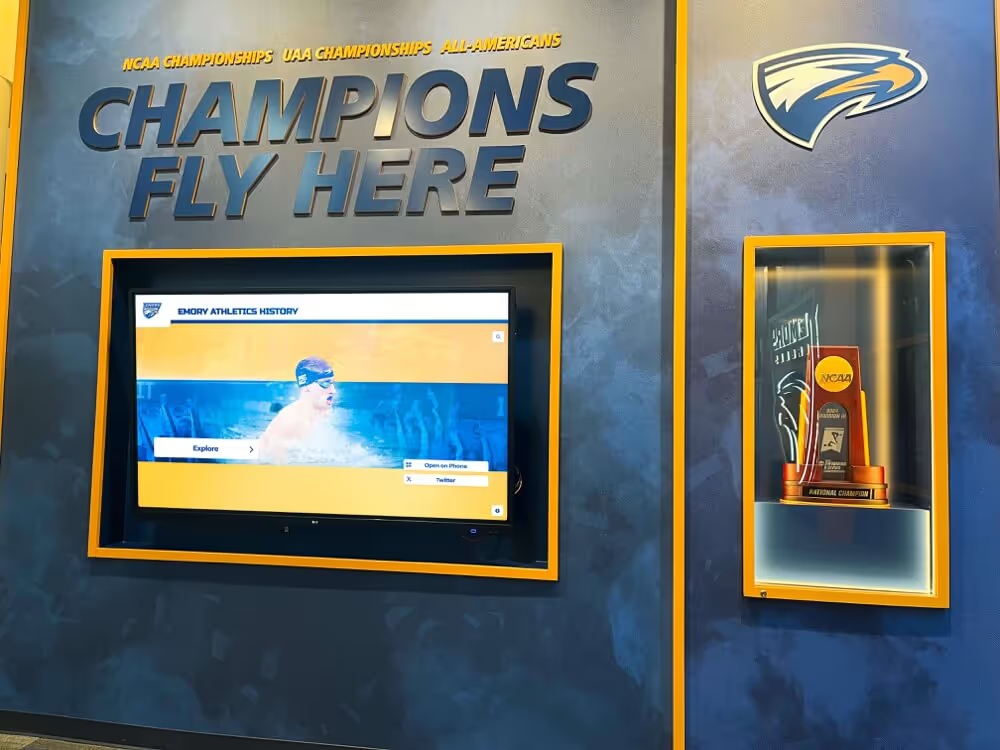
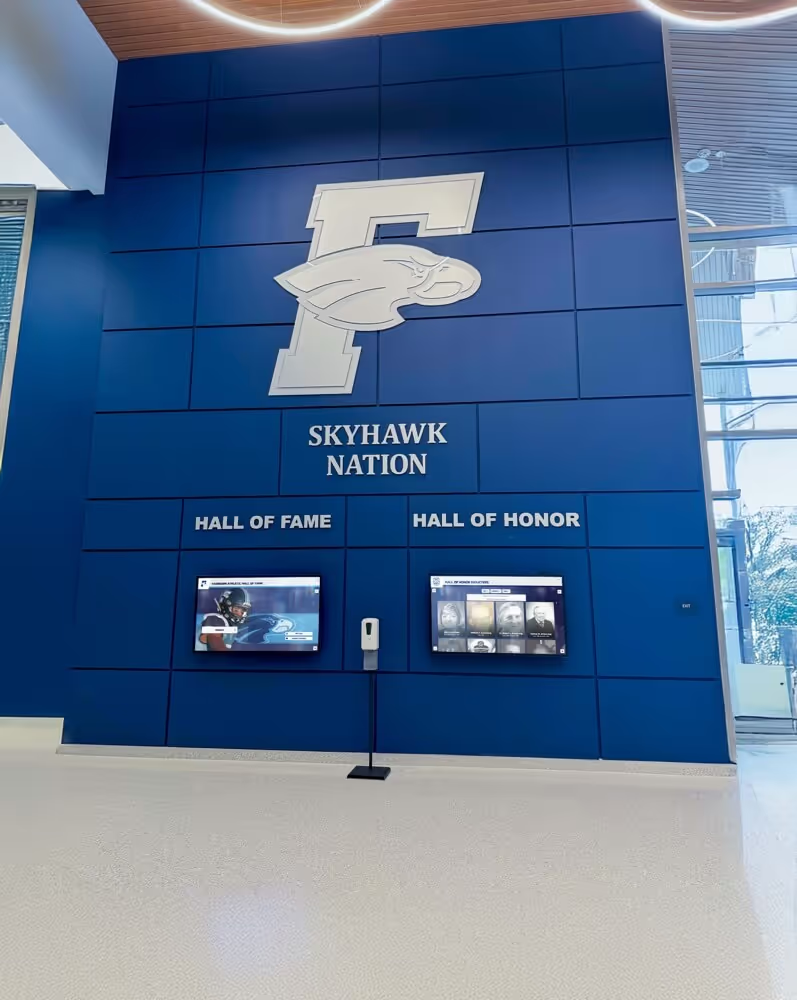
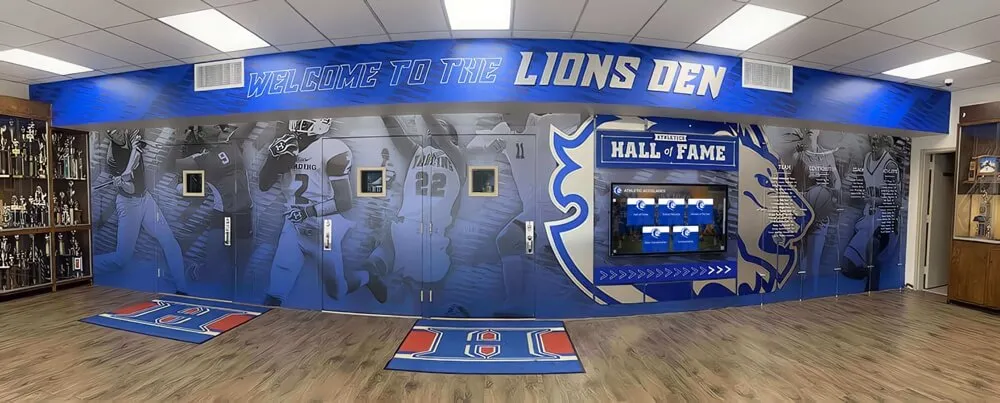
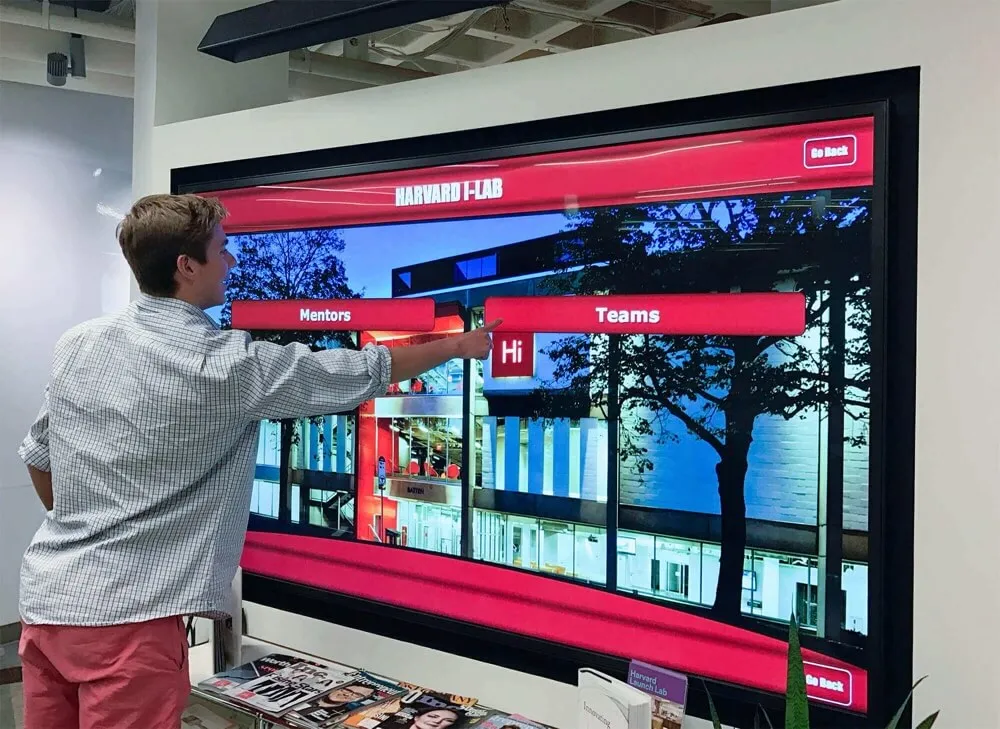
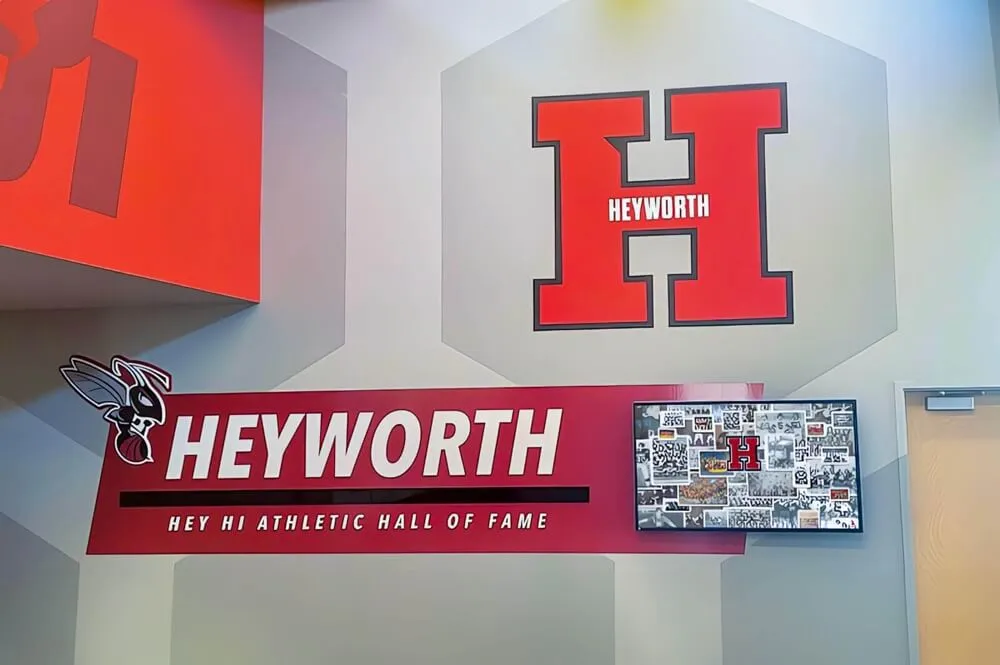
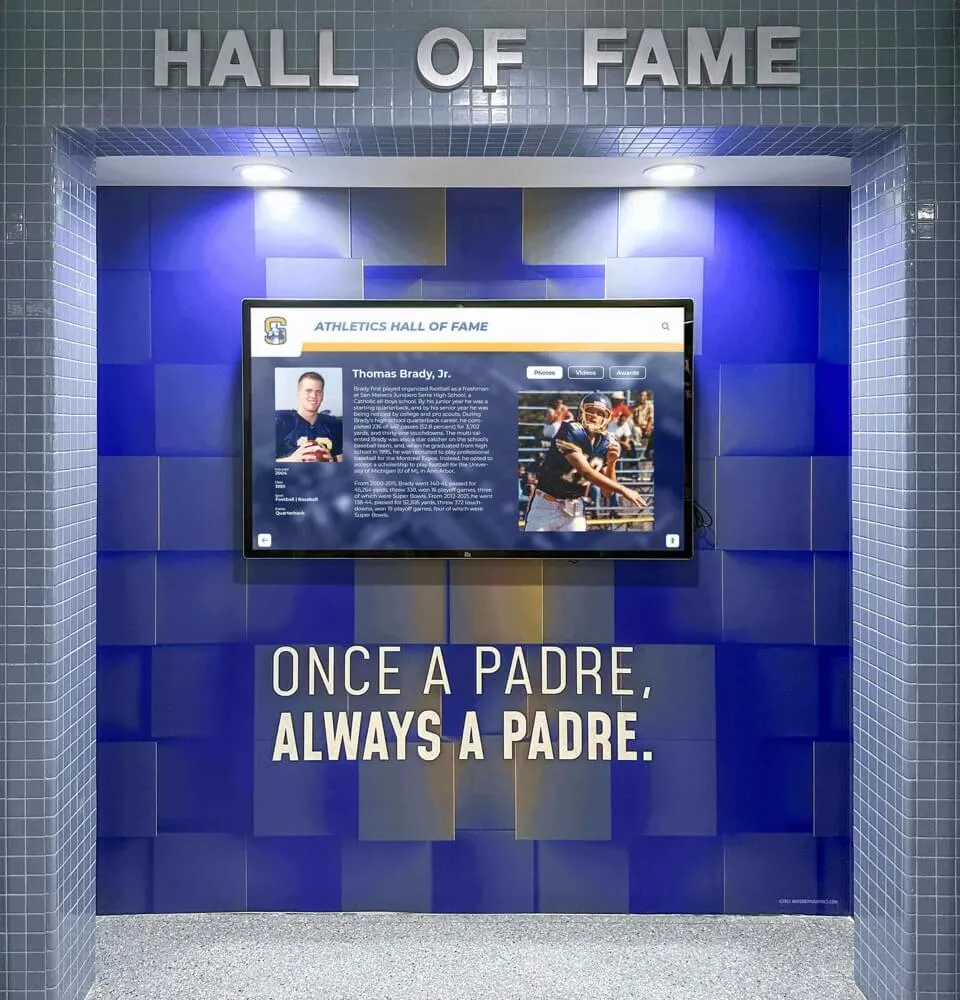
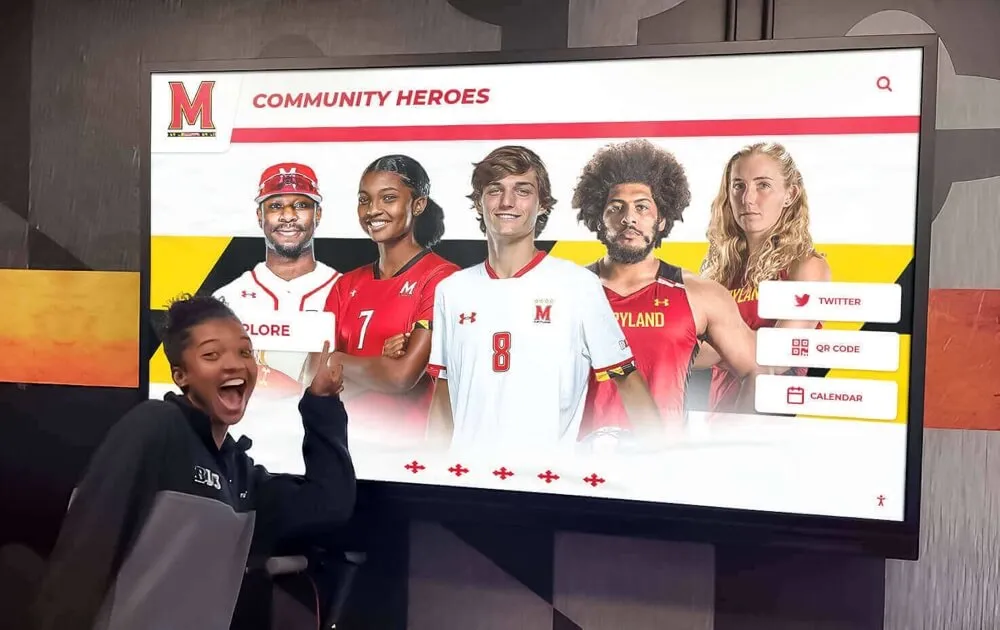
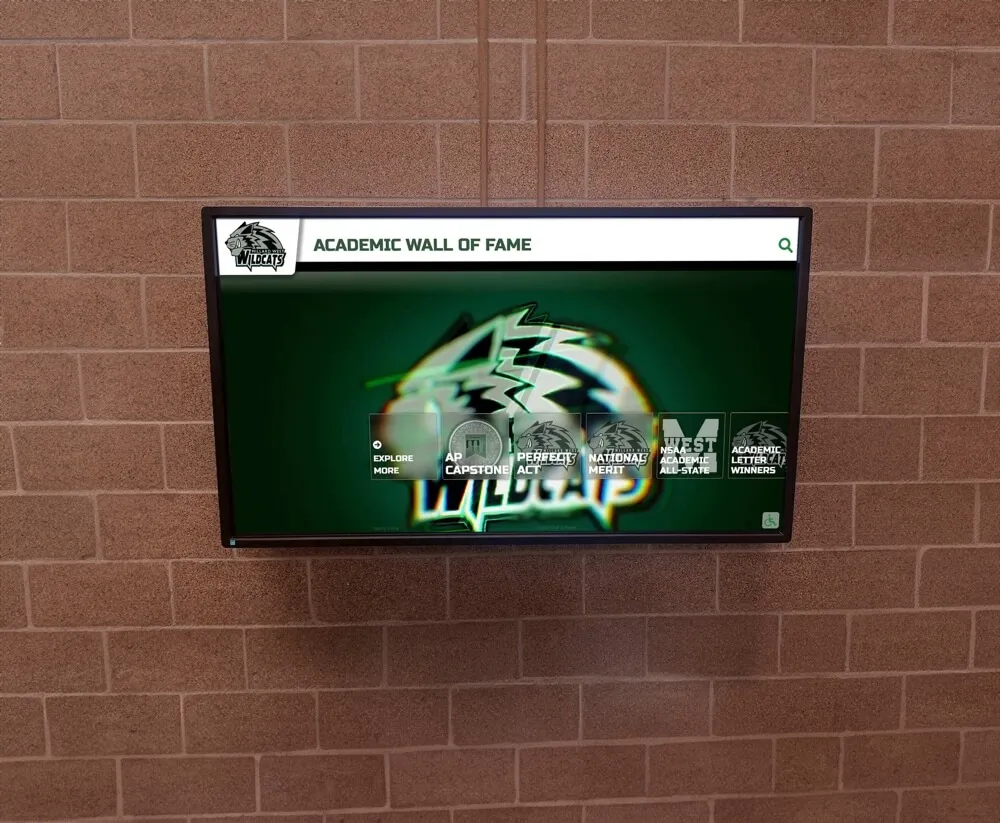
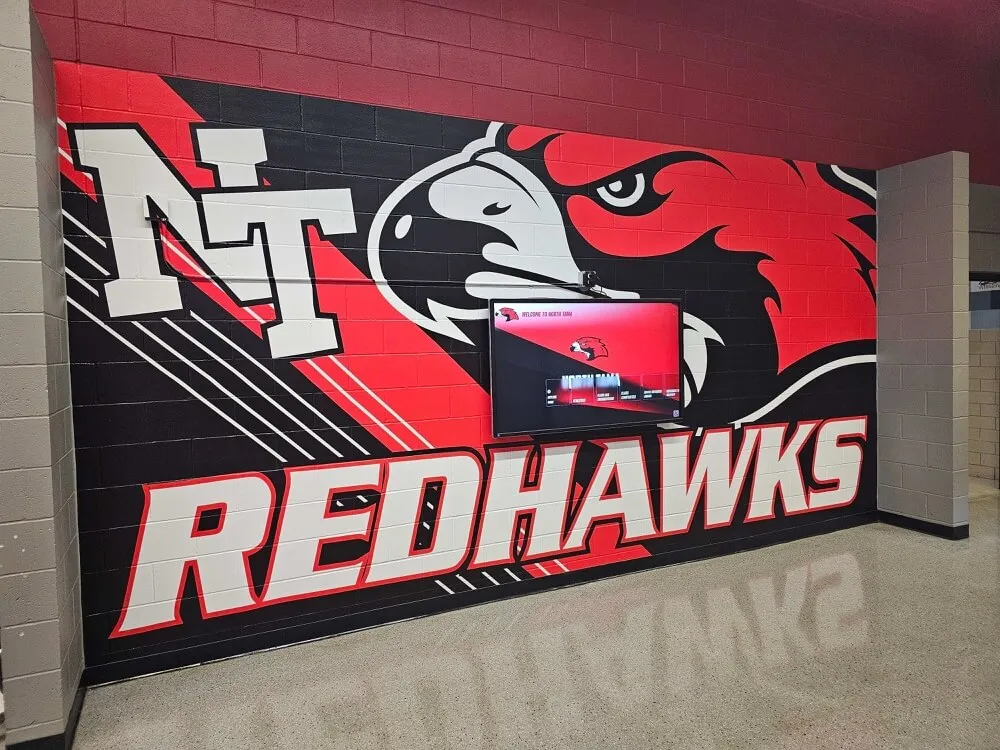
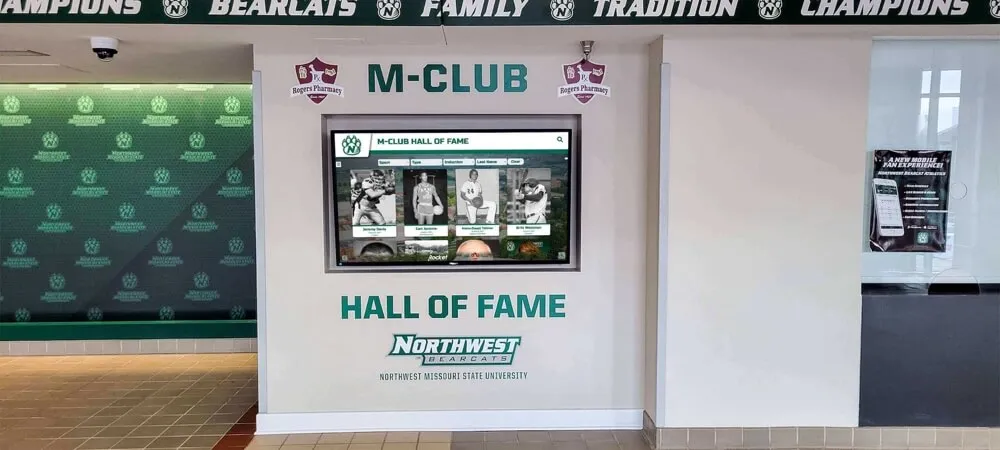
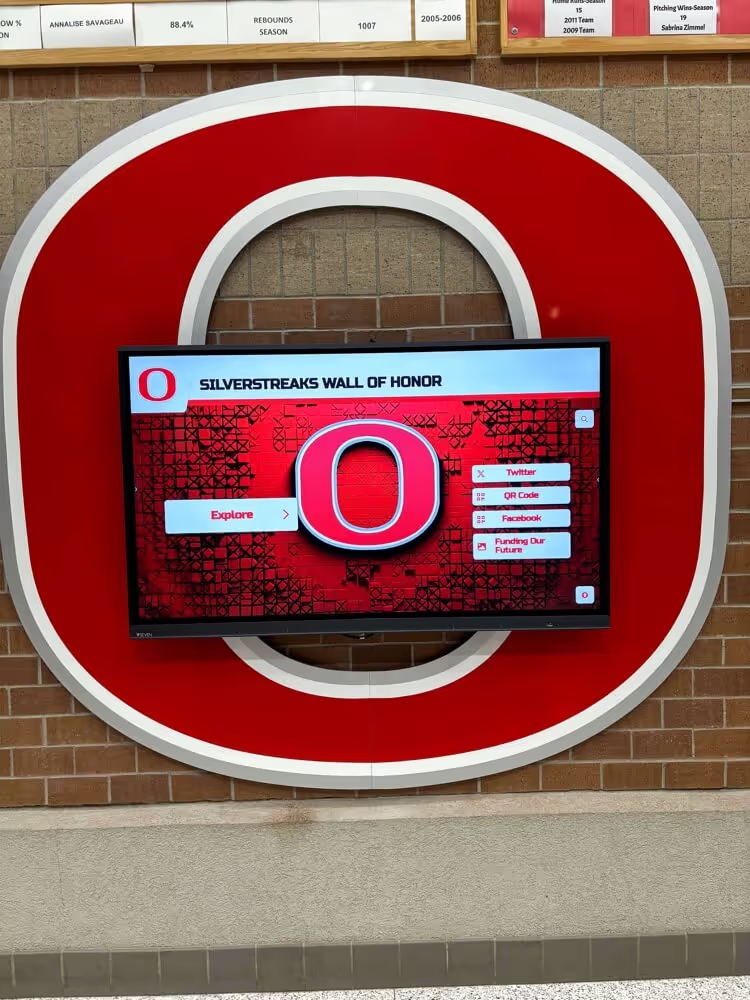
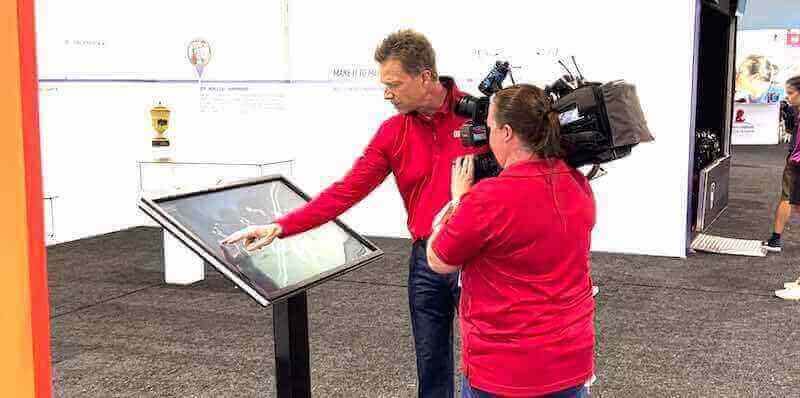
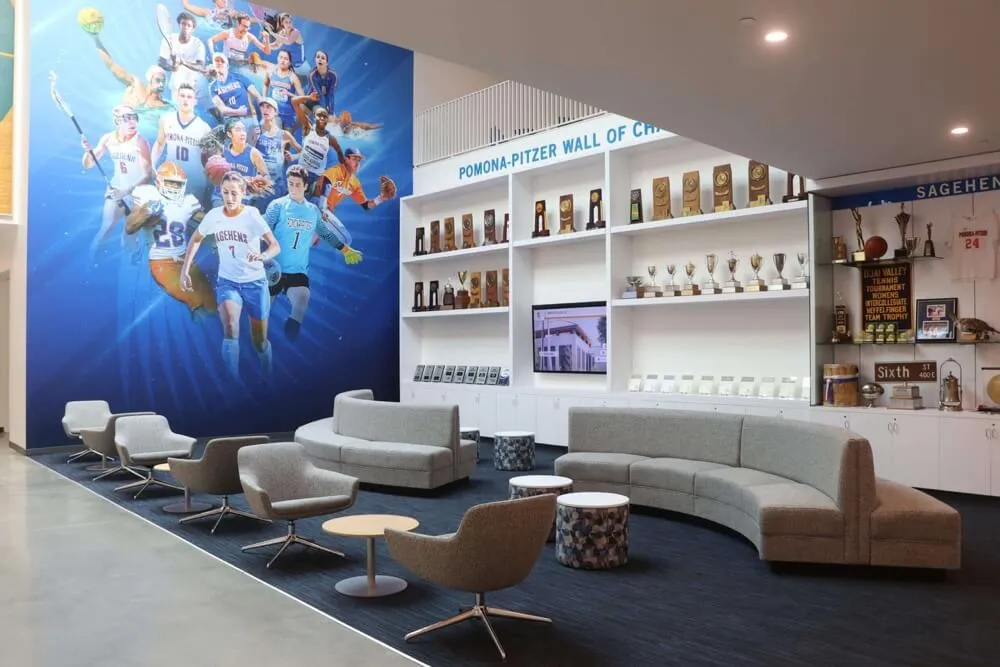
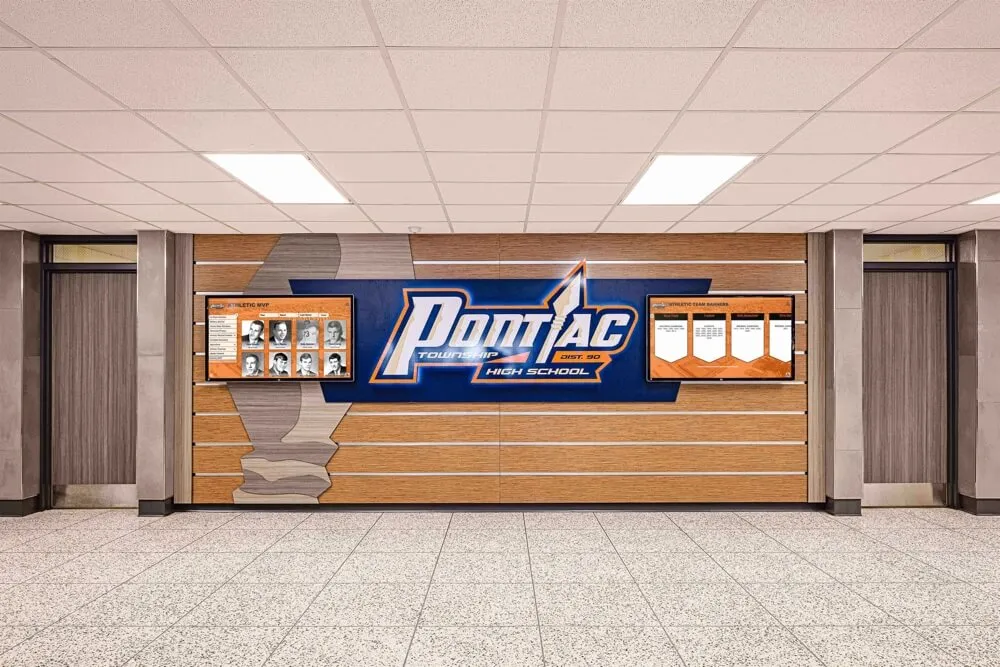
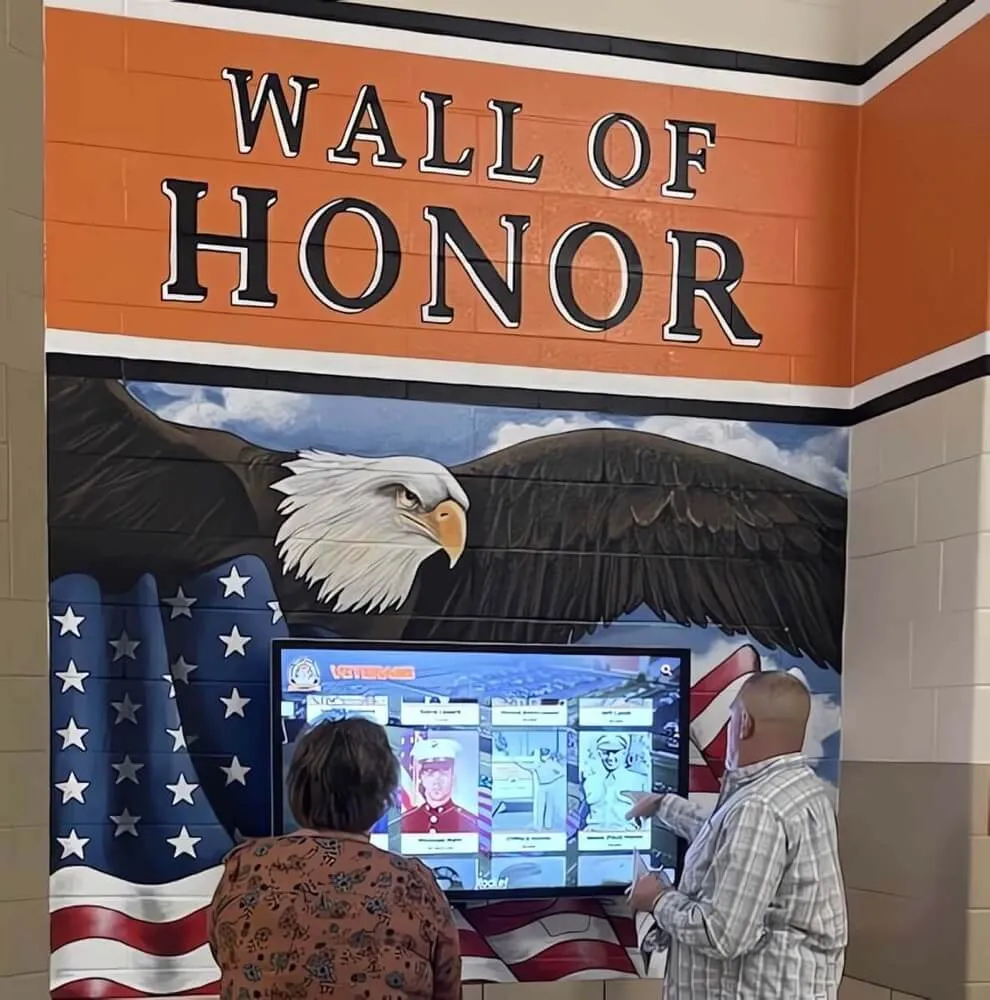
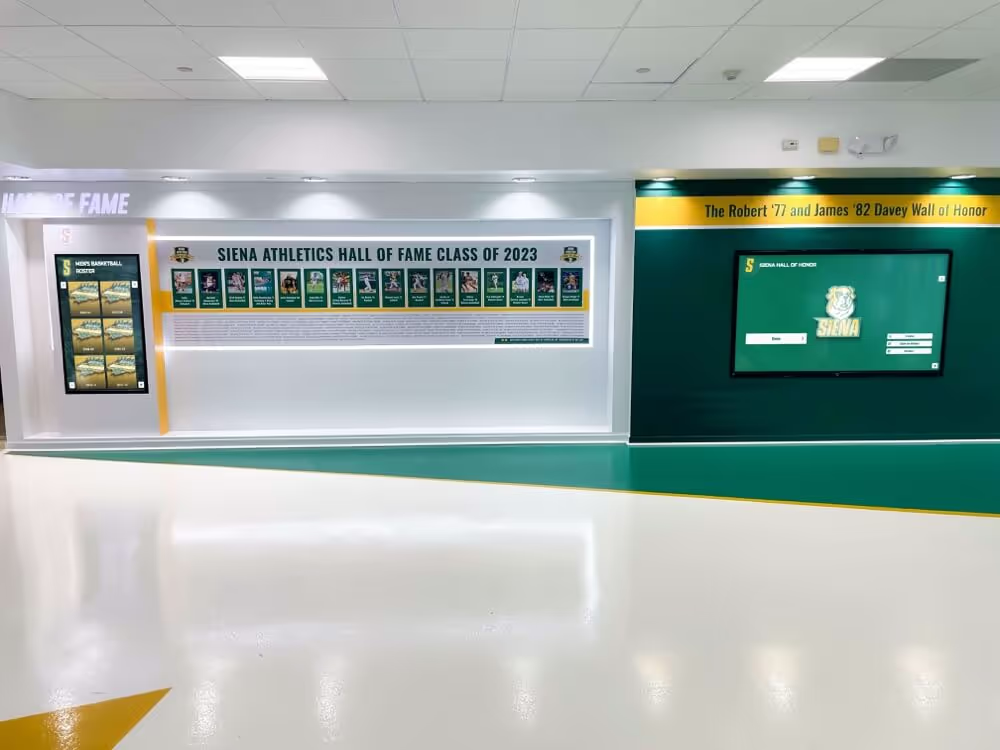
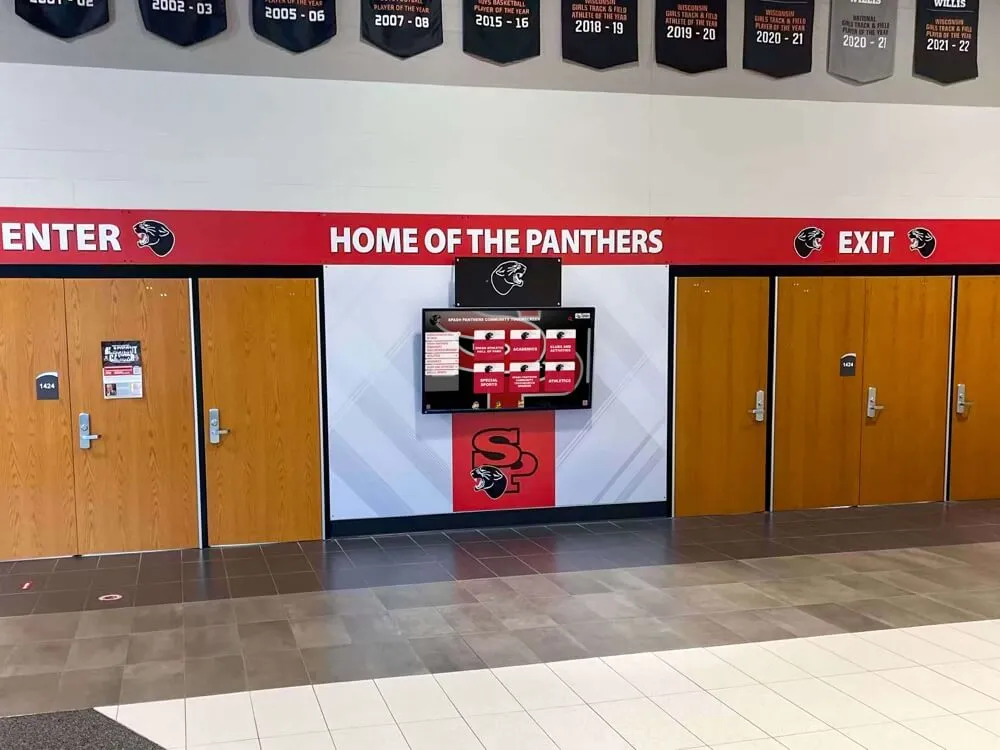
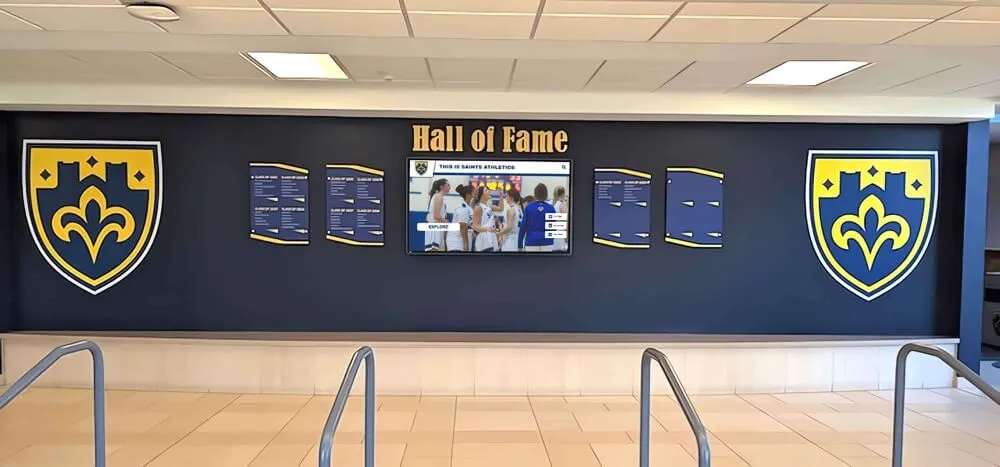
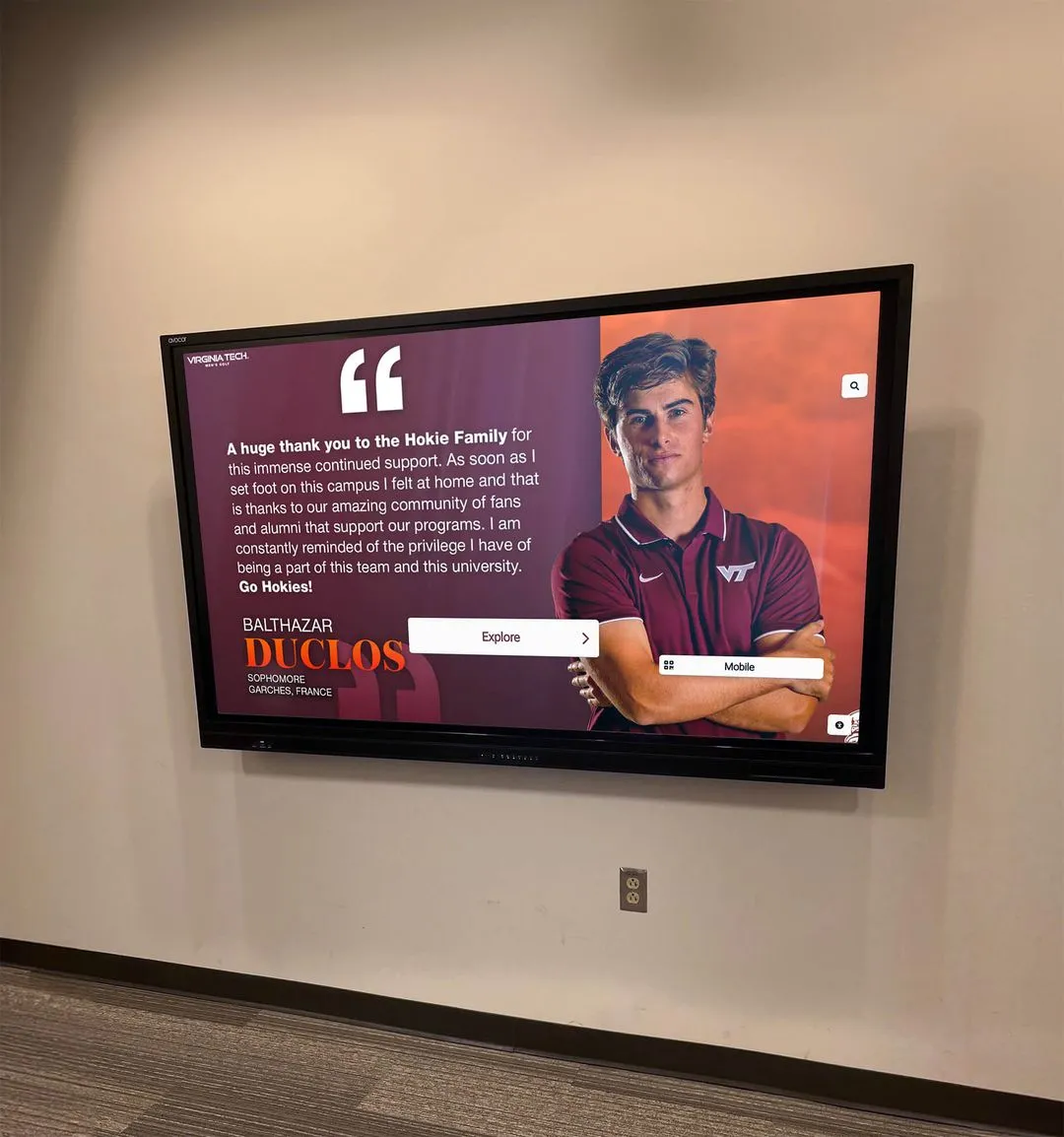
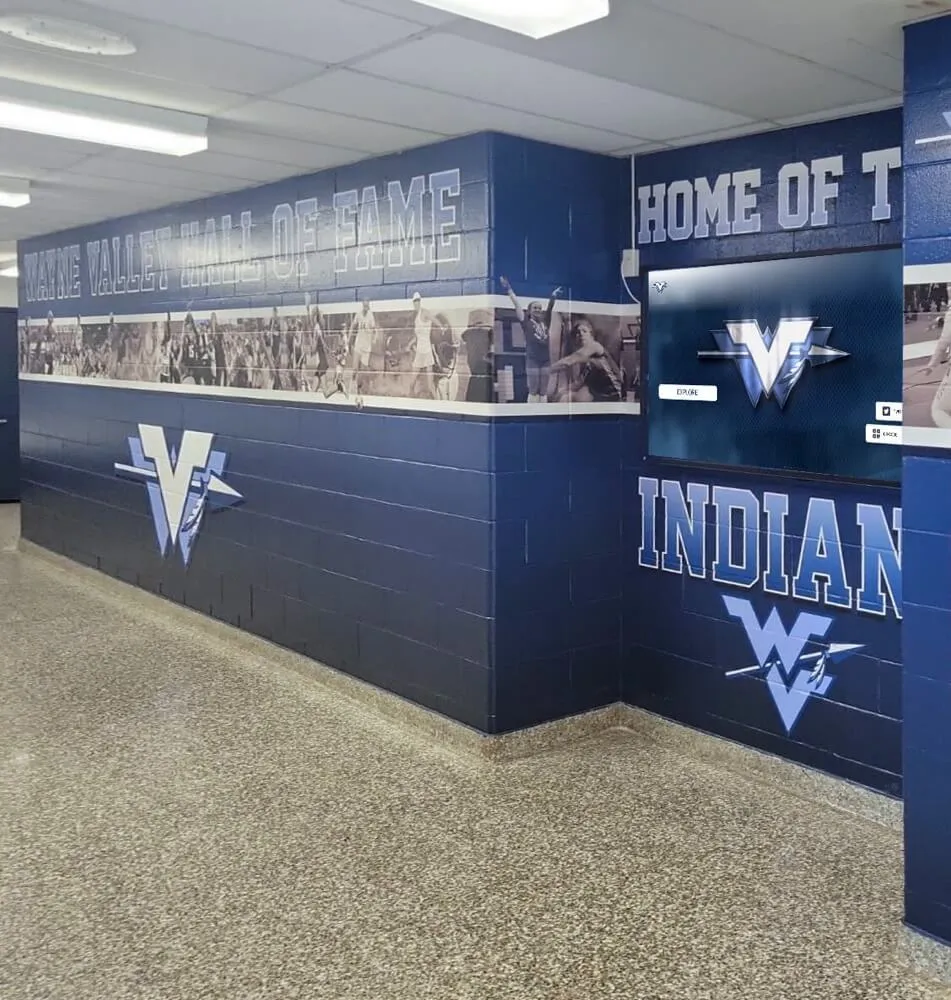
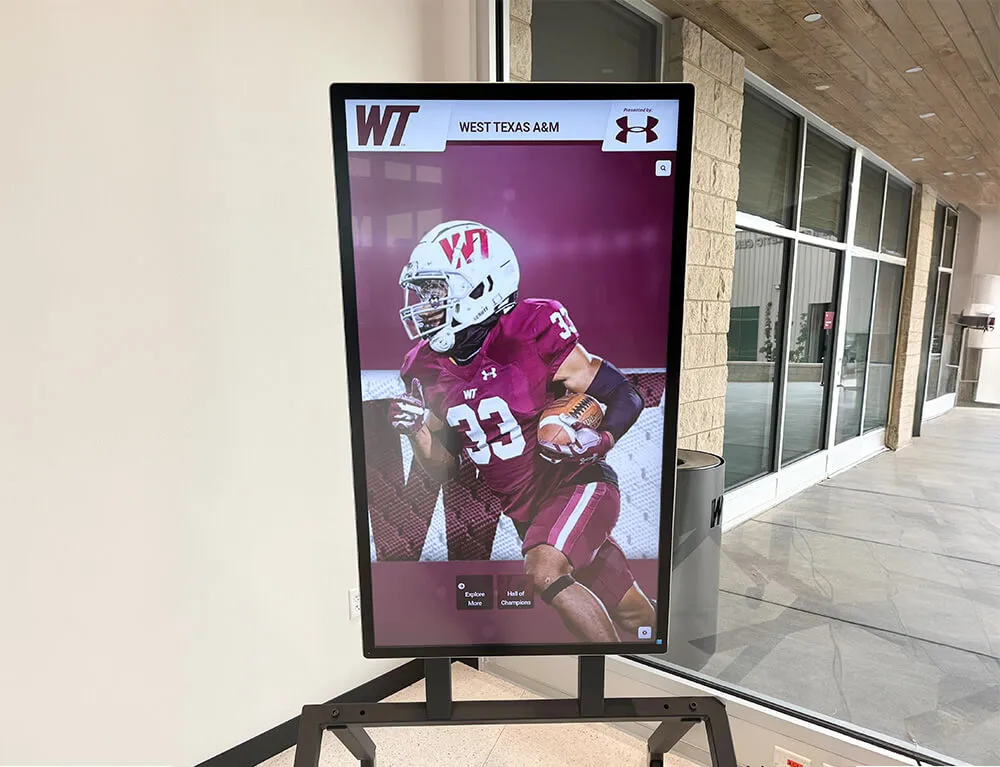
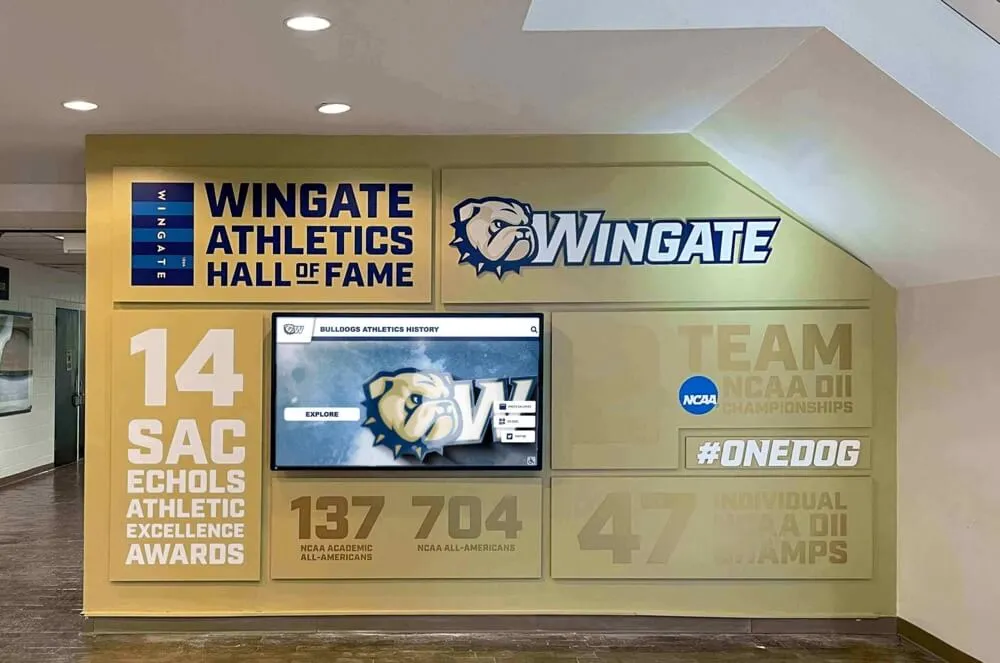
Digital recognition walls create engaging destinations where community members explore donor stories and capital campaign impact through interactive touchscreen interfaces
Video Tour Overview: Showcasing School Renovation Donor Recognition
This comprehensive walkthrough demonstrates how schools implement interactive digital recognition walls that celebrate renovation campaign donors while solving traditional recognition limitations through unlimited capacity, real-time updates, and rich multimedia storytelling capabilities.
Video Specifications and Target Platform
| Specification | Details |
|---|---|
| Video Length | 12-15 minutes comprehensive demonstration |
| Aspect Ratio | 16:9 (1920x1080 HD; 4K preferred for large displays) |
| Target Platform | Embedded web player, YouTube, school website, donor communications, campaign presentations |
| Accessibility | Full closed captions, audio description track |
| Streaming Format | Adaptive bitrate MP4 for all devices and bandwidth conditions |
Tour Structure: Scene-by-Scene Breakdown
This video tour follows the journey from traditional capital campaign recognition challenges through modern digital solutions:
- Traditional Donor Recognition Limitations (60-90 seconds) - Establishing physical plaque constraints
- Welcome to Digital Recognition Wall (90-120 seconds) - First impressions of interactive donor display
- Major Gift Donor Profiles (180-240 seconds) - Exploring comprehensive benefactor recognition
- Campaign-Wide Recognition Tiers (150-210 seconds) - Browsing donors across all giving levels
- Real-Time Campaign Progress Visualization (120-180 seconds) - Showcasing fundraising thermometer integration
- Historical Campaign Archives (120-180 seconds) - Exploring decades of capital project history
- Content Management Demonstration (90-120 seconds) - Behind-the-scenes editing capabilities
- Strategic Facility Placement (90-120 seconds) - Tour of recognition wall locations
- Fundraising Impact and Stewardship (60-90 seconds) - Demonstrating donor engagement benefits
- Implementation Process (45-60 seconds) - Path from planning to launch
Each scene demonstrates specific capabilities while building understanding of how digital platforms transform school renovation donor recognition from limited physical installations into comprehensive flexible celebration programs.
Learn comprehensive donor recognition strategies in donor recognition screen complete guide addressing stewardship best practices and implementation frameworks.
Scene 1: Traditional Donor Recognition Limitations (00:00-01:30)
Visual Elements: Montage showing common capital campaign recognition challenges—crowded donor walls with barely visible names, beautiful engraved plaques with no available space for new donors, certificates stored in development offices, and campaign materials showing donors who receive no permanent facility acknowledgment.
Narration Script: “Schools launching major renovation projects face a persistent recognition challenge: How do you honor hundreds of generous donors with the prominence their support deserves when physical wall space accommodates only limited names?
Traditional engraved donor walls create impossible constraints. A beautiful marble installation with brass plaques might accommodate 200 donor names before completely filling available lobby space. But successful renovation campaigns often attract 300, 500, or even 1,000+ supporters across multiple giving levels from $500 annual gifts to $250,000 naming opportunities.
What happens when that 201st donor contributes? Do you deny them permanent recognition because earlier supporters filled the available space? Do you remove smaller donors to accommodate major gifts? Do you install expensive wall expansions every few years as campaigns continue? These heartbreaking decisions undermine stewardship relationships and communicate to future donors that their generosity might not receive lasting acknowledgment.
Physical plaques face additional limitations beyond space: static presentations showing only names and contribution amounts with no context about campaign impact, inability to update recognition when donors increase commitments or campaigns achieve new milestones, expensive fabrication and installation delays meaning donors wait months to see their acknowledgment, and material deterioration requiring ongoing maintenance and eventual replacement.
Today we’ll explore how digital recognition walls solve these fundamental challenges, creating flexible platforms that celebrate unlimited donors while preserving complete campaign history and enabling continuous content enhancement impossible with conventional installations.”
On-Screen Action:
- Close-up of crowded traditional donor wall with overlapping plaques
- Development director reviewing long donor list with only partial wall space
- Certificate presentation at campaign event with no permanent display
- Construction photo showing beautiful new building with nowhere to honor all supporters
- Text overlay: “Limited Space • Static Presentation • Update Impossible • Costly Expansion”
Production Notes: Use authentic school facility footage showing genuine recognition constraints. Establish emotional weight of denying permanent acknowledgment to generous supporters. Maintain respectful tone while clearly articulating traditional approach limitations. Show disconnect between campaign success (many donors) and recognition capacity (limited space).
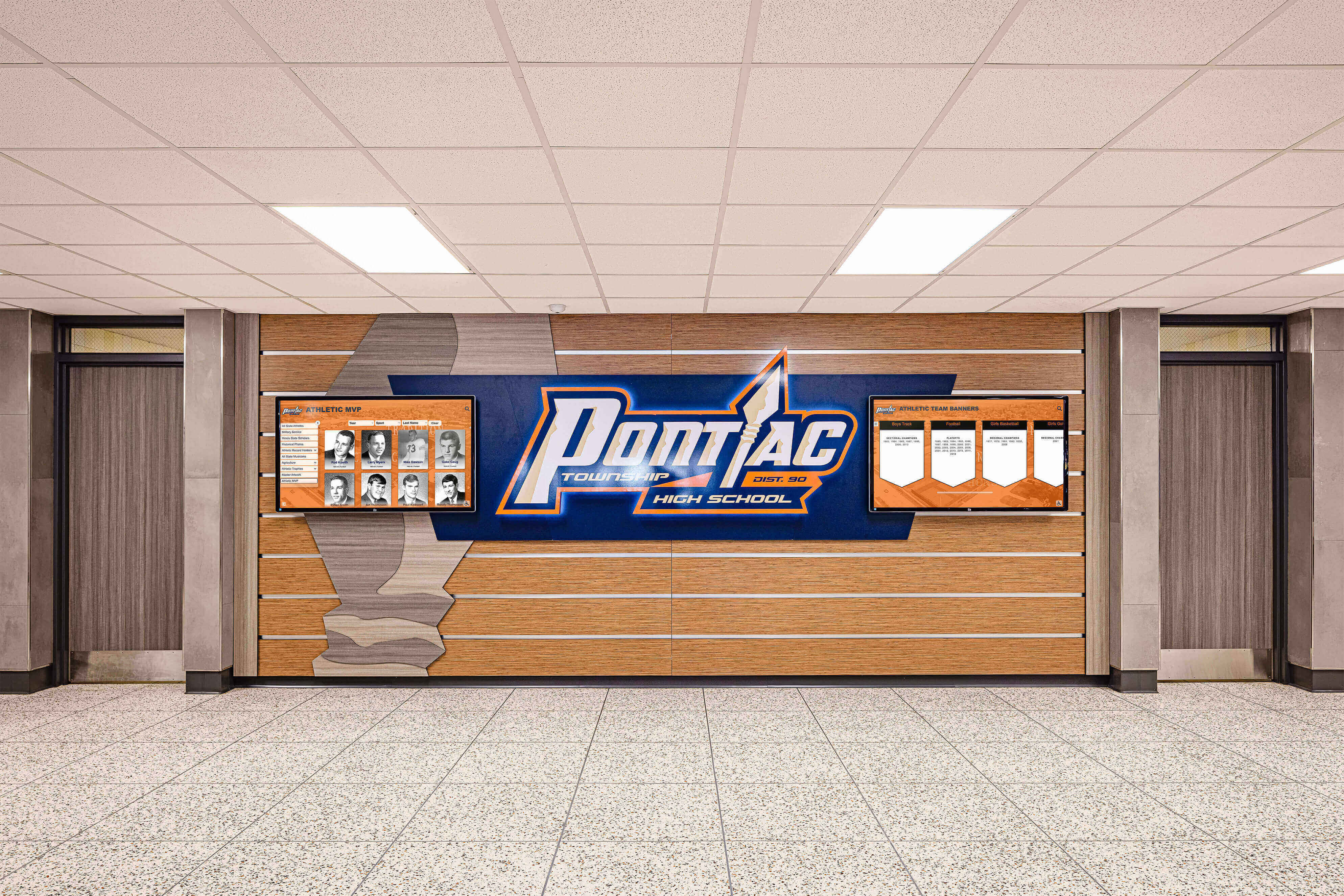
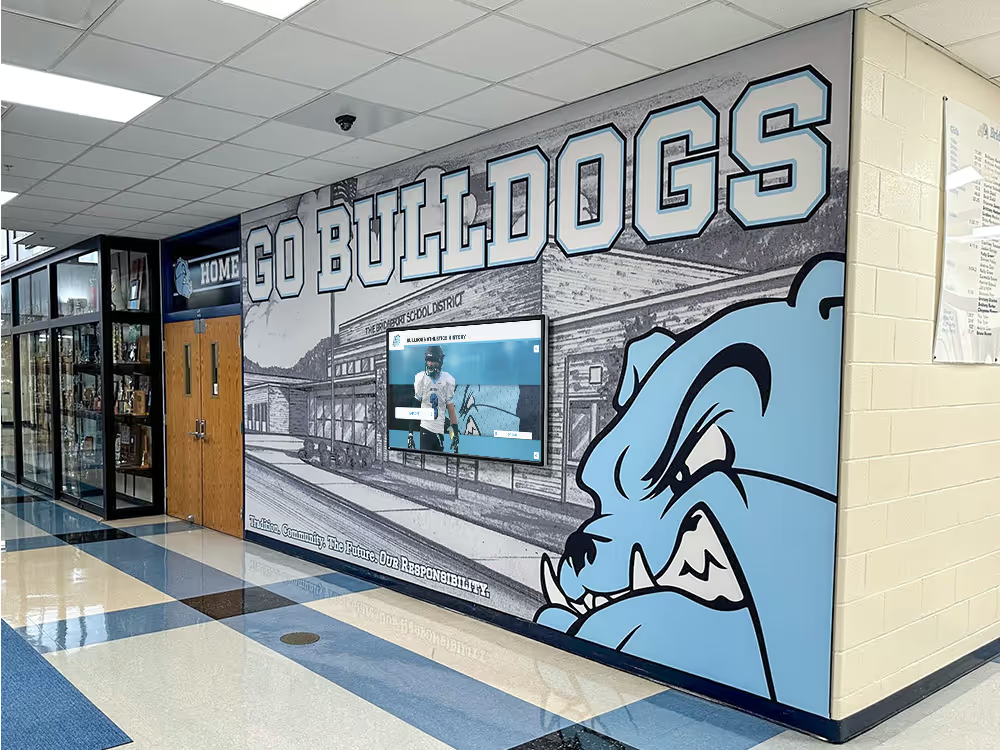
Traditional physical donor walls create space constraints that force difficult decisions about which supporters receive permanent recognition
Scene 2: Welcome to Digital Recognition Wall (01:30-03:30)
Visual Elements: Smooth transition revealing modern digital recognition wall in renovated school facility—prominent lobby location featuring large touchscreen display showing campaign overview with donor grid organized by contribution levels, professional photography of new building spaces, and intuitive navigation interface.
Narration Script: “Welcome to the future of school renovation donor recognition. This interactive digital wall transforms how educational institutions celebrate capital campaign supporters—showcasing unlimited donors with comprehensive profiles, archiving complete project history, and adapting in real-time as campaigns progress and new contributions arrive.
Notice the professional presentation: the home screen highlights your current renovation project with compelling before-and-after photography, campaign goal visualization showing fundraising progress, and featured major donors whose transformational gifts enabled the project. But unlike physical plaques limited by wall dimensions, this single touchscreen accommodates comprehensive recognition for every campaign supporter regardless of contribution size.
Here we see the Madison High School Science Wing Renovation Campaign featuring 450+ donors from lead benefactors who funded entire laboratory spaces to alumni contributing $1,000 in honor of former teachers. Every supporter receives appropriate permanent recognition through detailed digital profiles accessible via intuitive touch navigation.
The home screen organizes donors into recognizable giving societies: Founder’s Circle for $100,000+ naming gifts, Leadership Society for $25,000-99,999 major contributions, Benefactor Level for $10,000-24,999 supporters, Patron Level for $2,500-9,999 donors, and Friends Campaign for $500-2,499 community members—ensuring every contribution level receives proportional acknowledgment within inclusive recognition framework.”
On-Screen Action:
- Camera approaches display from visitor perspective establishing prominent placement
- Home screen shows renovation project overview with compelling imagery
- Campaign progress visualization demonstrates fundraising goal achievement
- Grid layout displays donor cards organized by contribution level
- Text overlays: “Unlimited Capacity • All Donors Recognized • Real-Time Updates • Professional Presentation”
- Interface responsiveness demonstration showing smooth touch navigation
Production Notes: Eliminate screen glare through proper lighting angles and polarizing filters. Capture vibrant colors and professional display quality. Show interface clarity and intuitive design. Emphasize unlimited digital capacity versus physical space constraints. Feature actual renovation imagery showing donor impact visually.
Discover digital donor recognition benefits in nonprofit donor recognition digital displays guide addressing inclusive stewardship strategies.
Scene 3: Major Gift Donor Profiles (03:30-07:30)
Visual Elements: Deep dive into comprehensive major donor profiles showing detailed recognition including biographical information, giving history, personal statements, facility naming acknowledgment, and rich multimedia content documenting campaign impact.
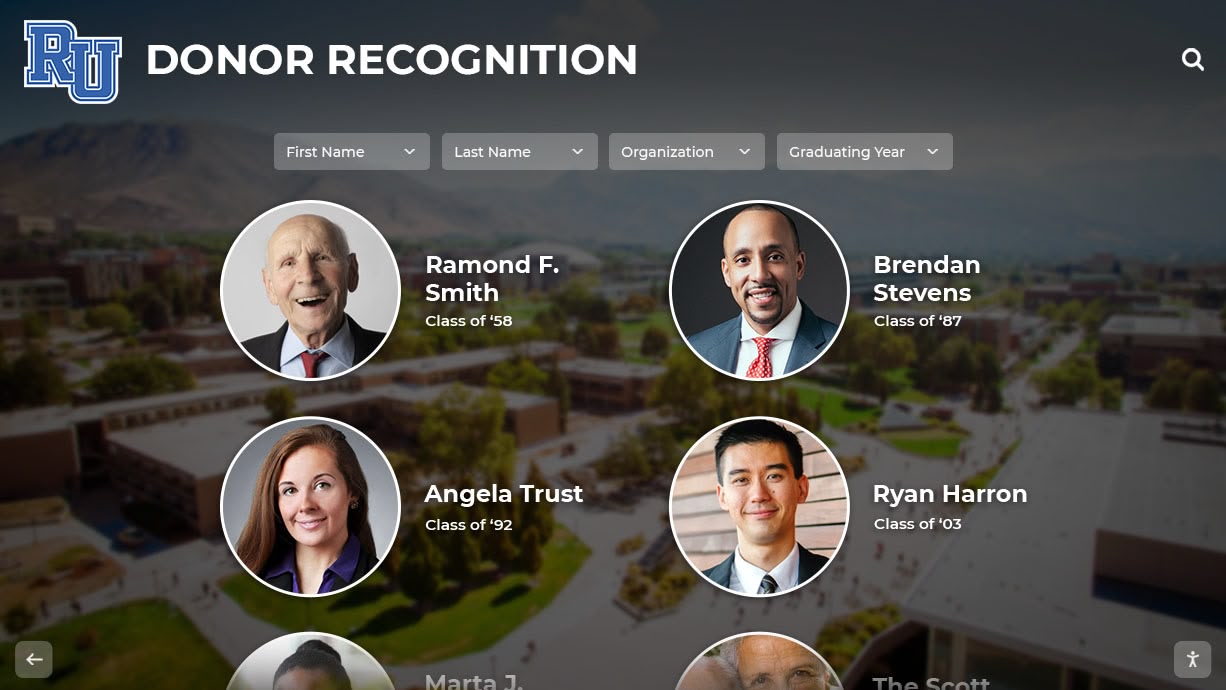
Narration Script: “Let’s explore major gift recognition in detail. Tapping any donor card reveals their complete profile—far beyond simple name engraving possible with traditional plaques.
Here’s the Patterson Family, whose $250,000 leadership gift enabled construction of the Patterson STEM Innovation Lab—the centerpiece of this science wing renovation. Their profile includes professional family photography, biographical context explaining their connection to Madison High School, detailed gift information including naming recognition, and most importantly, visual documentation of exactly what their generosity accomplished.
Notice the rich multimedia storytelling: before-and-after facility photos showing the complete laboratory transformation, architectural renderings demonstrating design vision, construction progress documentation capturing building evolution, and finished space photography showcasing students engaged in hands-on science learning within the beautiful new environment the Patterson Family funded.
Beyond physical space documentation, the profile includes the Patterson Family’s personal statement explaining why they chose to support this project: ‘Madison High School provided our daughters with exceptional education and caring teachers who sparked their love of science. Supporting this renovation ensures future students experience the same transformational learning in modern facilities reflecting advances in STEM education since our children graduated twenty years ago.’
This comprehensive recognition honors the Patterson Family appropriately while serving critical stewardship functions: demonstrating tangible impact to prospective major donors considering similar commitments, inspiring current parents and alumni by showcasing community members who invest substantially in student futures, and creating permanent legacy documentation the Patterson Family can share with relatives and future generations.
Browse additional major donors revealing diverse philanthropic motivations: The Riverside Corporation funded the Environmental Science Research Center supporting their sustainability initiatives and community workforce development needs. The Class of 1985 collectively contributed $150,000 honoring their 40th reunion to establish the Alumni Collaboration Commons where current students work on group projects. Dr. Jennifer Martinez established the Martinez Chemistry Lab Memorial recognizing her late husband who taught at Madison for thirty years.
Each major gift profile receives equivalent comprehensive recognition regardless of specific contribution amount—a $100,000 donor and $250,000 benefactor both enjoy detailed multimedia presentations impossible with brass nameplate engravings limited to 50 characters.”
On-Screen Action:
- Select major donor card revealing full profile
- Scroll through comprehensive biography and giving information
- Display before-and-after facility photos showing renovation impact
- Show architectural renderings and construction documentation
- Play video tour of completed named space if available
- Read personal donor statement explaining giving motivation
- Return to donor grid demonstrating easy navigation
- Browse additional major gift profiles showing recognition consistency
- Text overlays: “Comprehensive Profiles • Multimedia Impact Stories • Personal Statements • Facility Documentation”
Production Notes: Feature authentic donor content with proper privacy permissions. Show emotional connection through personal messaging and facility transformations. Demonstrate recognition depth impossible with physical plaques. Capture donor family members viewing their acknowledgment with visible pride if available for genuine emotional resonance.
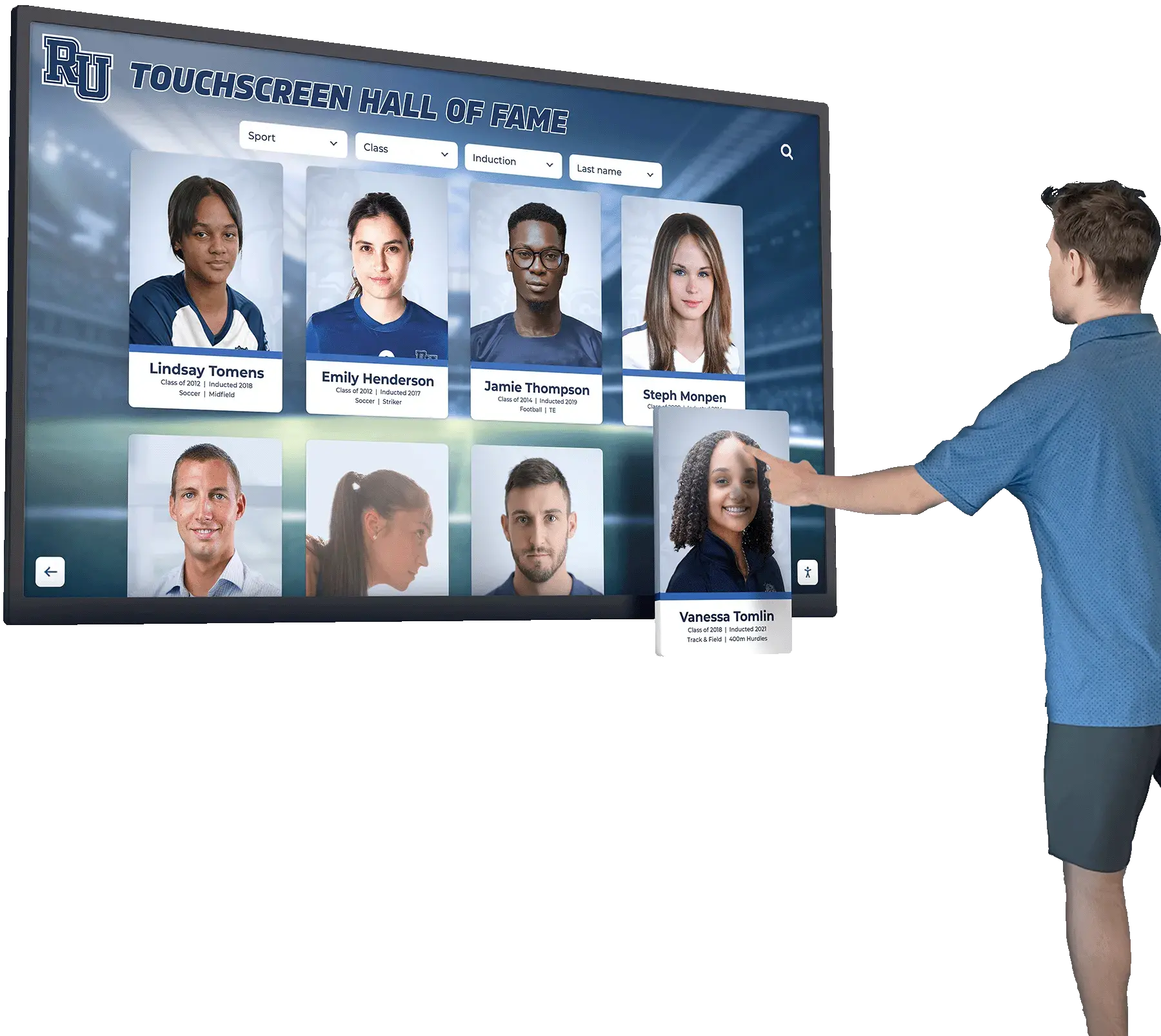
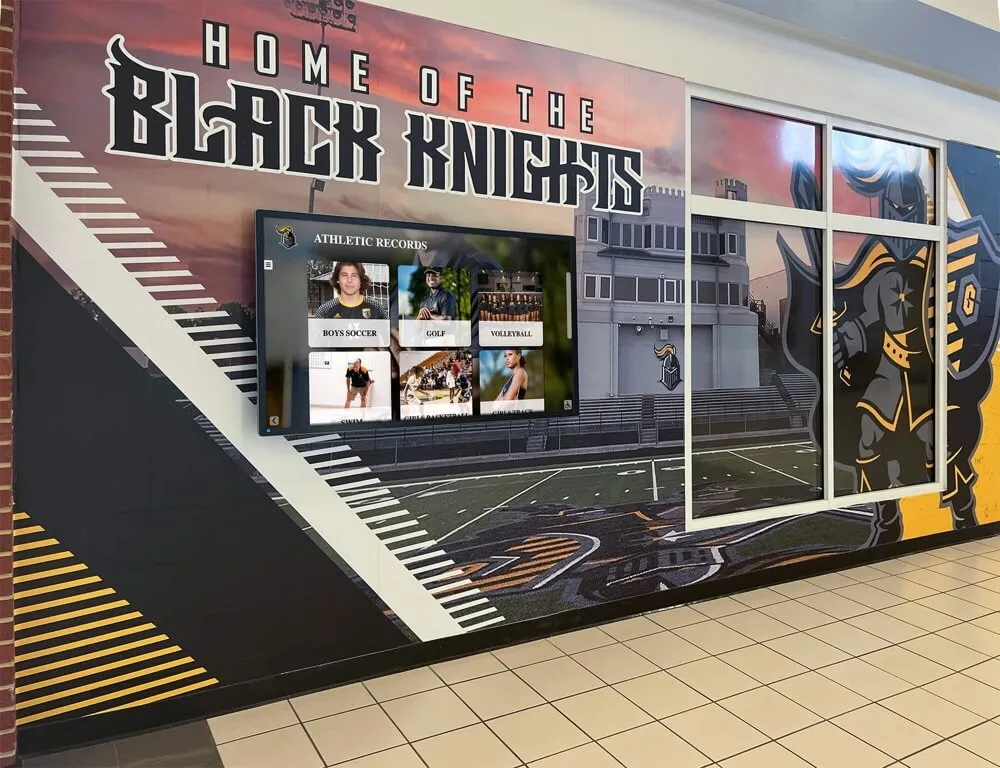
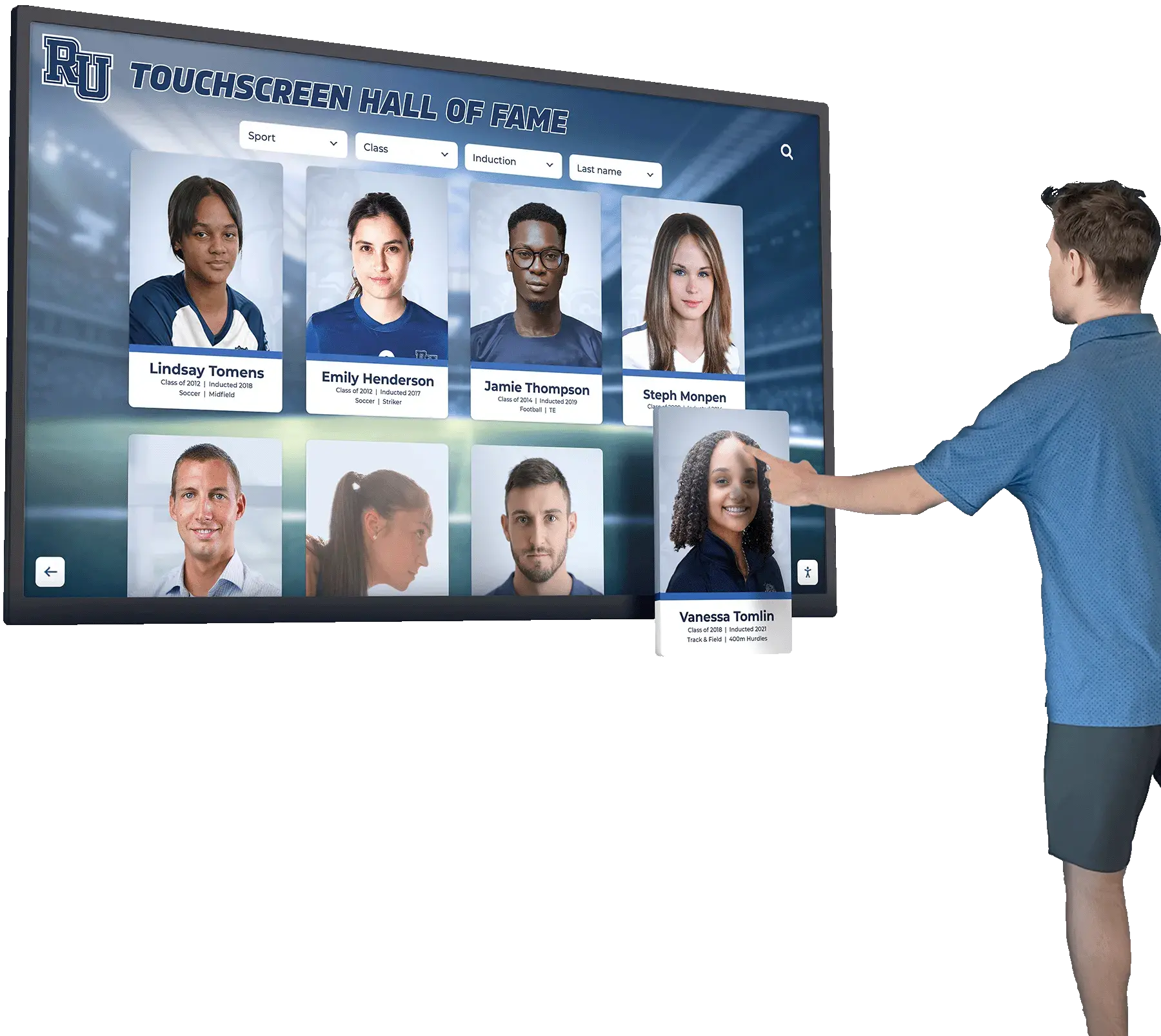
Intuitive touchscreen interfaces enable exploration of comprehensive donor profiles including biographies, giving history, and campaign impact documentation
Explore comprehensive recognition approaches in digital donor walls guide with multimedia storytelling frameworks.
Scene 4: Campaign-Wide Recognition Tiers (07:30-11:00)
Visual Elements: Demonstration of browsing donors organized by contribution levels showing how digital platforms celebrate supporters across all giving societies from major benefactors to modest community donors.
Narration Script: “Successful capital campaigns require broad philanthropic participation—not just major gifts from lead donors but meaningful contributions from hundreds of community members at all capacity levels. Digital recognition walls ensure every supporter receives appropriate acknowledgment regardless of contribution size.
Navigate to the Leadership Society recognizing $25,000-99,999 donors. Here we see forty-five families, alumni, local businesses, and foundations whose substantial gifts collectively provided over $2 million toward the $8 million campaign goal. Each Leadership Society member enjoys enhanced recognition profiles including professional photography, detailed biographical information, and personal statements—proportional acknowledgment befitting significant financial commitments.
Select the Benefactor Level showing $10,000-24,999 contributors. Notice how the platform provides consistent professional presentation across all giving tiers—Benefactor donors receive quality recognition honoring their generosity appropriately while appropriately differentiating major gift acknowledgment. Sixty-eight Benefactor Level supporters contributed nearly $1 million combined, representing substantial campaign impact deserving prominent permanent celebration.
Explore the Patron Level featuring $2,500-9,999 donors. Here we find 125 supporters including many alumni giving in honor of former teachers, local businesses supporting community education, parent groups making collective contributions, and families establishing modest memorials recognizing loved ones. Patron Level recognition includes donor names, contribution amounts, dedication information, and photos when provided—ensuring everyone feels valued appropriately.
Finally browse the Friends of the Campaign recognizing all $500-2,499 community donors. This tier includes 210 supporters whose collective $150,000+ contributions represent nearly 20% of total campaign fundraising. While Friends level profiles may be simpler than major gift recognition, every donor receives permanent acknowledgment with their name, contribution level, and optional dedication—visible through intuitive search rather than buried in fine print at bottom of crowded physical plaques.
This inclusive recognition philosophy communicates powerful cultural messages: every gift matters regardless of size, the school values broad community support not just major donor cultivation, and future contributors at all levels can trust their generosity will receive lasting appropriate acknowledgment. Contrast this with traditional physical donor walls where space constraints often force recognition of only $25,000+ gifts, leaving 80% of campaign supporters with no permanent facility acknowledgment despite collectively providing 30-40% of fundraising totals.”
On-Screen Action:
- Navigate to Leadership Society showing enhanced profiles
- Scroll through Benefactor Level with consistent recognition quality
- Display Patron Level featuring alumni memorial gifts and business supporters
- Show Friends of Campaign with inclusive recognition of all contributors
- Demonstrate search function finding specific donor names instantly
- Display statistics showing campaign participation across all levels
- Compare physical plaque mockup with limited space to digital unlimited capacity
- Text overlays: “All Levels Recognized • Inclusive Philosophy • Unlimited Capacity • Search Function • Appropriate Differentiation”
Production Notes: Feature authentic content across all giving levels demonstrating inclusive approach. Show ease of navigation between tiers. Emphasize cultural benefits of universal recognition versus exclusionary physical limitations. Include development director testimonial about stewardship impact and improved donor retention if available.
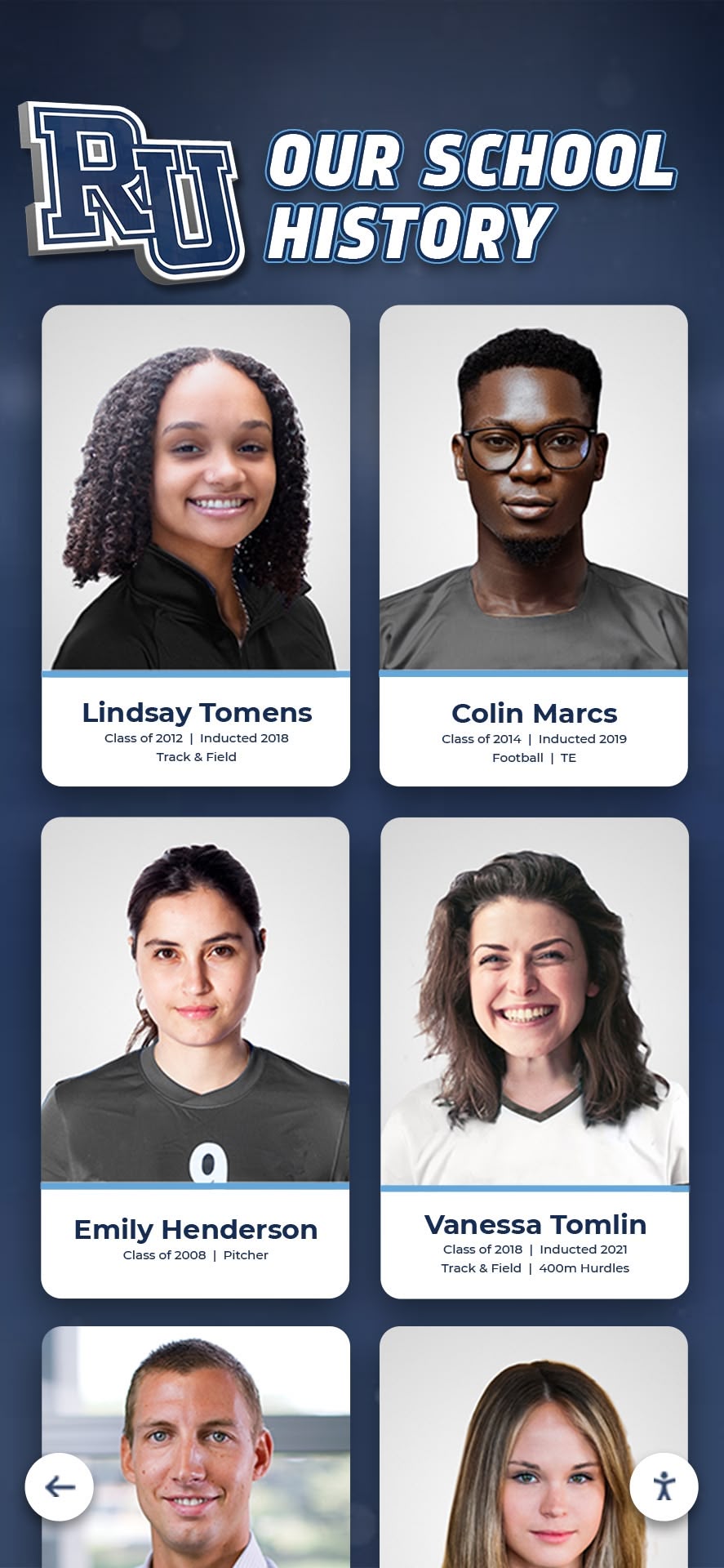
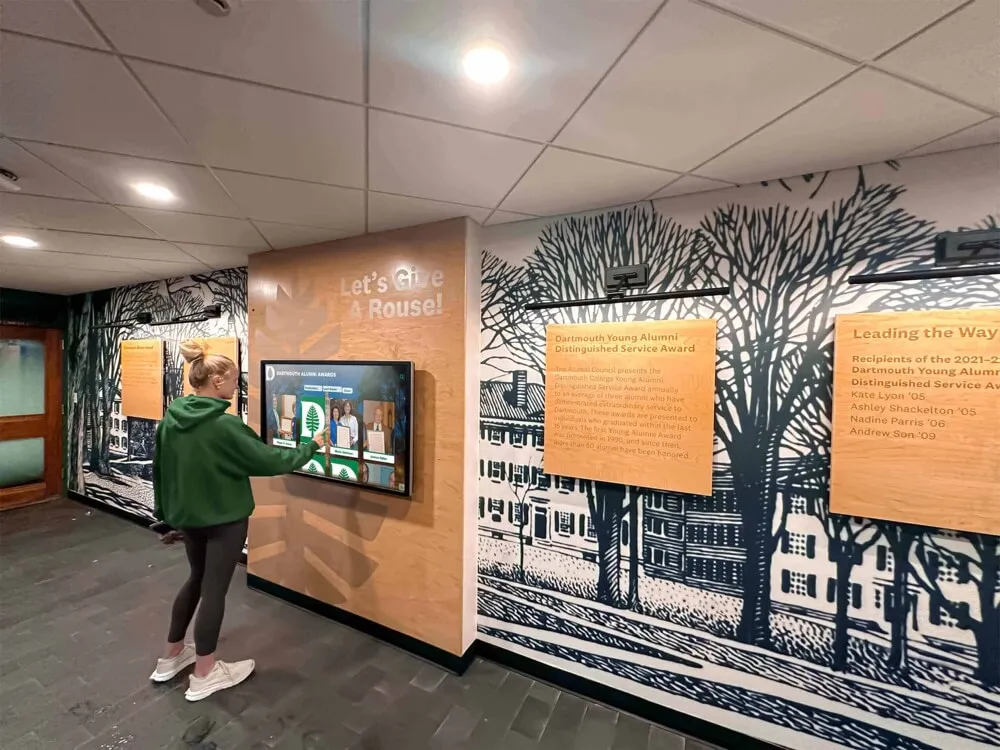
Digital platforms accommodate unlimited donors across all contribution levels ensuring inclusive recognition impossible with space-limited physical walls
Discover inclusive recognition strategies in digital wall of honor plaques guide addressing comprehensive acknowledgment approaches.
Scene 5: Real-Time Campaign Progress Visualization (11:00-14:00)
Visual Elements: Demonstration of integrated campaign thermometer and progress tracking showing how digital recognition walls serve dual purposes as donor acknowledgment and fundraising motivation tools throughout active capital campaigns.
Narration Script: “Digital recognition walls provide unique advantages during active campaigns by combining donor acknowledgment with real-time fundraising progress visualization that inspires continued giving and community momentum.
The campaign overview screen displays current fundraising status with compelling visual elements: total dollars raised updated weekly as new gifts arrive, percentage of goal achieved with clear progress bar, countdown to campaign deadline creating appropriate urgency, number of donors recognized encouraging broad participation, and recent gifts highlight celebrating newest contributors immediately.
This real-time transparency serves multiple strategic functions. For prospective donors touring renovated facilities or attending campaign events, visible progress demonstrates community support momentum making their own contributions feel impactful rather than isolated charitable acts. When they see ‘450 donors have already contributed $7.2 million toward the $8 million goal,’ their gift becomes part of collective achievement within reach rather than seemingly impossible distant target.
For existing donors, campaign progress updates provide satisfying confirmation that their earlier contributions helped catalyze broader community support. Seeing fundraising advance from $5 million at their gift date to $7.2 million months later validates their leadership role while maintaining engagement for potential future enhancement gifts or planned giving conversations.
The system enables flexible campaign tracking accommodating complex capital project realities. Multiple concurrent campaigns can be featured separately—the Science Wing Renovation running alongside Athletic Facility Improvements and Technology Infrastructure upgrades each with distinct progress tracking and donor recognition. Multi-year campaigns show annual progress toward cumulative goals with year-by-year breakdowns celebrating donors by commitment timing.
Behind the scenes, development staff update campaign progress through simple web-based interfaces requiring no technical expertise. When quarterly gift processing adds $250,000 from recent donations, updating the campaign total takes minutes—automatically recalculating percentages, updating visual progress bars, and refreshing recent donor highlights. This real-time responsiveness keeps community engaged with campaign evolution rather than viewing stale recognition frozen at outdated fundraising levels.
Contrast this dynamic approach with traditional physical donor walls where campaign progress remains invisible until final completion when permanent plaques are fabricated months after projects finish—missing entirely the opportunity to leverage recognition as ongoing fundraising motivation throughout active campaigns.”
On-Screen Action:
- Display campaign overview showing real-time fundraising progress
- Demonstrate thermometer visualization approaching goal
- Show recent donors highlight celebrating newest contributions
- Navigate between multiple concurrent campaigns if applicable
- Display year-by-year progress for multi-year initiatives
- Screen recording showing admin interface updating campaign totals
- Split screen showing instant display refresh after update
- Text overlays: “Real-Time Progress • Community Momentum • Fundraising Motivation • Multi-Campaign Tracking • Easy Updates”
Production Notes: Capture compelling campaign progress visualizations with clear design. Show emotional impact of approaching goal visualization. Include development staff demonstration of update process if possible. Feature campaign event footage with donors viewing progress if available showing engagement and enthusiasm.
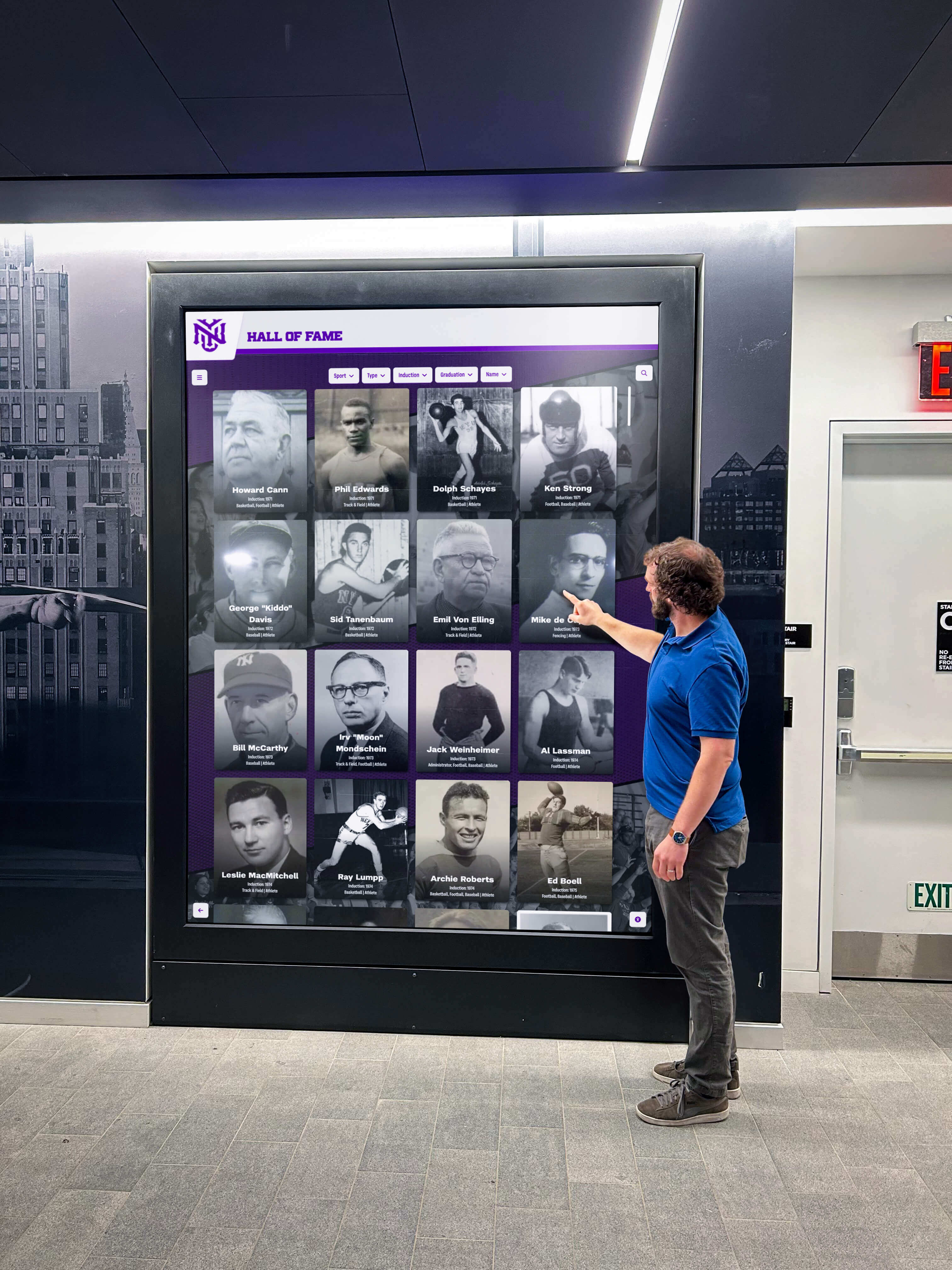
Real-time campaign progress visualization inspires continued giving while celebrating donor community throughout active fundraising initiatives
Scene 6: Historical Campaign Archives (14:00-17:00)
Visual Elements: Demonstration of browsing historical capital campaigns showing decades of school facility improvements and donor communities that made transformational projects possible over time.
Narration Script: “Here’s where digital recognition reveals transformative long-term value: unlimited historical capacity preserving complete institutional legacy rather than replacing old recognition when new campaigns launch.
Tap ‘View Historical Campaigns’ revealing your school’s complete capital project history. The 2024 Science Wing Renovation we’ve been exploring. The 2018 Athletic Complex Expansion featuring 320 donors who contributed $6.5 million upgrading stadium, field house, and training facilities. The 2012 Library Renovation with 250 supporters funding technology integration and flexible learning spaces. Scroll further back to 2005 Arts Wing Addition, 1998 Classroom Building, even 1985 Gymnasium Construction.
Each historical campaign preserves complete donor recognition exactly as originally celebrated—no deletions to accommodate newer projects, no lost acknowledgment due to deteriorating physical plaques, no forgotten supporters whose generosity transformed facilities. The 1985 Gymnasium donors who may have passed away or lost touch with the school remain permanently honored alongside current contributors, creating continuous institutional narrative connecting past generosity to present gratitude.
Let’s explore the 2018 Athletic Complex campaign in detail. Notice how historical profiles can be enhanced with retrospective content unavailable during original campaign: facility photos showing athletic spaces still in active use benefiting current students, updates about major donors’ continued engagement or life achievements, memorial acknowledgments for supporters who have passed, and anniversary reflections celebrating five years of community enjoyment.
This historical depth serves critical institutional functions. During new campaign planning, prospective major donors explore previous projects understanding your school’s track record successfully completing capital initiatives with appropriate donor stewardship. They see evidence that supporters from past decades remain honored prominently rather than forgotten once buildings are occupied—demonstrating your institution values lasting relationships not transactional fundraising.
For alumni relations, historical archives strengthen emotional connections when graduates return for reunions or family campus tours. Alumni who donated during their prime earning years discover their 20-year-old gifts still prominently celebrated while seeing current parents continuing philanthropic traditions they helped establish. This continuity reinforces that their legacy extends beyond their individual contribution to sustained culture of community investment in student futures.
Current families browsing historical campaigns develop appreciation for sustained community support required to build and maintain excellent educational facilities. Seeing decades of donors across generations normalizes charitable giving as expected community participation rather than exceptional behavior, potentially inspiring their own contributions to current needs.”
On-Screen Action:
- Navigate to historical campaigns archive
- Scroll through decades of capital projects with donor totals
- Select 2018 Athletic Complex showing complete preserved recognition
- Open historical donor profile demonstrating ongoing honor
- Show enhanced retrospective content added years after original campaign
- Display timeline view showing institutional facility evolution
- Demonstrate search function finding specific historical donors
- Text overlays: “Complete Archives • Permanent Recognition • Enhanced Historical Content • Decades Preserved • Institutional Legacy”
Production Notes: Feature authentic historical content spanning multiple campaigns if available. Emphasize permanent recognition versus physical plaque replacement. Show emotional connection to sustained tradition and institutional gratitude. Include testimonial from long-time donor or development director about legacy value if possible.
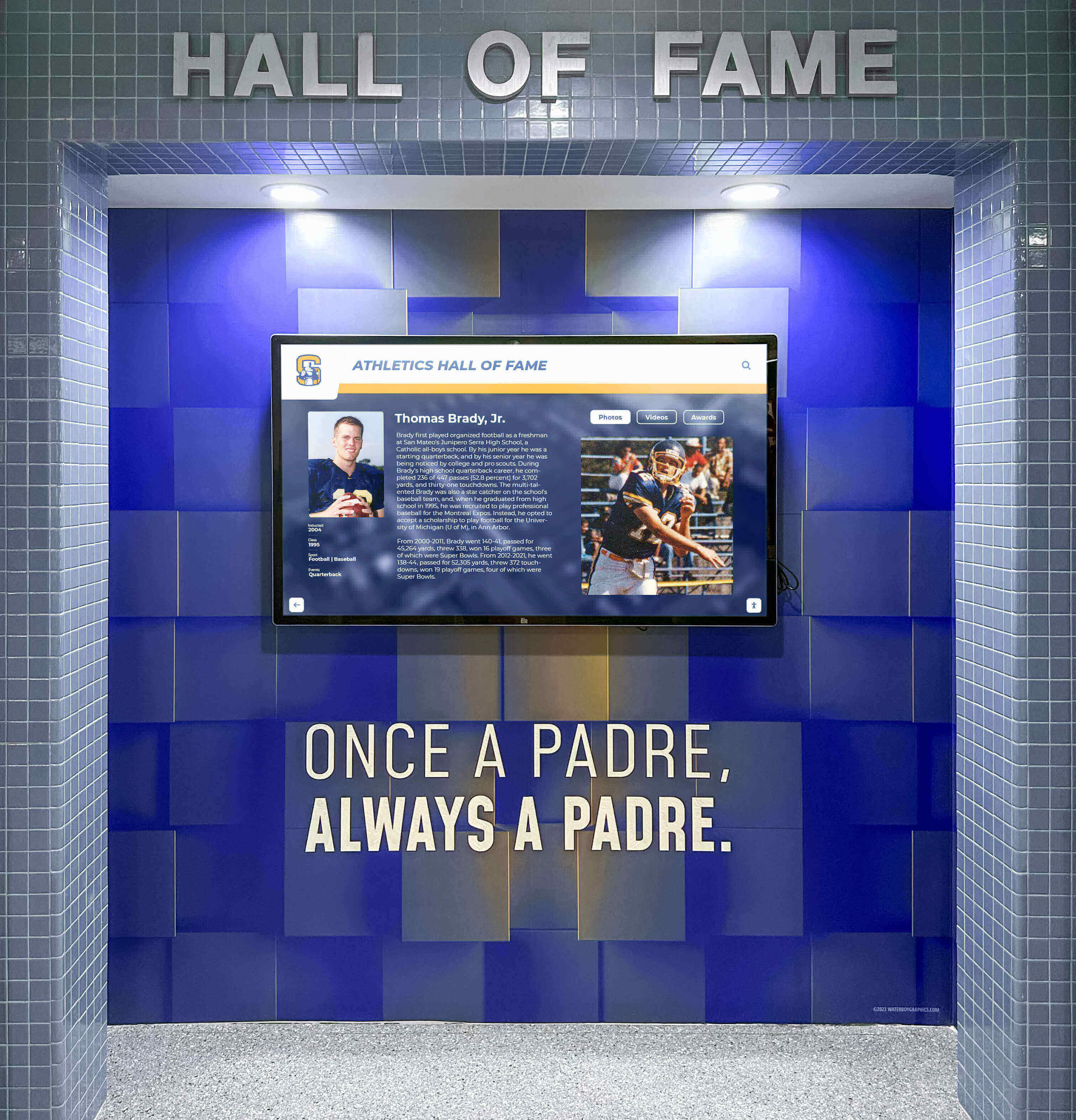
Historical archives preserve complete capital campaign legacy connecting decades of donor generosity to current institutional gratitude
Explore historical preservation in digital archives schools colleges universities guide with comprehensive archiving frameworks.
Scene 7: Content Management Demonstration (17:00-19:00)
Visual Elements: Behind-the-scenes demonstration of cloud-based content management showing how development staff easily add donors, update campaigns, and enhance recognition throughout fundraising initiatives.
Narration Script: “Capital campaigns span multiple years with ongoing donor activity requiring frequent recognition updates. Digital platforms accommodate this reality through intuitive content management accessible to development staff without technical expertise.
Let’s look behind the scenes at the administration system. Development staff log into the cloud-based platform from any internet-connected device—office computer, laptop at campaign events, even tablets during donor meetings. Here’s the admin dashboard showing current campaign with options to add donors, update profiles, modify campaign progress, and customize featured content.
Adding a new major donor takes minutes following simple workflow. When a lead gift arrives, open the donor template: enter names and contact information, select giving society based on contribution amount, upload professional photography if provided, add biographical details highlighting community connections, include personal statements or dedications if donor wishes, and attach facility naming information for major gifts. Preview how it appears on public display, then publish immediately.
The recognition goes live instantly—no waiting for plaque fabrication, no installation scheduling, no physical facility modifications. When that major donor attends next week’s groundbreaking ceremony, they can see their prominent acknowledgment already displayed for community celebration. This immediate recognition responsiveness demonstrates genuine gratitude while enabling stewardship opportunities impossible when acknowledgment lags months behind contributions.
Throughout active campaigns, profiles can be enhanced as additional context becomes available: updating campaign progress totals monthly as gift processing clears, adding construction progress photos documenting facility transformation, uploading completed building photography once renovation finishes, incorporating ribbon-cutting ceremony images showing donor families celebrating project completion, and including student testimonials about learning in new spaces philanthropic support provided.
The system accommodates complex capital campaign realities: pledges with multi-year payment schedules showing total commitment amounts alongside completed payments, anonymous donors receiving recognition without names per their preferences, memorial and tribute gifts honoring loved ones with appropriate biographical context, matching gifts credited to both original donors and matching companies, and corporate sponsors receiving logo displays and URL links when appropriate.”
On-Screen Action:
- Screen recording showing login to content management system
- Navigate admin dashboard showing campaign management tools
- Click “Add New Donor” revealing simple profile template
- Fill in donor information demonstrating intuitive interface
- Upload photos using drag-and-drop functionality
- Show campaign progress update process
- Preview function displaying exactly how content appears
- Click publish showing instant live update
- Split screen showing admin edit and public display simultaneously
- Text overlays: “Cloud-Based Management • Minutes to Publish • No Technical Skills Required • Instant Updates • Flexible Throughout Campaigns”
Production Notes: Capture actual CMS interface with donor information appropriately anonymized. Show confidence and ease through proficient navigation. Emphasize time savings and accessibility for non-technical development professionals. Include brief testimonial from development staff about management simplicity if available.
Learn about platform management in best platforms building virtual hall of fame 2025 with comprehensive system comparisons.
Scene 8: Strategic Facility Placement (19:00-21:00)
Visual Elements: Tour of multiple display locations throughout renovated school facilities showing strategic placement maximizing visibility and donor engagement across different audiences.
Narration Script: “Strategic placement ensures renovation donor recognition reaches every constituency—prospective donors, current families, alumni visitors, community members, and students—while maximizing stewardship impact and fundraising motivation.
The primary display location in the main building entrance creates immediate cultural impact. As visitors enter renovated facilities, they encounter comprehensive donor celebration demonstrating community values and philanthropic culture. This prominent placement serves multiple audiences: prospective major donors touring campus during cultivation conversations see evidence of robust support and appropriate recognition, current families understand that community investment makes excellent facilities possible, and students daily observe generosity enabling their educational experiences.
Development office displays serve targeted strategic functions. When prospective donors meet with fundraising staff for cultivation conversations, touchscreen recognition walls in conference rooms become natural conversation starting points. ‘Here’s how we celebrated leadership donors from our recent Science Wing campaign including naming opportunities, comprehensive profiles, and permanent legacy recognition similar to what we’re envisioning for our upcoming Athletic Complex project.’
Renovated facility displays create direct visual connection between gifts and tangible outcomes. The digital recognition wall mounted in the new Science Wing lobby ensures every student, teacher, and parent using those laboratories encounters donor acknowledgment daily. This placement maximizes stewardship value—donors visiting their named spaces see students actively benefiting from their generosity while experiencing appropriate gratitude from the community their philanthropy serves.
Community gathering space displays reach broader audiences beyond school community. Recognition walls in auditorium lobbies, gymnasium entrances, or library commons areas encounter visitors attending school events who may not have children enrolled but represent prospective donors for future campaigns. These displays normalize charitable giving as community participation while showcasing opportunities for their own contributions.
All displays connect to the same content library with synchronized updates. Add one donor profile, publish once, and recognition appears across all locations simultaneously. Or customize each display’s emphasis—main entrance features current active campaign prominently while historical displays in older building wings highlight the original donors who funded those spaces decades ago.”
On-Screen Action:
- Wide shot of main entrance display establishing prominent placement
- Move to development office showing cultivation meeting context
- Display placement within renovated Science Wing connecting gifts to outcomes
- Show community event context with non-parent visitors engaging
- Demonstrate content synchronization across multiple displays
- Display facility map showing strategic placement throughout campus
- Text overlays: “Strategic Placement • Multiple Audiences • Synchronized Content • Stewardship Maximized • Fundraising Culture”
Production Notes: Capture authentic facility environments with natural engagement from diverse stakeholders. Show displays in actual use contexts rather than empty spaces. Demonstrate comprehensive visibility strategy throughout campus. Emphasize stewardship and cultivation advantages of strategic placement.

Strategic facility placement ensures donor recognition reaches all stakeholders while maximizing stewardship impact and fundraising effectiveness
Scene 9: Fundraising Impact and Stewardship (21:00-22:30)
Visual Elements: Demonstration of how digital recognition walls strengthen fundraising culture, improve donor retention, and provide measurable stewardship advantages supporting development objectives.
Narration Script: “Digital recognition walls deliver measurable fundraising and stewardship benefits extending far beyond simple donor acknowledgment.
Schools implementing comprehensive digital recognition report significant improvements in donor retention rates. According to nonprofit fundraising research, organizations providing prominent meaningful recognition experience 25-35% higher year-over-year donor retention compared to those with limited acknowledgment programs. When capital campaign supporters see their contributions celebrated prominently through professional multimedia presentations, they feel genuinely valued—increasing likelihood of continued annual giving and responsiveness to future campaign solicitations.
Major gift cultivation benefits substantially from digital recognition capabilities. During prospect tours and stewardship meetings, development staff demonstrate exactly how leadership contributions will be recognized through enhanced profiles, facility naming, and permanent legacy preservation. This tangible recognition preview helps prospective donors visualize their future philanthropy’s community impact and personal acknowledgment, reducing hesitation and accelerating gift decisions.
The unlimited capacity advantage directly supports fundraising strategy by enabling inclusive recognition philosophies. When every contributor regardless of gift size receives permanent appropriate acknowledgment, campaigns can emphasize broad participation rather than focusing exclusively on major gift cultivation. This approach builds sustainable fundraising cultures where community members at all capacity levels feel valued—generating more reliable diverse revenue streams than dependence on small numbers of large donors.
Analytics capabilities provide valuable development intelligence impossible with physical plaques. Modern platforms track which donor profiles receive most views, how long visitors engage with recognition content, which campaigns generate greatest interest, and seasonal patterns in display usage. These insights inform content improvement strategies, campaign messaging refinement, and recognition enhancement priorities ensuring stewardship investments maximize engagement.
Perhaps most significantly, digital recognition removes recognition-related objections during gift conversations. When prospective donors express concerns that their $10,000 contribution might not receive appropriate acknowledgment alongside major $100,000 gifts, development staff can demonstrate inclusive recognition where every supporter receives professional permanent celebration—eliminating artificial fundraising barriers created by physical plaque space limitations.”
On-Screen Action:
- Display analytics dashboard showing engagement metrics
- Show major gift cultivation meeting using recognition as visual aid
- Demonstrate inclusive recognition across all giving levels
- Feature donor testimonials about recognition satisfaction if available
- Display retention statistics comparing before/after implementation
- Show development staff using platform during donor conversations
- Text overlays: “25-35% Better Retention • Cultivation Tool • Inclusive Philosophy • Analytics Intelligence • Objection Prevention”
Production Notes: Balance quantitative metrics with emotional storytelling. Include development director testimonial about fundraising impact if possible. Show authentic donor reactions to recognition. Emphasize strategic value beyond surface-level acknowledgment.
Scene 10: Implementation Process (22:30-23:45)
Visual Elements: Overview of implementation journey from planning through launch showing realistic timelines, support resources, and partnership approach ensuring successful renovation donor recognition program.
Narration Script: “Creating comprehensive digital donor recognition requires systematic planning and implementation—but the process is straightforward with proper guidance and partnership.
Typical implementation spans 8-12 weeks from initial planning through launch. Planning and consultation phase establishes your recognition priorities, giving society structure, content organization, and display placement strategy. Development teams decide which historical campaigns to include, how to balance major gift differentiation with inclusive broad recognition, what multimedia content to feature, and how recognition integrates within overall capital campaign communications.
Hardware procurement and installation takes 2-4 weeks including professional display mounting, network configuration, and touchscreen calibration. Rocket Alumni Solutions coordinates all technical complexity ensuring reliable operation in high-traffic public environments with appropriate security and climate considerations.
Content development represents the most time-intensive phase—gathering donor information, photos, biographical details, and facility documentation building your initial recognition library. Rocket provides templates, training materials, and direct support streamlining this process. Many schools begin with current campaign donors then systematically expand historical archives over subsequent months as time permits.
Development staff training ensures confident platform management before launch. Training covers adding donors, updating campaigns, customizing layouts, and troubleshooting common situations. Most staff achieve proficiency within single training session given intuitive design requiring no technical expertise.
Launch preparation includes promotional planning, unveiling event coordination during open house or campaign celebration, and community announcement strategy. Many schools celebrate recognition wall debuts during groundbreaking ceremonies, ribbon cuttings, or donor appreciation events maximizing visibility and immediate engagement.
Ongoing support continues long after launch. Platform updates and feature enhancements arrive automatically. Technical support responds to questions promptly. Training resources including video tutorials and live assistance ensure sustained success throughout capital campaigns and beyond.”
On-Screen Action:
- Timeline graphic showing implementation phases with realistic duration
- Installation time-lapse showing mounting and configuration
- Content development workflow demonstration
- Training session showing staff learning platform
- Launch event footage with donor and community celebration
- Support resources display with tutorials and contact options
- Text overlays: “8-12 Week Implementation • Comprehensive Training • Ongoing Support • Partnership Approach • Successful Launch”
Production Notes: Balance technical information with approachable reassuring presentation. Show actual installation and training when possible. Include school administrator testimonial about implementation experience. Emphasize partnership approach ensuring long-term success not just initial deployment.
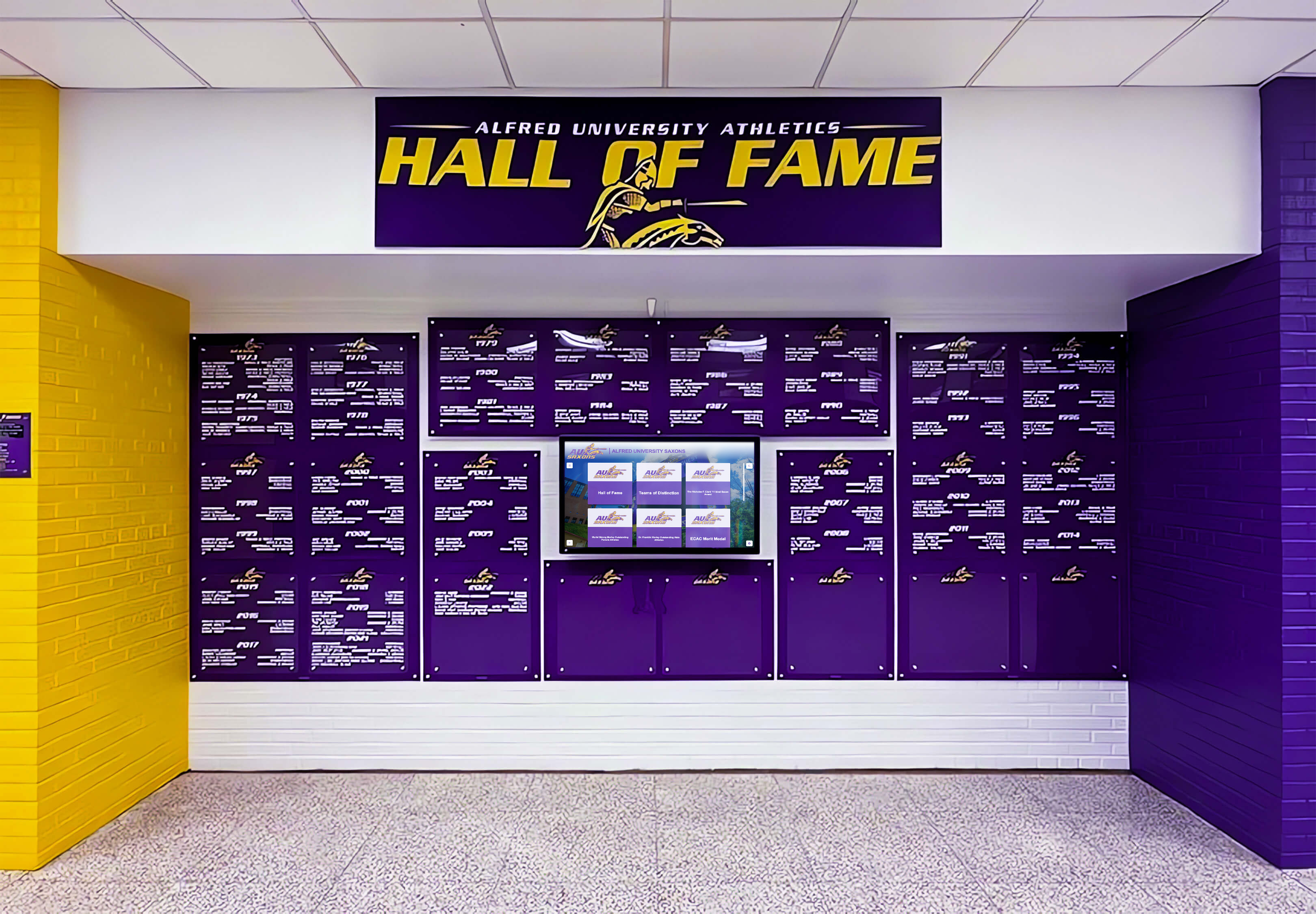
Professional implementation ensures optimal performance, reliability, and sustained engagement in busy school facility environments
Production Equipment and Technical Specifications
Professional video tours require appropriate equipment creating polished demonstrations effectively communicating digital recognition wall capabilities.
Camera Equipment
Primary Camera: Professional video camera or high-end mirrorless system (Sony A7 IV, Canon R6, Panasonic S5) capable of 4K recording at 60fps minimum. Shoot in 4K even if delivering 1080p final product—extra resolution enables stabilization and digital zoom during editing without quality loss.
Lens Selection: 24-70mm f/2.8 zoom provides versatility for wide facility establishing shots, medium donor profile demonstrations, and tight interface detail captures. Prime lenses (35mm f/1.4, 50mm f/1.2) offer superior low-light performance in school lobbies and corridors with mixed ambient lighting.
Stabilization: Gimbal stabilizer (DJI RS 3, Zhiyun Crane 3S) enables smooth camera movement approaching displays and touring facilities. Motorized slider for controlled linear movements highlighting display details. Professional fluid-head tripod for static interface demonstrations and extended presentations.
Lighting Approach
School facility environments present challenging lighting with mixed sources requiring careful balance.
Key Lighting: LED panel lights (Aputure 300d II, Godox VL300) with controllable color temperature (3200K-5600K) matching ambient conditions. Large soft boxes creating even light without harsh shadows on subjects. Battery-powered units essential for locations without accessible power.
Display Lighting: Careful exposure balancing screen brightness with ambient lighting preventing blown-out displays. Polarizing filter reduces screen glare and reflections. Slightly underexpose displays by 1/3 to 2/3 stop maintaining screen detail and readability in camera.
Ambient Balance: Match supplemental lighting color temperature to dominant ambient sources preventing color casts. White balance correctly in-camera reducing post-production color correction requirements and maintaining efficient workflow.
Audio Recording
Narration Recording: Professional USB condenser microphone (Rode Podmic, Shure SM7B, Electro-Voice RE20) in treated environment recording voice-over separately from video. Acoustic foam panels eliminating room echo ensuring broadcast-quality narration clarity suitable for professional institutional communications.
Location Audio: Wireless lavalier microphone systems (Rode Wireless Pro, Sennheiser EW-DP) capturing subject audio during demonstrations and donor testimonials. Boom microphone with shotgun capsule for ambient sound and interview recording.
Audio Processing: Normalize levels to -3dB peak preventing distortion. Apply noise reduction removing background hum and air handling systems. Add compression for consistent volume throughout narration. Subtle EQ enhancing voice clarity and intelligibility especially for older viewers or hearing-impaired audiences.
Closed Captioning and Accessibility
Caption Requirements: Professional closed captions with accurate spelling (especially donor names and technical terms), proper punctuation, and appropriate timing synchronized precisely with audio. Caption editing software or professional services ensuring accuracy meeting educational accessibility standards and ADA compliance.
Audio Description: Separate audio track describing visual elements for visually impaired viewers including on-screen text, navigation actions, donor photos, facility imagery, and important visual information not covered by narration.
Transcript Document: Complete written transcript available as downloadable PDF or web page enabling search engine indexing, easier reference during development meetings, and comprehensive accessibility accommodation.
Distribution Strategy and Promotion
Completed video tours require strategic distribution maximizing reach and supporting fundraising objectives across multiple stakeholder audiences.
Primary Distribution Channels
School Website Embedding: Feature video prominently on development pages, capital campaign information, donor recognition materials, and prospective family tours. Include clear calls-to-action directing viewers to contribute or contact development office.
YouTube Channel: Upload to school or district YouTube channel optimizing title, description, and tags for discovery. Create playlist combining tour video with campaign updates, groundbreaking footage, and completed facility reveals.
Capital Campaign Materials: Include video in donor cultivation presentations, grant applications, board reports, and community update communications showcasing recognition approach and stewardship commitment.
Social Media Excerpts: Create 60-90 second highlight clips optimized for social platforms showcasing compelling features and donor stories. Vertical format (9:16) for Instagram Stories and TikTok, square format (1:1) for Facebook feeds.
Video SEO Optimization
Video Title: “Digital Recognition Wall for School Renovation Donors | Interactive Donor Display Tour” - front-loaded with primary keywords while remaining natural and compelling.
Description: Comprehensive 300+ word description explaining what viewers learn, timestamp chapters enabling navigation, links to related campaign resources, donor contact information, and clear call-to-action. Include relevant keywords naturally throughout description.
Tags: Comprehensive tagging including “digital recognition wall,” “donor recognition,” “school renovation,” “capital campaign,” “donor wall,” “interactive displays,” and related variations.
Thumbnail: Custom-designed thumbnail showing touchscreen interaction with donor profiles, overlaid text highlighting key benefit (“Honor Every Donor” or “Unlimited Recognition Capacity”), and clear institutional branding.
Campaign Integration
Cultivation Meetings: Use video during major gift prospect meetings demonstrating recognition approach and stewardship commitment. Tablet or laptop playback enables personalized viewing in intimate settings.
Board Presentations: Include video in capital campaign approval presentations showing trustees how donor recognition will be handled professionally and inclusively.
Grant Applications: Embed video in foundation grant proposals demonstrating institutional capacity for appropriate donor stewardship and professional campaign management.
Annual Reports: Feature recognition wall prominently in annual reports with video links showcasing campaign success and donor community celebrating support.
Measuring Video Tour Performance and Recognition Impact
Systematic assessment demonstrates video value while identifying optimization opportunities ensuring maximum fundraising and stewardship impact.
Video Engagement Metrics
View Counts and Sources: Total video views segmented by traffic source (website embedding, YouTube search, email campaigns, social media) revealing which distribution channels drive engagement effectively.
Completion Rates: Percentage of viewers watching entire video versus dropping off early indicating content quality and pacing. Analyze drop-off points identifying sections needing improvement. Target 50%+ completion rate for 12-15 minute comprehensive demonstrations.
Chapter Engagement: Analyze which sections receive most attention, replays, and sharing revealing topics of greatest stakeholder interest. Use insights informing content emphasis in future development communications.
Interaction Rates: Click-through on embedded calls-to-action, links in descriptions, and conversion actions (contact requests, campaign contributions, event registrations) measuring how effectively video drives desired development outcomes.
Fundraising Impact Correlation
Campaign Giving Trends: Track campaign contribution patterns before and after video tour deployment identifying correlation with increased giving frequency, higher average gifts, or broader participation.
Prospective Donor Engagement: Survey major gift prospects about video tour impact on their understanding of recognition approach and comfort with contribution decisions. Track whether video viewing correlates with faster gift commitments and reduced cultivation cycle time.
Retention Improvements: Monitor year-over-year donor retention comparing periods before and after digital recognition implementation. Track whether enhanced acknowledgment correlates with improved sustained giving patterns.
Recognition Objection Reduction: Document whether development staff report fewer recognition-related objections or concerns during gift conversations after video tour enables prospective donors to see comprehensive inclusive acknowledgment approach before committing contributions.
Conclusion: Video Tours Demonstrate Recognition Transformation
Video tour walkthroughs provide compelling demonstration of how digital recognition walls transform school renovation donor acknowledgment from space-limited physical installations into comprehensive flexible celebration platforms that strengthen fundraising culture while honoring every supporter appropriately.
Book a Live Digital Recognition Wall Demo
Experience interactive donor recognition firsthand through personalized video demonstration showcasing how your school can celebrate unlimited capital campaign supporters while preserving complete institutional legacy and strengthening fundraising culture through engaging visual storytelling.
Schedule Your Demo TodayThe comprehensive demonstration explored in this guide showcases how digital recognition technology transforms school renovation donor celebration from capacity-limited temporary displays into unlimited permanent showcases honoring every contribution across all giving levels while adapting in real-time throughout active capital campaigns with flexible content management.
From major benefactor profiles featuring comprehensive multimedia facility impact documentation to inclusive Friends of Campaign recognition ensuring every contributor receives appropriate permanent acknowledgment, digital platforms solve persistent traditional limitations while creating engaging stewardship experiences that genuinely inspire continued generosity, strengthen community philanthropic culture, and demonstrate institutional commitment to donor appreciation.
Ready to transform your capital campaign donor recognition? Explore how Rocket Alumni Solutions provides comprehensive interactive recognition systems combining professional commercial-grade hardware, intuitive cloud-based content management, flexible templates accommodating diverse institutional needs, and ongoing partnership support ensuring your school celebrates every renovation supporter while building lasting philanthropic traditions connecting past generosity to future community investment in student success.
Discover additional capital campaign strategies in church interactive donor boards guide featuring recognition frameworks adaptable across institutional contexts, or explore giving tuesday donor recognition ideas demonstrating stewardship approaches that maximize year-end giving campaigns.