Destination Imagination: How Schools Showcase Student Creators and Display Tournament Achievements
- Home /
- Blog Posts /
- Destination Imagination: How Schools Showcase Student Creators and Display Tournament Achievements
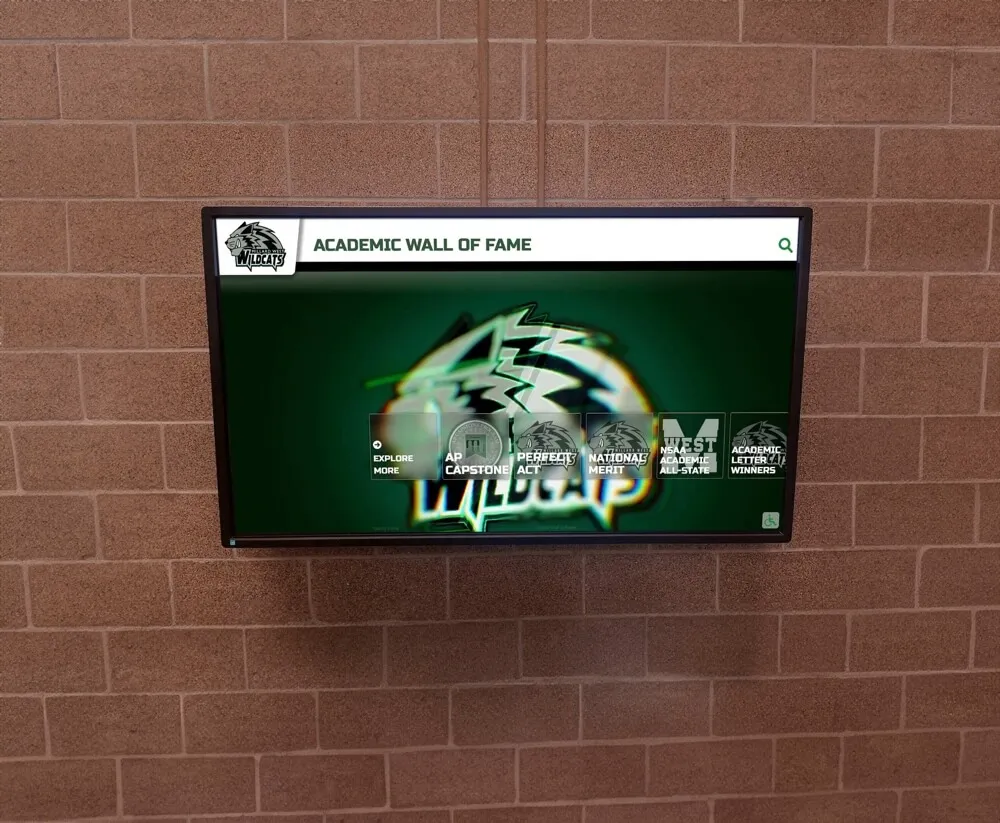
The Easiest Touchscreen Solution




Live Example: Rocket Alumni Solutions Touchscreen Display
Interact with a live example (16:9 scaled 1920x1080 display). All content is automatically responsive to all screen sizes and orientations.
Every spring, thousands of student teams across the country walk into gymnasiums, convention halls, and university arenas prepared to present months of original creative work to a panel of trained appraisers. They carry handbuilt structures, perform original theatrical scripts, demonstrate engineering solutions, and face spontaneous challenges they’ve never seen before—all in pursuit of a Destination Imagination tournament ribbon, trophy, or the chance to advance to Global Finals. These are extraordinary accomplishments. Yet in many schools, the trophy sits quietly in a corner while the athletic case down the hall fills with banners and framed championship photos.
This guide is for the principals, program managers, counselors, and booster parents who want to change that. Destination Imagination creates student creators whose work deserves the same permanent, visible recognition that athletic programs receive. The following pages explain how to build recognition systems that honor DI achievements properly—from understanding what the competition structure actually produces to designing displays that survive team rosters and individual members alike.
Destination Imagination operates at the intersection of creativity, collaboration, teamwork, and academic rigor. The students who compete in it are doing genuinely original work: building mechanical structures from scratch, composing theatrical performances, developing scientific research, and solving spontaneous challenges under pressure. The recognition infrastructure most schools have in place was designed for athletic programs—banners, trophy cases, sport-specific display spaces. DI achievements need recognition that reflects their particular character: multidisciplinary, team-based, creative, and cumulative over a season of preparation.

Digital academic recognition displays on school walls bring creative and competitive achievements the same visibility traditionally reserved for athletics
What Destination Imagination Actually Measures
Before designing recognition systems, it helps to understand what DI competition actually evaluates—because the achievement story is richer than a placement ribbon suggests.
The Challenge Structure and What It Demands
Destination Imagination organizes competition around Team Challenges in distinct categories. While the specific offerings vary from season to season, the program typically features challenges in technical engineering, scientific investigation, fine arts and theatrical performance, improvisational performance, structural engineering, service learning, and early learning (for younger students). Each challenge is released at the start of the season, giving teams several months to develop their solution independently.
The central rule governing DI competition is the Interference policy: all work on the team’s solution must be done by team members themselves, with adult Team Managers permitted to teach skills and ask questions but not to solve problems or build solutions for the students. This constraint is not a technicality—it’s the competitive foundation. A DI solution is entirely student-created in a way that most academic competitions cannot claim. When a team’s theatrical backdrop, mechanical device, or scientific demonstration succeeds at a tournament, the students built it. That fact should inform how schools recognize it.
Each team challenge is evaluated on multiple dimensions, typically including:
- The quality of the central technical or creative solution
- Integration of required elements specified in the challenge
- The quality of the performance or presentation
- Creativity and originality across all components
- Overall team presentation, including costumes, props, and staging
Teams also receive a separate score for the Instant Challenge—a timed spontaneous problem-solving exercise presented at the tournament that tests adaptability, communication, and creative thinking under pressure. The Instant Challenge score is combined with the Team Challenge score to produce the final team ranking.
The Tournament Progression
Destination Imagination competitions operate on a tiered structure that parallels athletic playoff systems and deserves recognition at each level.
Regional or Local Tournaments serve as the entry point. Teams present their solution to appraisers for the first time in front of an audience. This first public presentation—often after months of practice in garages, classrooms, and basements—is itself an achievement worth documenting. Teams that place in the top tier at their regional tournament advance to the next level.
State or Affiliate Tournaments bring together regional qualifiers from across a state or territory. Competition intensifies significantly at this level, and any team finishing in the top placements can claim a state-level achievement that merits permanent recognition.
Global Finals represents the pinnacle of the DI competition cycle—a multi-day event typically held in late May at a major university campus, drawing thousands of student team members and their families from across the United States and dozens of countries. Teams advancing to Global Finals have already proven themselves at regional and state levels. Placing at Global Finals among the top teams in the world is a championship-tier achievement by any reasonable standard.
For schools building comprehensive recognition programs, the academic decathlon approach to awards ceremonies offers a useful model for how to scale recognition proportionally to achievement level—a principle that applies directly to DI’s tiered tournament structure.
Why DI Achievements Often Go Underrecognized
Understanding why Destination Imagination recognition falls short in many schools helps identify where recognition systems need to improve.
The Visibility Gap
Athletic achievements are inherently visible—scores appear on scoreboards, games draw crowds, championship banners hang in gyms visible to hundreds of students daily. DI tournaments typically happen off-campus at unfamiliar venues. Many students, parents, and faculty members have no idea a DI team from their school competed until they hear about it secondhand. Without active recognition infrastructure, the achievement remains invisible to the school community.
The Documentation Gap
Sports programs accumulate documentation naturally: game programs, newspaper coverage, team photos, action shots, statistical records. DI achievements leave behind trophies and ribbons, but the creative work itself—the theatrical script, the engineering solution, the performance—often goes undocumented. A DI team that built a bridge-testing apparatus over six months, refined it through a dozen iterations, and used it to place first at regionals has a richer story than any trophy communicates. Recognition programs need to capture that story, not just display the award.
The Display Infrastructure Gap
Most schools have trophy cases designed around athletic hardware—football trophies, basketball championship plaques, swim meet first-place ribbons. DI ribbons and trophies look different and don’t always fit the existing display architecture. More importantly, athletic display systems don’t accommodate the contextual information that makes DI achievements meaningful: which challenge category, what the solution entailed, who the team members were, which tournament levels they competed in, and what their scores were.
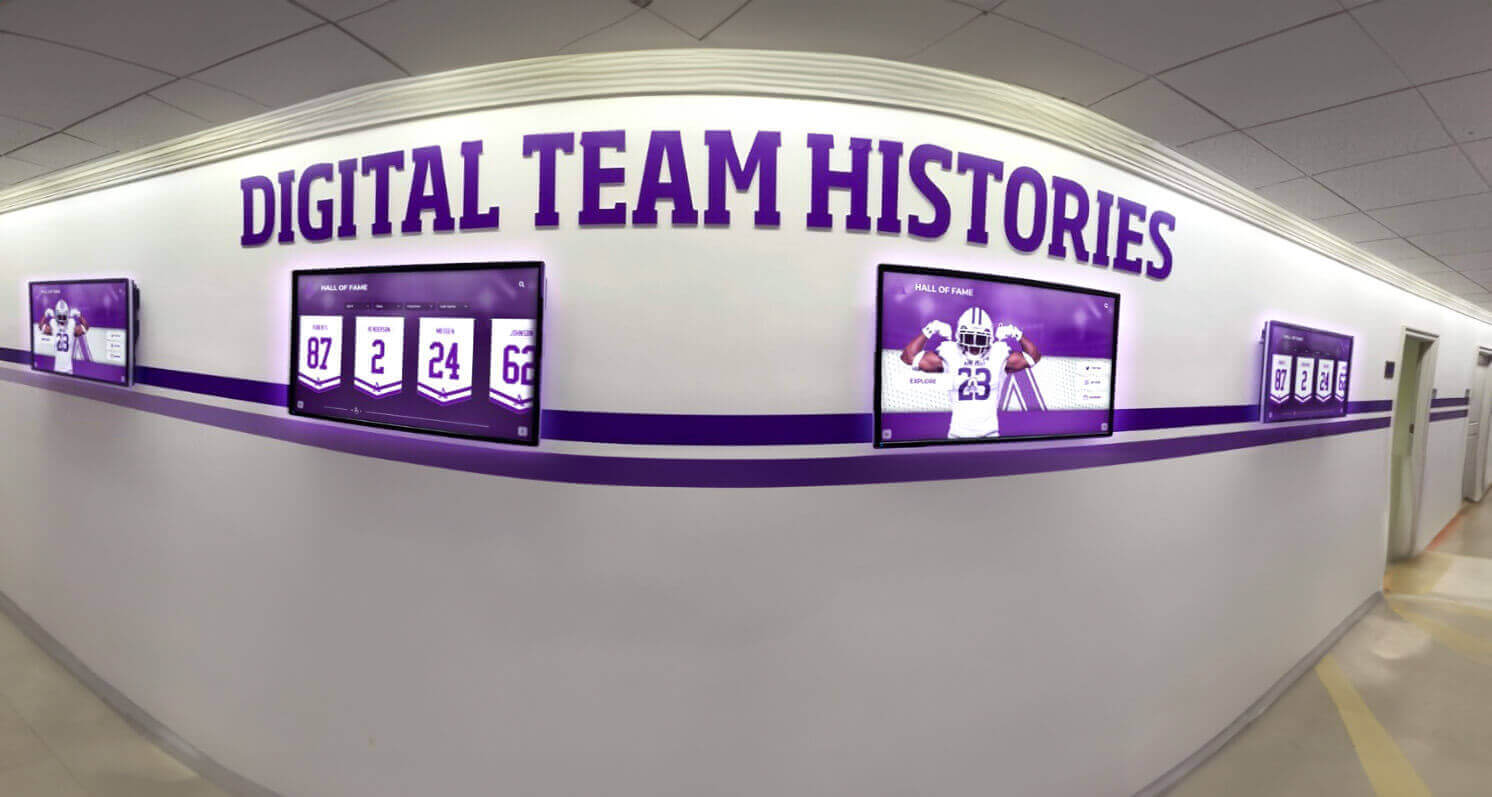
Dedicated team history displays allow schools to tell the full story behind each competitive achievement rather than reducing it to a single trophy
Building a Destination Imagination Recognition System
Effective DI recognition operates at several levels simultaneously: honoring the current team’s season, building a cumulative program archive, and creating visibility for the program that attracts future participants.
Season Documentation: Capturing the Achievement Story
The most durable recognition systems begin with documentation during the season rather than after the tournament. Schools with strong DI recognition programs typically capture:
Process documentation: photographs of the team working on their solution at various stages, time-stamped to show the progression from early concept to finished product. A Before/During/After photo set for a mechanical solution or theatrical set piece tells a compelling story that a single trophy cannot.
Challenge summary materials: a one-page or digital description of which challenge category the team competed in, what the central problem was, and how the team approached it. Many community members and future students don’t know what DI challenges involve; this context transforms a ribbon into an achievement story.
Tournament results by level: rather than displaying only the final tournament placing, effective recognition documents the full progression—regional placement, state placement, and Global Finals placement if applicable. A team that placed first at regionals, third at state, and competed at Global Finals has three distinct achievements worth displaying.
Team member profiles: individual team members deserve recognition alongside the team as a whole. Some DI participants compete across multiple years and multiple challenge categories, building competitive records that deserve the same documentation as a four-year letter winner in athletics.
For frameworks on how to structure this kind of documentation, comprehensive scholastic wall of honor planning covers the principles schools use to move from trophy display to full achievement storytelling—principles directly applicable to DI recognition.
Physical Display Strategies
Physical display infrastructure for DI achievements should accomplish several things that trophy cases alone cannot.
Dedicated program space: DI recognition benefits from a defined space that signals the program’s importance rather than tucking awards into a corner of an existing case. This could be a wall section in a STEM classroom hallway, a dedicated display in the school’s innovation or maker space, or a featured case near the main office. The location should be visible to daily traffic.
Visual differentiation by level: a first-place regional ribbon, a state qualifier certificate, and a Global Finals banner represent fundamentally different achievement levels. Display design should communicate this hierarchy visually—through size, framing, placement, or prominent labeling. A global finalist deserves the same wall prominence as a state athletic champion.
Challenge category identification: every DI display element should clearly identify which challenge category the team competed in. A team that placed at Global Finals in the Technical challenge and a different team that placed in Fine Arts both deserve recognition, but they represent different kinds of creative excellence. Category identification helps community members understand the breadth of the program.
Multi-year accumulation design: a recognition display that only shows the current year’s achievements is replaced every year and accumulates no institutional memory. Effective DI displays are designed from the start to grow—adding each year’s team and placements in a format that eventually tells the full history of the program.
Learn more about practical approaches in building digital walls of achievement that grow with your program, which covers the structural decisions that make long-term recognition archives sustainable.
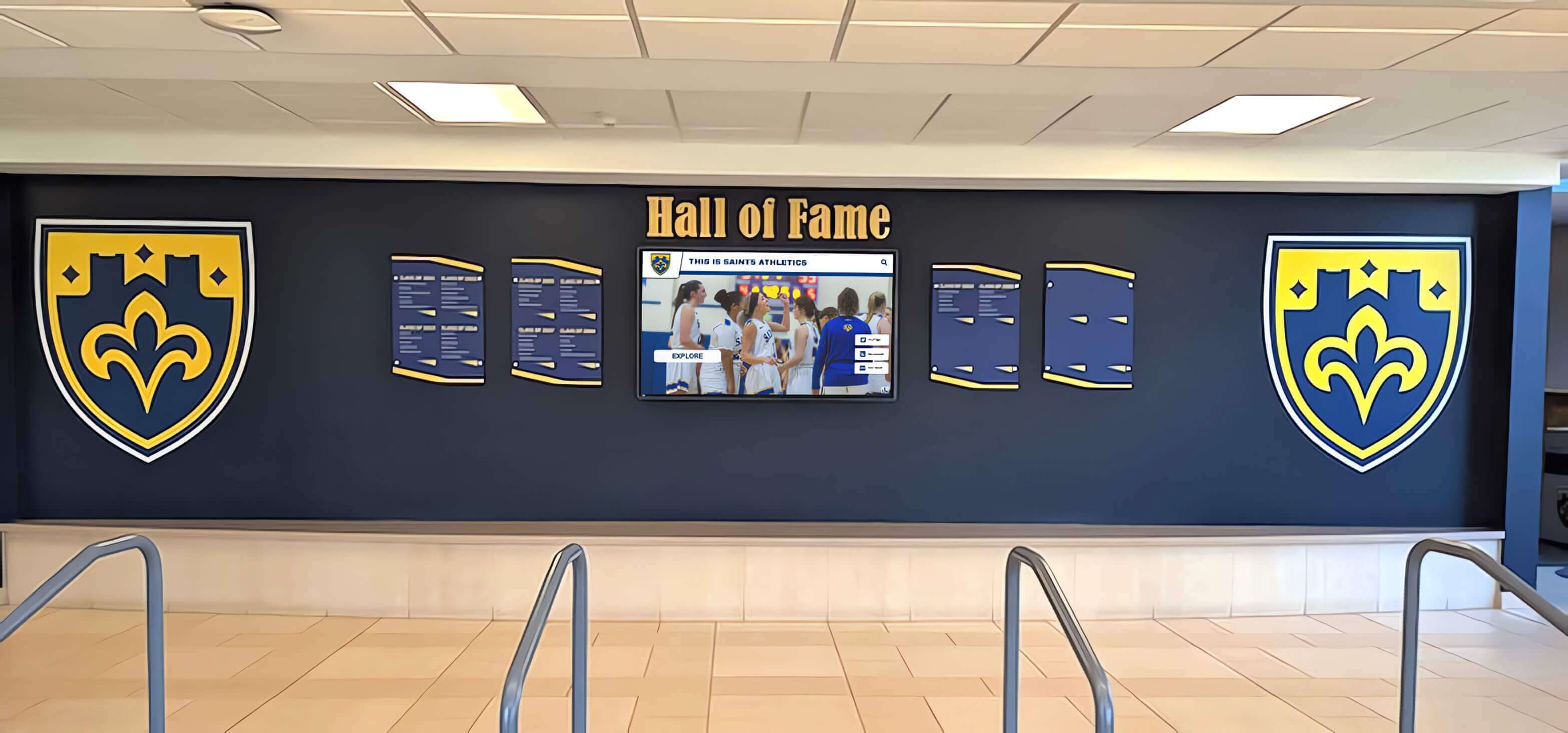
Hall of fame lobby displays integrate physical awards with digital screens to create recognition environments that honor both current and historical achievement
Digital Recognition for Destination Imagination Programs
Digital recognition technology changes the economics of DI display in ways that solve several of the problems physical displays face alone.
Storage without sacrifice: a physical trophy case has fixed space. Over time, schools face impossible choices about which past achievements to remove to make room for new ones. Digital recognition platforms eliminate this constraint—every team, every year, every placement can be stored and displayed without crowding out current achievements.
Rich media beyond trophies: digital displays can incorporate photographs, video clips, team solution descriptions, and appraiser feedback in ways physical cases cannot. A 30-second video clip of a team’s Instant Challenge performance, displayed on a lobby touchscreen, communicates more about what DI competition involves than a ribbon and a team photo ever could.
Searchable program history: a school with a decade of DI competition history has an extraordinary story to tell. Digital systems allow community members, prospective team members, and alumni to search that history—finding teams from specific years, challenge categories, or competition levels. This searchability transforms a recognition display into a living archive.
Remote update capability: DI tournament results come in quickly during competition season. Cloud-connected digital recognition platforms allow program managers to update displays from anywhere—adding new placements, uploading tournament photos, and publishing achievement announcements the same day results are posted, rather than waiting for a monthly update cycle.
For schools exploring how digital platforms compare to static displays for program recognition, understanding what a digital hall of fame is and how it works covers the core capabilities that make digital recognition systems valuable for academic program archives.
Recognizing Individual DI Achievers
DI is a team competition, but individual recognition matters for participants who invest years in the program.
Multi-Year Participant Recognition
Students who participate in Destination Imagination across multiple seasons develop skills and competitive track records that deserve individual documentation. A student who competed in four different challenge categories over four years, contributed to three state tournament appearances, and helped a team reach Global Finals twice has an achievement story comparable to a four-year varsity athlete.
Recognition for multi-year participants should document:
- Each season of participation with challenge category and tournament results
- Specific roles within the team (team captain, primary builder, lead performer)
- Cumulative competitive record across seasons
- Any individual recognitions received (appraiser comments, tournament honors)
Schools that recognize individual DI achievement alongside team achievement see stronger program culture—students understand that their personal investment in the program is seen and valued, not just the group outcome.
For frameworks on how outstanding student honor walls balance individual and collective recognition, the principles apply directly to DI programs working to honor both team-level and individual-level achievement.
Team Manager and Advisor Recognition
Adult Team Managers operate under the strict Interference constraint that defines DI’s integrity—they facilitate, mentor, and support without solving. This is genuinely difficult, especially for skilled adults who can see exactly how to improve a student’s solution. Team Managers who guide teams to state or global competition have demonstrated exceptional facilitation skill and deserve recognition alongside the students they supported.
Advisor recognition can take several forms:
- Named recognition alongside team displays (“Team Manager: [Name], [Years]”)
- Program-level recognition for advisors who have sustained multi-year programs
- Acknowledgment at end-of-year ceremonies alongside team members
Including Team Manager names in DI recognition displays also helps with program continuity—when new faculty members or parents consider taking on the Team Manager role, seeing previous managers named alongside successful teams communicates the value the school places on that contribution.
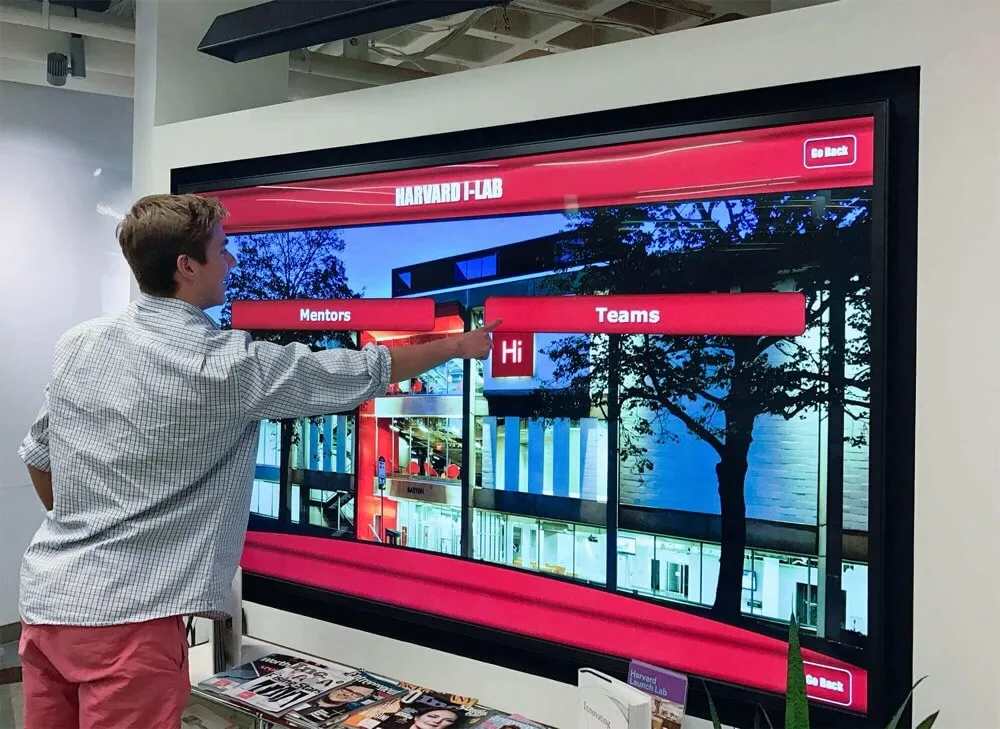
Interactive touchscreen displays at innovation labs can incorporate team manager and mentor recognition alongside student achievement profiles
DI Recognition in the Context of School-Wide Achievement Programs
Destination Imagination programs achieve more visibility and cultural impact when they are integrated into broader school recognition infrastructure rather than siloed as a standalone program.
Academic Achievement Recognition Alongside Athletics
The core recognition equity principle that should guide DI display decisions is straightforward: an achievement that required comparable time, effort, skill, and competitive success to an athletic championship should receive comparable recognition. A DI team that competed at Global Finals—which required qualifying through regional and state tournaments, preparing an original solution for six months, and performing under competitive pressure—has cleared a bar equivalent to many athletic state championships.
This does not mean DI recognition should look identical to athletic recognition. It means schools should ask whether the DI display is visible, permanent, and descriptive in the same way that athletic displays are visible, permanent, and descriptive. If the answer is no, the gap is worth closing.
For practical strategies on school achievement recognition across academic and competitive programs, the resource covers how schools systematically audit recognition equity and close the gaps between athletic and academic program visibility.
Cross-Program Recognition Events
End-of-year recognition events are a natural venue for DI celebration alongside other academic competitive programs. Schools that combine athletic award ceremonies with academic competition recognition—including DI, Science Olympiad, Academic Decathlon, Model UN, and similar programs—create ceremonies that reflect the full range of student achievement rather than privileging one category over others.
These cross-program events work best when:
- Each program receives proportional ceremony time based on achievement level (a Global Finals team deserves ceremony treatment comparable to a state athletic championship)
- Recognition materials (programs, displays, social media content) treat all achievement categories with equivalent production quality
- Trophy and award presentations involve program managers and Team Managers alongside students
- Community members who funded or supported the program are acknowledged
For end-of-year school assembly approaches that integrate academic and competitive recognition, the planning frameworks there address how to structure ceremonies that give every program its appropriate moment.
DI as a Legacy Program
Schools that have sustained Destination Imagination programs for a decade or more have something valuable that newer programs do not: a competitive legacy. Teams whose founding members have graduated can look back at a display chronicling the program’s evolution, earliest championships, and the students who established it. Current team members feel connected to something larger than their individual season.
Building toward this kind of legacy requires thinking about recognition from the beginning as an archive rather than just a trophy display. Every team photograph, tournament result, and challenge description filed in an accessible format is a contribution to the legacy. Schools that invest in preserving school achievement history as a time capsule for future generations create the conditions under which a DI program becomes a genuine institutional tradition rather than an annual activity.
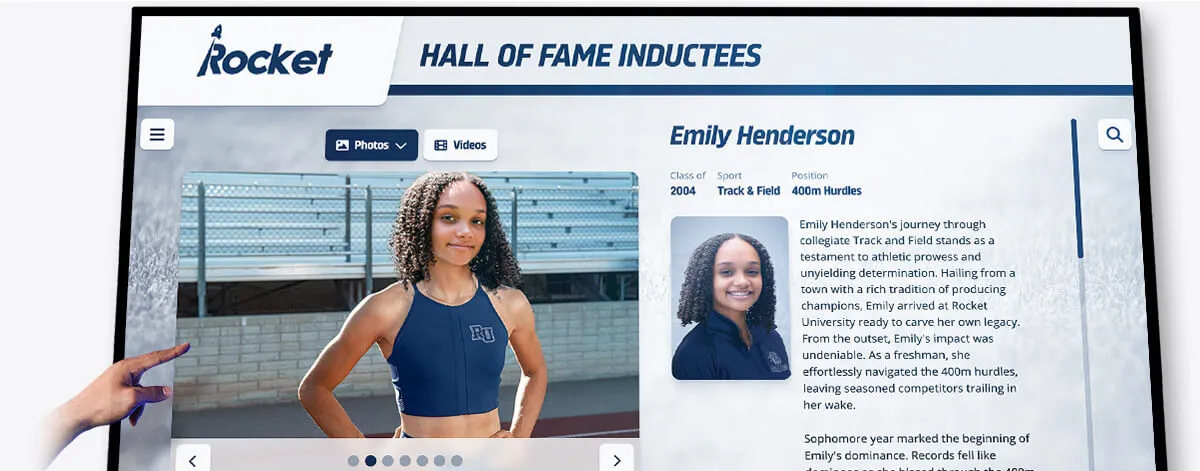
Individual achievement profiles on digital hall of fame systems capture the full story behind each competitor's journey, from first season through final tournament
Practical Steps for Starting or Upgrading DI Recognition
For program managers ready to build or improve recognition infrastructure, a phased approach manages the work without requiring everything at once.
Phase One: Document This Season Thoroughly
Before investing in display infrastructure, build the documentation habit. During the current DI season:
- Assign someone to photograph team meetings, build sessions, and practice presentations at each stage
- Create a one-page summary of the team’s challenge, approach, and season results as soon as the tournament concludes
- Collect signed photo permissions from team members and their families before the season ends
- Request copies of appraiser scoring sheets where possible—these contain specific feedback that enriches the achievement story
This documentation exists regardless of what display format you eventually use. It is the raw material for every recognition format from a simple bulletin board post to a full digital display profile.
Phase Two: Establish Permanent Display Presence
Once documentation exists, establish a physical display presence that will persist beyond the current season:
- Choose a location that will remain available and visible year to year (not a temporary bulletin board)
- Design the display to accommodate future additions—leave space for additional years rather than filling the frame with current content
- Include the program name, challenge category, competition level, team members, and Team Manager for every display element
- Use framing and presentation quality that matches the school’s existing athletic displays
For schools exploring how academic programs like DI, FBLA, FFA, and similar clubs can share recognition infrastructure, FBLA and FFA award displays and trophy approaches covers the design and placement strategies that work across academic competitive programs.
Phase Three: Integrate Digital Recognition
For programs ready to move beyond physical displays alone, digital recognition platforms offer capabilities that physical cases cannot match:
- Touchscreen display integration: a wall-mounted touchscreen in the school hallway or lobby can present the full DI program archive in searchable, browsable format—photographs, team details, challenge descriptions, tournament results—while taking up no more physical space than a mounted screen
- Remote content management: cloud-connected systems allow program managers to update DI content without requiring IT assistance or physical access to the display
- Video integration: short video clips of team performances, challenge presentations, or competition moments can be incorporated into digital profiles, turning a name-and-date recognition entry into a full narrative moment
- Multi-program consolidation: digital displays serving DI, Science Olympiad, academic bowl, and similar programs can share infrastructure while maintaining separate program identities
Interactive touchscreen storytelling for school recognition programs covers how schools are using these platforms to bring creative and academic program achievements the same digital storytelling quality previously reserved for athletics.
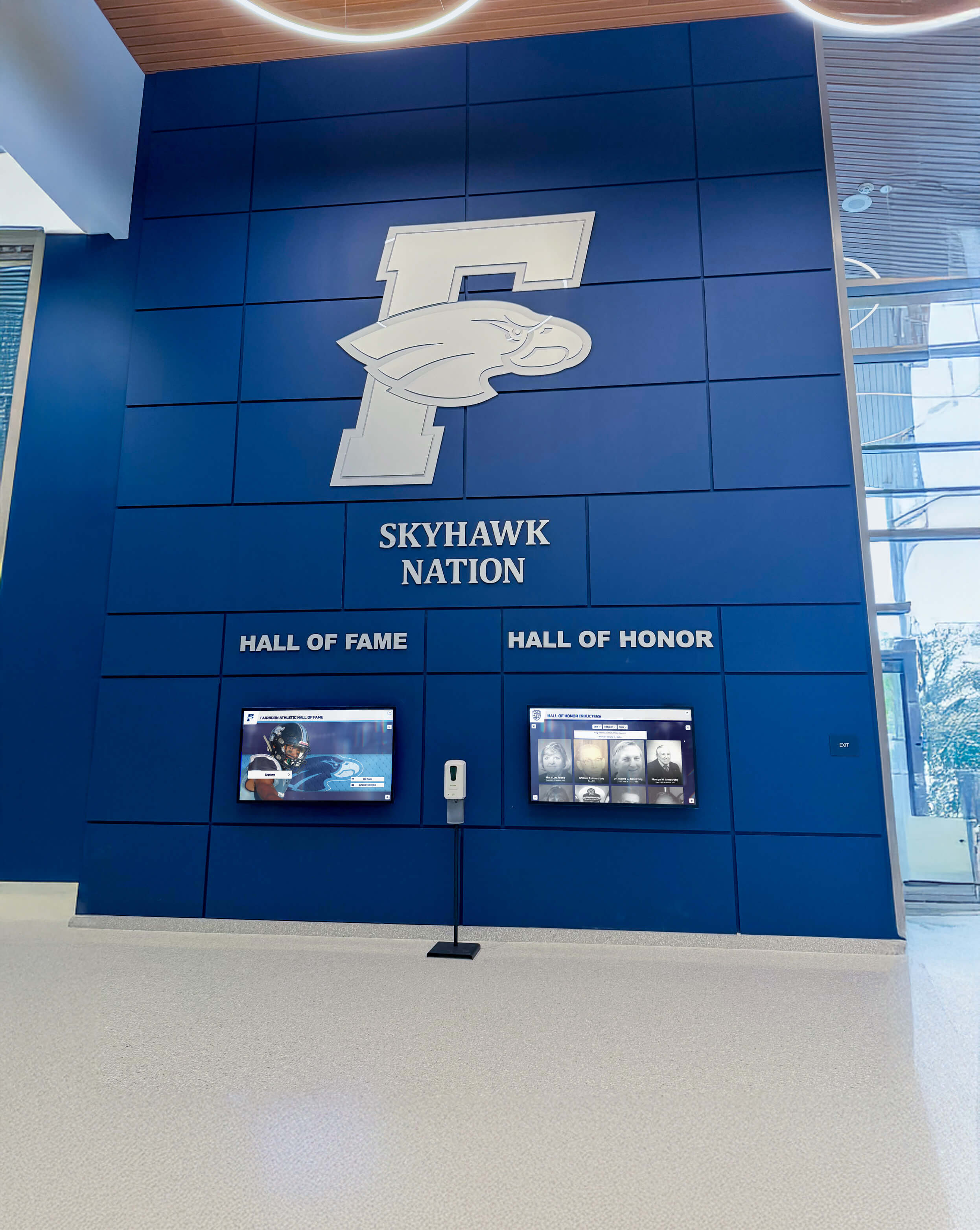
School lobby recognition walls bring competitive achievement displays into the highest-traffic areas of campus, ensuring the community sees and values program success
How Rocket Alumni Solutions Supports DI and Creative Program Recognition
Rocket Alumni Solutions builds digital recognition platforms designed specifically for school environments, with capabilities that match the particular needs of creative program recognition.
The platform allows schools to create dedicated DI program displays that include team rosters, challenge descriptions, tournament placement history, photographs, and video content—all manageable through a simple content management system that doesn’t require technical expertise. Display updates can be pushed remotely as soon as tournament results are available.
For schools that want to consolidate academic and athletic recognition on shared infrastructure, Rocket’s systems accommodate multiple program categories on a single display network, with each program maintaining its own visual identity and content library. A school can honor its DI Global Finals team, its state athletic champions, its academic bowl winners, and its honor roll students on a unified platform rather than managing separate systems for each.
The touchscreen display format is particularly well-suited for DI recognition because it allows the challenge description and team solution story to be presented alongside the trophy and placement information. Community members who don’t know what Destination Imagination involves can tap into a profile and understand what the team built, what problem they solved, and how they competed—context that a ribbon in a glass case can never provide.
If you’re ready to give your Destination Imagination program the recognition infrastructure it deserves, Rocket Alumni Solutions offers touchscreen walls of fame, digital achievement displays, and content management systems designed to bring creative student achievement the same permanent, visible recognition that athletic programs receive.
Destination Imagination produces student creators who have done original, self-directed work at a competitive level that most adults would find genuinely challenging. The recognition those students receive should reflect that. Building recognition infrastructure that captures the full story—team composition, challenge category, competitive level, creative approach, and multi-year trajectory—transforms a tournament ribbon into a lasting statement about what a school values. That is exactly the kind of institutional signal that attracts the next generation of creative problem solvers to walk through the door and sign up for the team.
Live Example: Rocket Alumni Solutions Touchscreen Display
Interact with a live example (16:9 scaled 1920x1080 display). All content is automatically responsive to all screen sizes and orientations.