



Championship banner display is one of those problems that feels like a good one to have — until the day your athletic director realizes the gymnasium rafters are full and this year’s state title has nowhere to go. Schools with long-running successful programs face a real constraint: decades of winning produce more championship banners than any single gym can hold, and makeshift overflow solutions rarely do justice to the athletes who earned those titles.
This guide walks through practical approaches for displaying championship banners in school gymnasiums, strategies for when physical wall space runs out, and how digital archives complement — rather than replace — the tradition of hanging cloth banners from the rafters. Whether you’re planning a first installation or rethinking a facility crowded with 30-plus years of history, these ideas cover the full spectrum from vinyl hardware to interactive touchscreens.
Every championship banner represents a season’s worth of sacrifice, early mornings, and collective commitment to something bigger than individual statistics. The display decision — where to hang it, how big to make it, what happens when space is gone — deserves more thought than it typically receives.

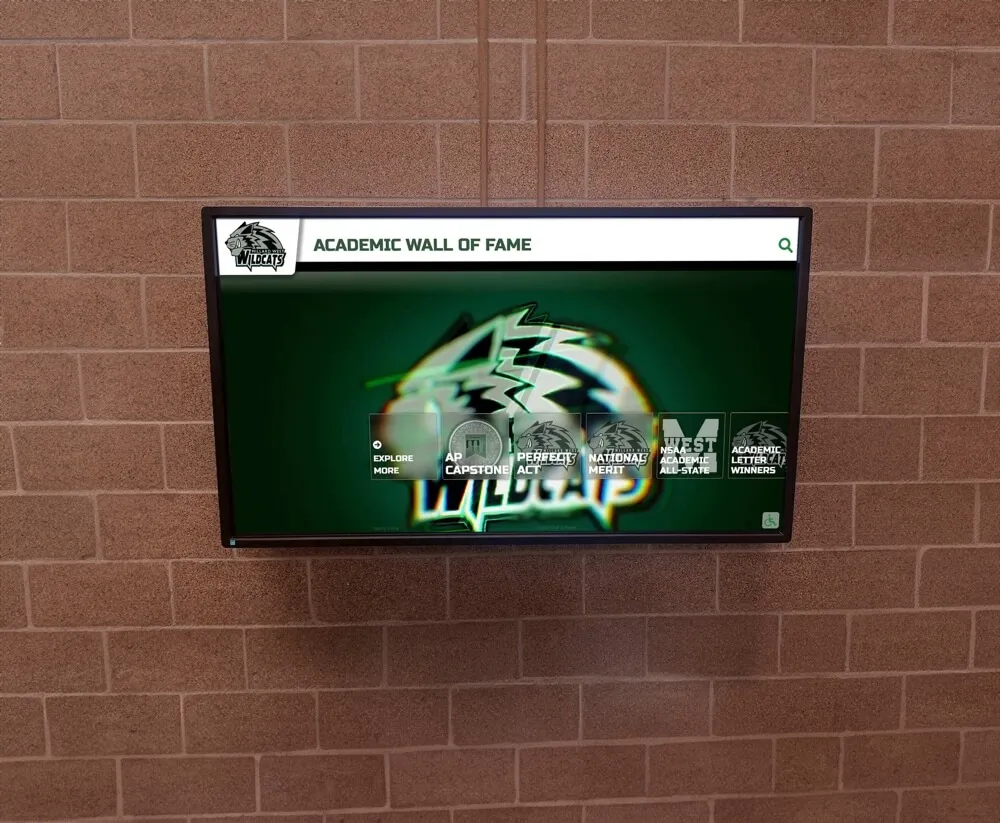
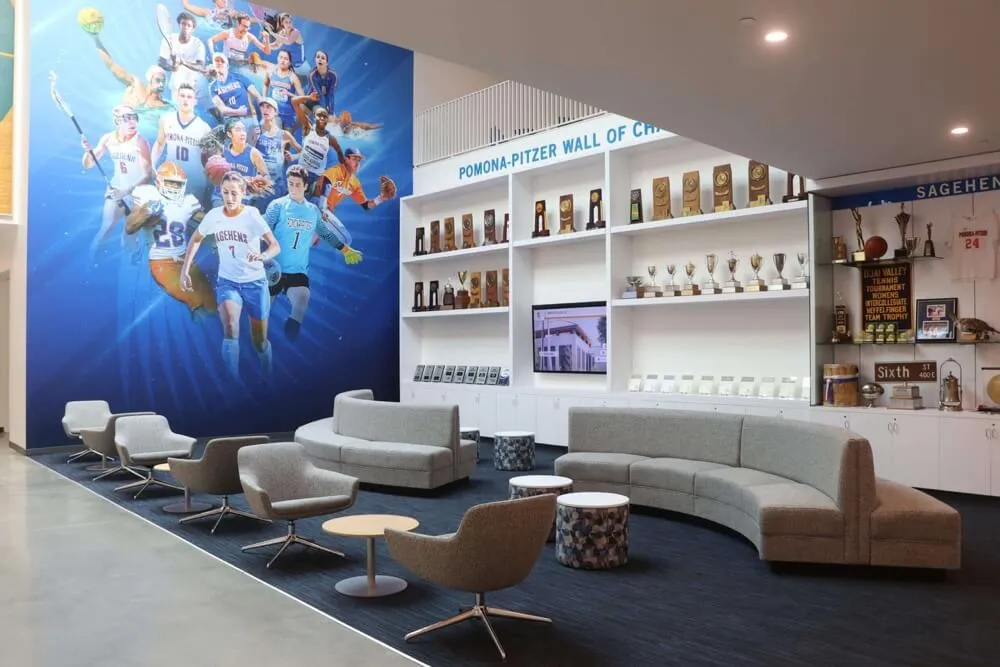
Physical banners create immediate visual impact in gyms and hallways — but wall space is finite, and a long-running program will eventually need a plan
Why Championship Banner Display Deserves a System
Most schools approach banner display reactively: a championship is won, a banner is ordered, someone figures out where to hang it. That approach works fine for a program’s first decade. After twenty or thirty years of sustained success, it produces a chaotic visual environment where early banners are sun-bleached and barely legible, newer banners compete for space at awkward angles, and the overall effect communicates clutter rather than legacy.
A systematic approach to championship banner display answers three questions upfront:
- What physical standards govern every banner — size, material, color scheme, typography?
- Where does each banner hang, in what order, and what happens when those spaces fill?
- How is the complete championship record preserved and made accessible when physical space runs out?
Schools that answer these questions create recognition environments that grow more impressive with each passing season. Those that don’t eventually face expensive retrofits and difficult conversations about which older banners to retire.
Physical Championship Banner Display: Getting the Fundamentals Right
Before exploring digital solutions, getting the physical display fundamentals right matters. The most sophisticated digital archive in the world doesn’t excuse a banner that’s crooked, faded, or hung so high that nobody can read it during a game.
Standard Banner Sizing and Materials
Consistency across all banners matters more than people realize. When every banner in a gymnasium measures the same dimensions and uses the same color system, the visual effect reads as institutional pride. When banners vary in size, material, and color scheme because they were ordered from different vendors across different decades, the effect reads as disorganization.
Recommended physical standards:
- Size: 24" × 36" for standard sport/year banners; 30" × 60" for major championship categories such as state titles or national honors
- Material: 13-oz. vinyl for outdoor-rated durability; polyester mesh where air circulation matters in older gymnasium constructions
- Grommets: Brass or stainless grommets at all four corners, plus midpoints on longer edges
- Finish: Matte finish reduces glare under gymnasium fluorescent lighting; gloss finishes photograph better for digital archives
- Color system: Limit banner backgrounds to two or three school colors; use consistent typography hierarchy across all banners
For schools starting fresh or standardizing an existing collection, ordering replacement banners for the oldest and most deteriorated originals keeps the display legible. Some schools retain originals in archival storage while displaying reproductions — a reasonable compromise that honors both the artifact and the viewing experience.
Detailed installation guidance, including hardware selection and load-bearing considerations for older gymnasium structures, is available in this championship banner installation resource for school gyms.
Banner Placement Strategies in the Gym
Where banners hang communicates priorities. A few placement principles worth following:
Hang by sport, then chronologically within each sport. Grouping all swimming banners together, all football banners together, and so on makes it easy for visitors to find specific programs at a glance. Within each sport group, oldest-to-newest or newest-to-oldest both work — just pick one and stay consistent.
Reserve the prime sight lines for your most significant titles. The wall visible from the main entrance gets the most natural attention during games. State championships and national titles belong here. Conference and regional titles can fill secondary positions.
Use vertical space deliberately. Gymnasium walls extend 20 to 30 feet in many school facilities. Banners hung too high become unreadable during events. A tiered approach — most significant titles at eye-to-shoulder height, supporting titles above — balances visibility with space efficiency.
Leave deliberate gaps for future additions. Nothing communicates confidence in a program’s trajectory like visible open space with clear intent. A designated section for future titles tells current athletes exactly what the program expects from them.
Advantages of Physical Banners
- Immediate emotional impact during live athletic events
- Permanent, tangible recognition visible from the court or field
- No technology to maintain or update
- Low ongoing cost once installed
- Tradition-rich environment that builds program culture over decades
Limitations of Physical Banners
- Wall space is finite and eventually exhausted
- Banners fade, fray, and deteriorate over decades
- No capacity for photos, video, or detailed statistics
- Difficult to update or correct after installation
- Late additions create visual consistency challenges

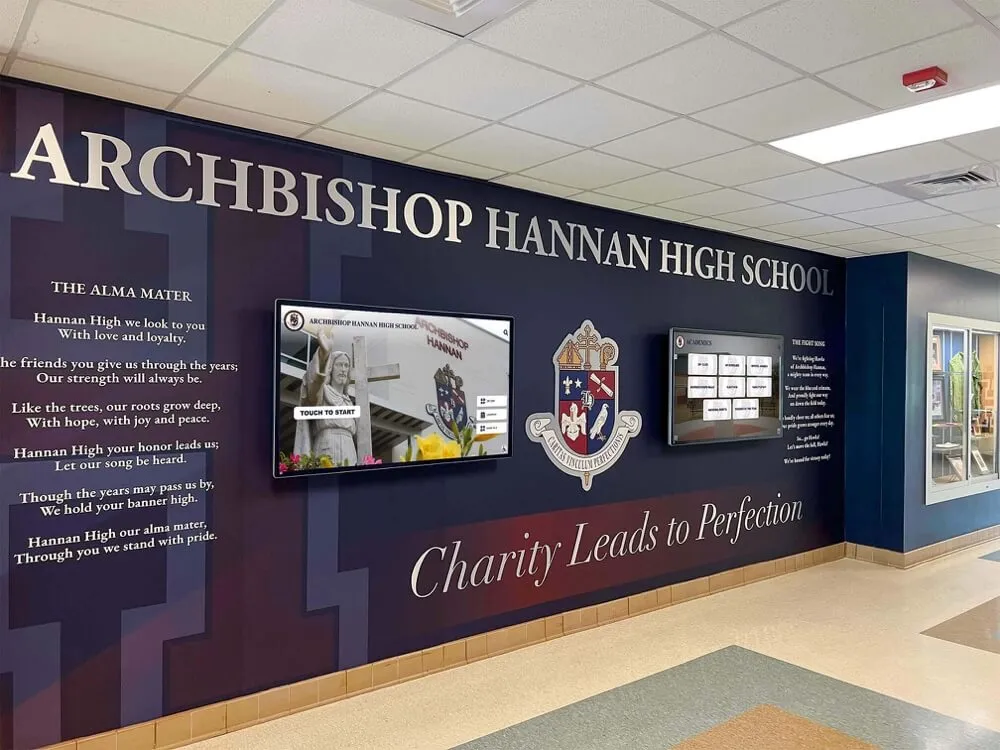
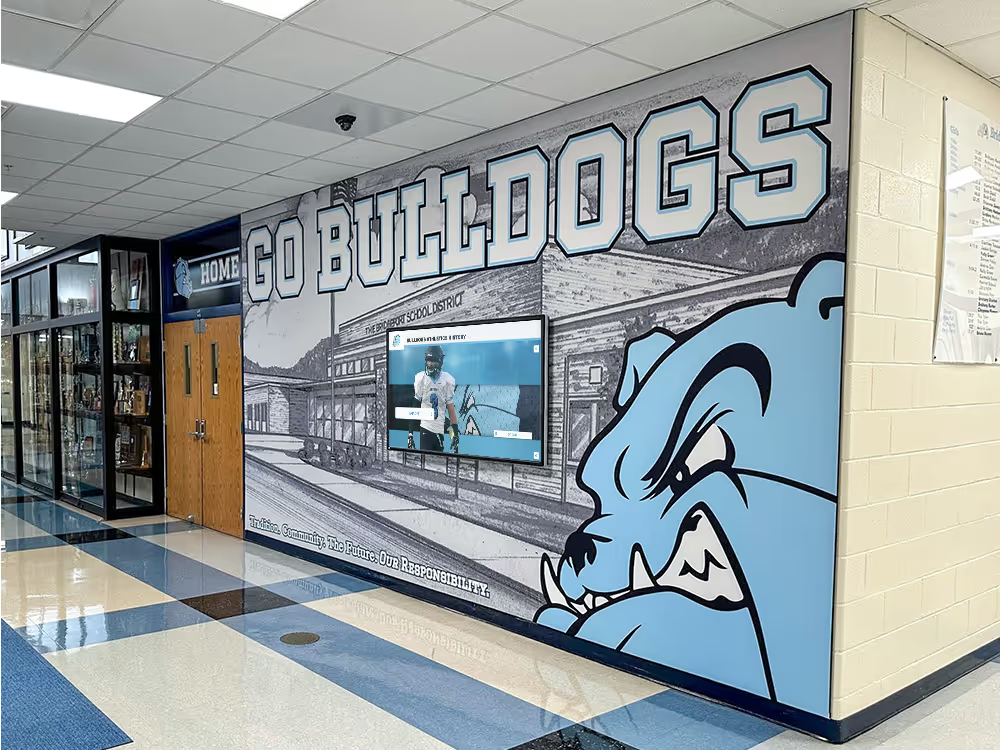
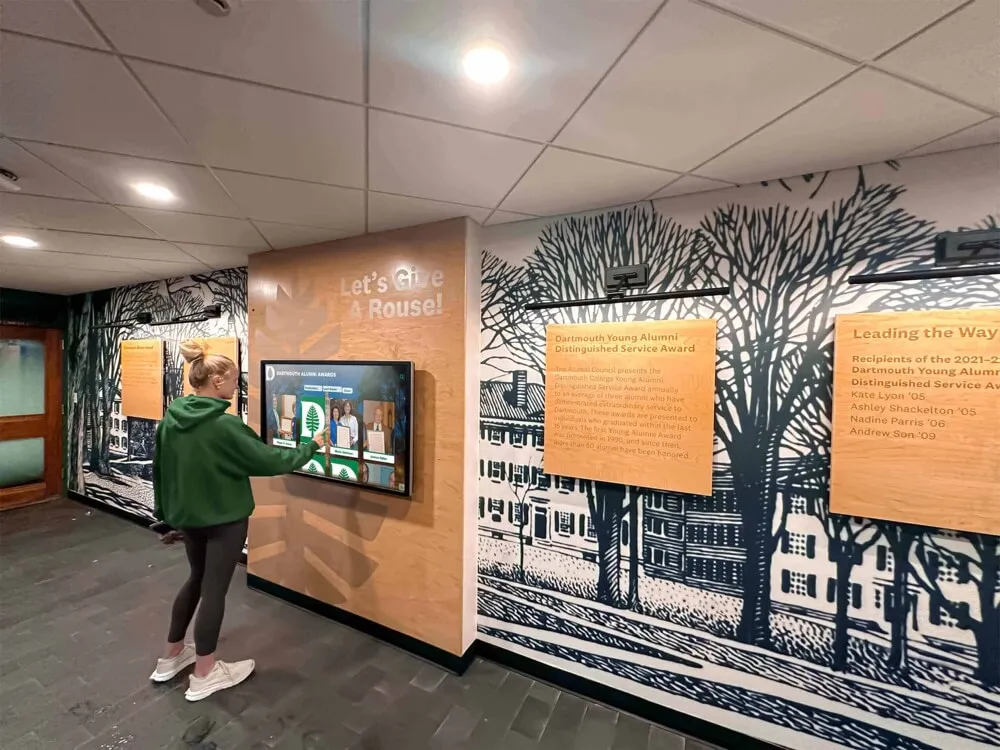
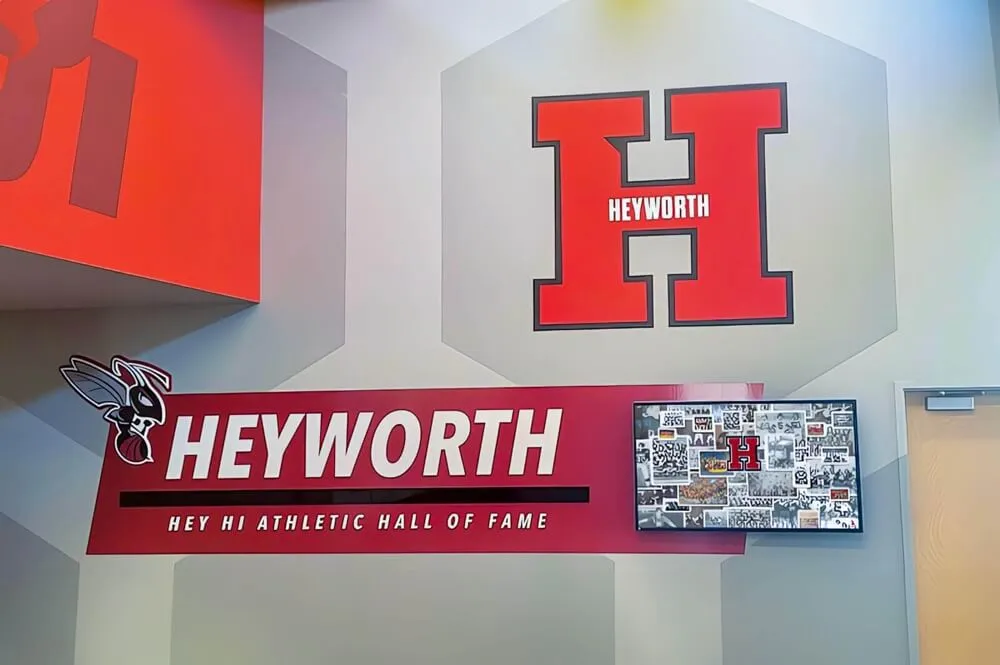
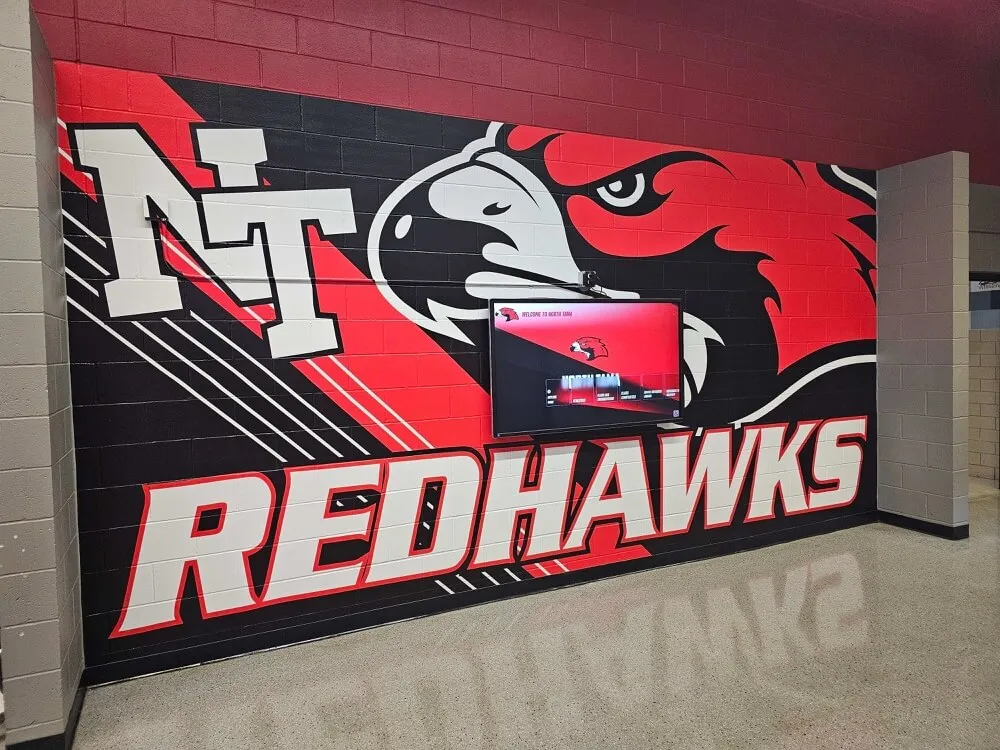
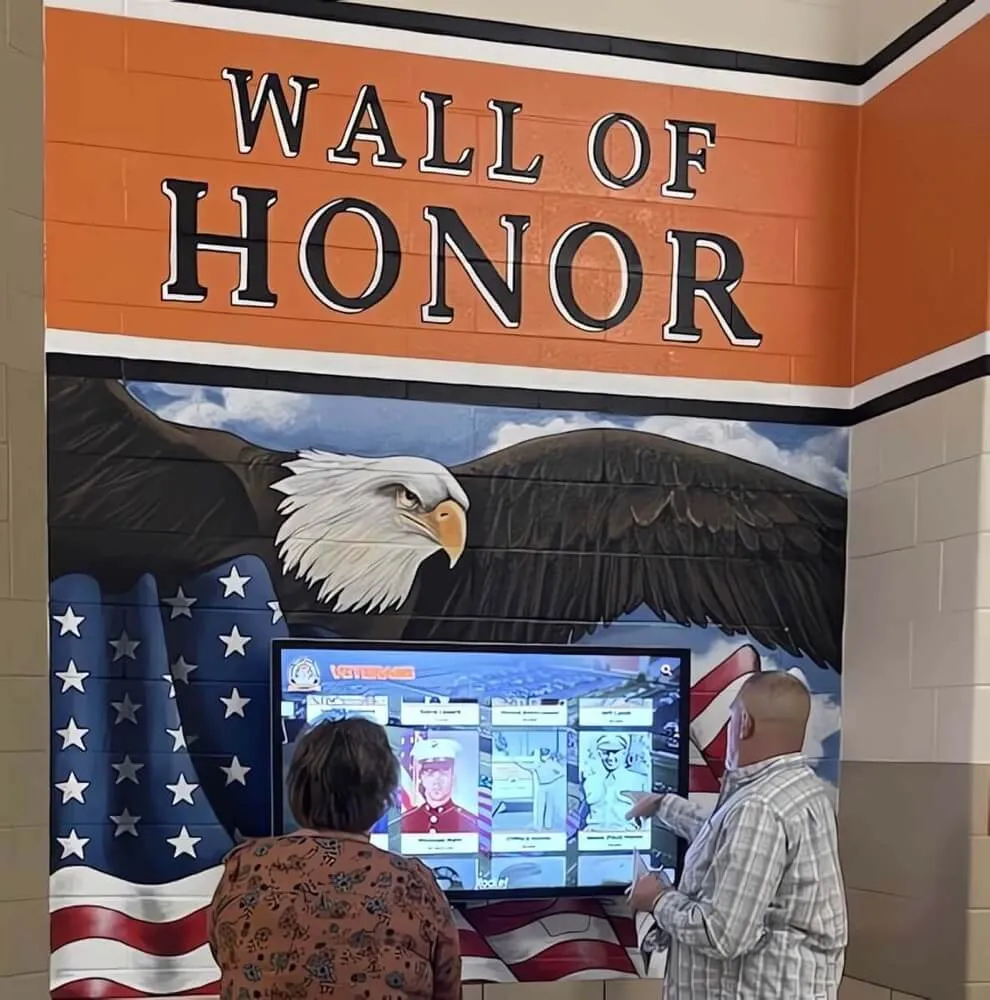
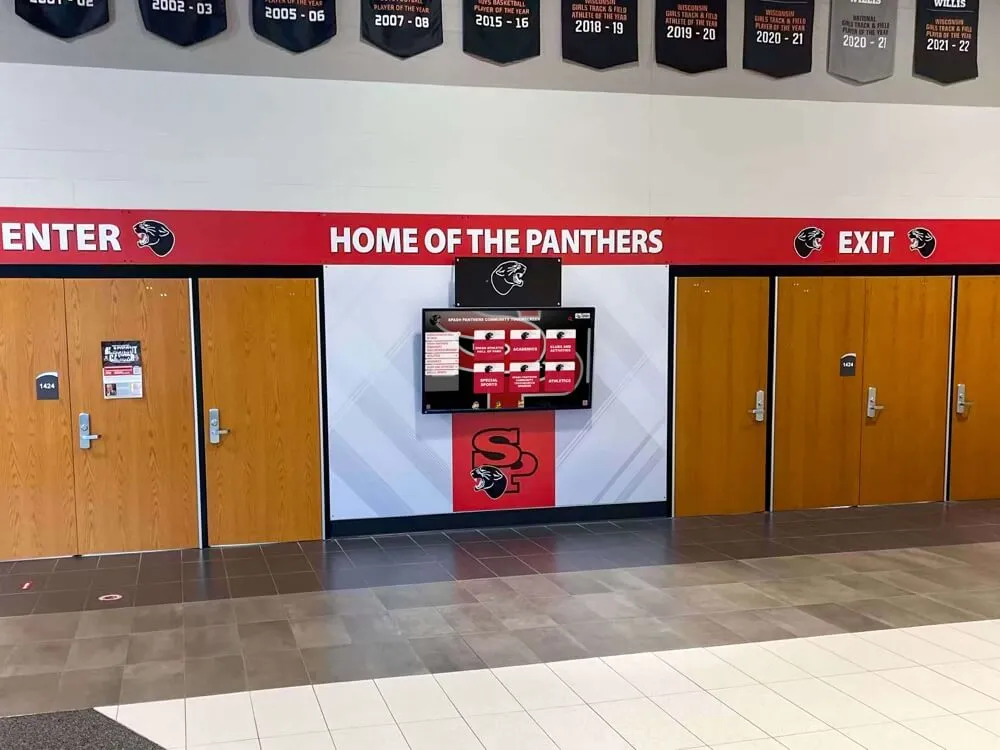
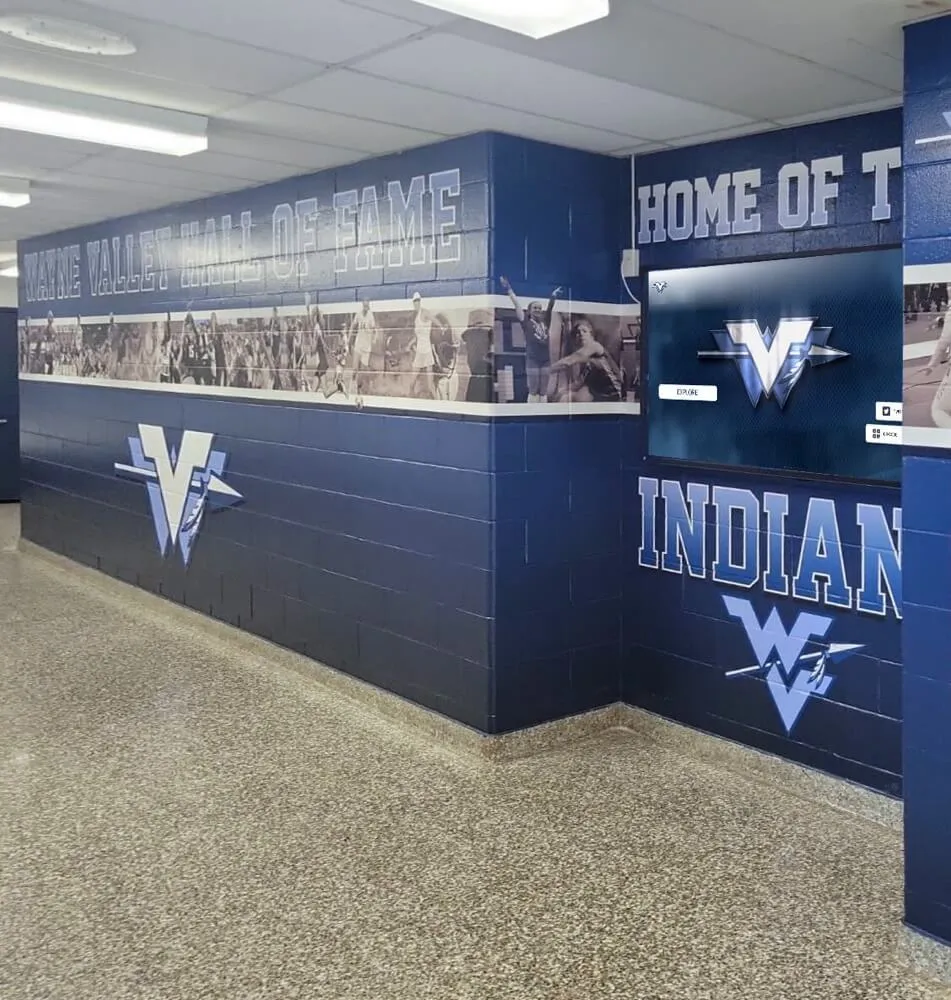
A well-designed hallway mural paired with a digital screen creates a natural bridge between physical tradition and digital depth
A broader look at how schools design their gymnasium walls — including record boards, hall of fame installations, and banner arrangements — is explored in gymnasium wall display ideas covering championship banners and record boards.
Championship Banner Template Considerations
Establishing a championship banner template before placing orders saves significant cost and headache over time. A standardized template specifies:
- Background color(s) and color codes (Pantone or CMYK)
- School name font, size, and position
- Sport name font, size, and position
- Championship type and year font, size, and position
- Logo placement and approved logo files
- Grommet positions
Once a template exists, every new banner order takes minutes to complete rather than requiring a design conversation with a vendor each time. Templates also prevent the gradual visual drift that makes older gymnasium banner collections look inconsistent when viewed together.
For schools developing or refreshing their banner templates, championship banner design ideas for high school gyms and athletic halls offers practical guidance tailored specifically to school athletic facilities.
The Overflow Problem: When Your Gym Runs Out of Wall Space
Schools with long-running successful programs eventually face a literal wall. A program that wins two or three championships per year across multiple sports accumulates banners faster than any gymnasium can absorb. At some point, adding another banner means compromising something else: readability, aesthetic cohesion, or the visibility of earlier achievements.
This overflow problem is more common than most people realize. A detailed review of options for schools navigating gym wall constraints appears in championship banners for gyms and digital overflow solutions.
Overflow Plan Option 1: Expand to Adjacent Spaces
The most straightforward overflow strategy moves banner display beyond the main gymnasium.
Hallway galleries: School hallways adjacent to athletic facilities offer significant linear footage for banner display. A hallway running alongside a gymnasium can hold dozens of additional banners while also serving as a natural gathering space during halftime or between events. Hallway placement keeps athletic recognition visible during regular school days, not only on game nights.
Athletic department lobbies and entrances: The entrance to an athletic facility is premium recognition real estate. Championship banners flanking the main entrance create an immediate impression of program excellence for visiting teams, recruits, and families encountering the building for the first time.
Multipurpose rooms and commons areas: School cafeterias, multipurpose rooms, and student commons often have substantial ceiling and wall space suitable for overflow banner display. This approach distributes recognition across the building rather than concentrating it in a space students visit only during games.
Weight rooms and training facilities: Athletic support spaces used daily by student-athletes are ideal for championship recognition. Banners in training areas create constant visual reminders of what the program has achieved and what current athletes are working toward.

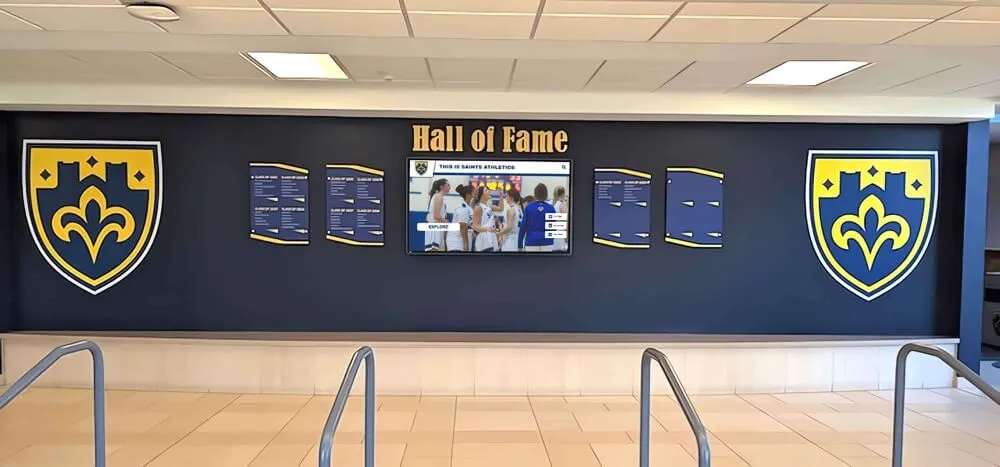
Hallway spaces adjacent to the gym can absorb overflow banners while doubling as everyday recognition environments for the full school community
Overflow Plan Option 2: Retire and Archive Physical Banners
Some schools address overcrowding by establishing formal retirement policies for older banners. Under this approach, banners older than a set threshold — 20 years, 30 years, or at program director discretion — are retired from display and transferred to archival storage or presented to the relevant coaching staff as mementos.
Banner retirement works best when paired with a digital archive that maintains the complete championship record even after physical banners leave the wall. Without a digital complement, retiring banners erases institutional memory — a cost that outweighs the space savings.
Practical considerations for banner retirement programs:
- Communicate the policy publicly before retiring any banners
- Offer retired banners to coaching families or program alumni before storing or disposing
- Photograph every banner in high resolution before retirement to support future archiving
- Document the complete championship record — sport, year, category, coach — in a permanent database
Overflow Plan Option 3: Consolidation Banners
Rather than displaying individual annual championship banners, consolidation banners group multiple championships onto a single display.
Sport-decade banners list all championships won by a given program across a decade on one banner: “Basketball Championships: 2010, 2013, 2015, 2016, 2018, 2019.” One banner replaces what would otherwise be six.
Program legacy banners take this further, displaying a complete championship timeline for a specific sport on an oversized banner — the program name followed by every year a title was won. This format works particularly well for programs with exceptional winning traditions where the full list creates more impact than separate banners for each season.
Consolidation banners require careful design to remain readable at gymnasium distances. Minimum font size requirements and adequate contrast between text and background become even more important when a single banner carries significant information load.
The full range of design approaches for school banner systems — including consolidation strategies — is explored in school banner ideas covering creative designs for halls, gyms, and digital walls of fame.
Digital Archives: The Permanent Solution to Physical Space Limits
Physical overflow strategies buy time, but they don’t solve the underlying constraint: physical space is finite, and a successful athletic program will always produce championships faster than wall space materializes. Digital archives address the root cause.
A digital championship archive preserves the complete record of every title a school’s programs have won — with photos, statistics, rosters, and historical context — in a format that requires no physical space and never runs out of room.
What a Digital Championship Archive Contains
A comprehensive digital archive goes well beyond a list of years and sports. The most useful archives include:
- Complete championship record by sport and year, searchable by any combination of filters
- Team rosters documenting every athlete who contributed to championship seasons
- Season statistics providing context for what made championship teams exceptional
- Coaching staff records recognizing the leaders who built championship programs
- Photos from championship games, celebrations, and banner presentation ceremonies
- Video highlights from championship-winning moments
- Historical context connecting championships to the broader program narrative
This depth transforms a static list into a living institution. Alumni can search for their own championship seasons, current athletes can explore how previous teams built on each other’s success, and families visiting for the first time can understand the program’s full history in minutes.
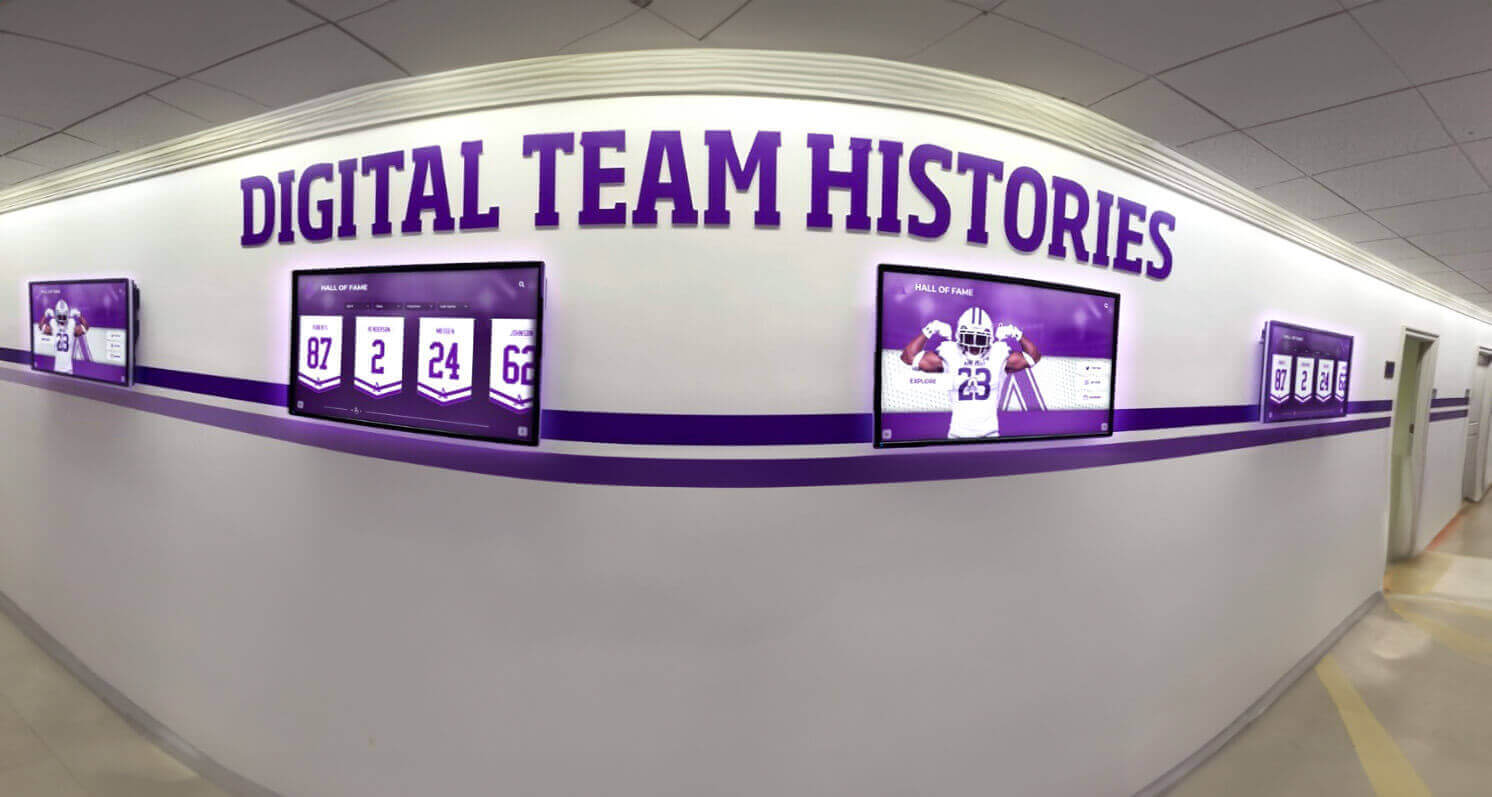
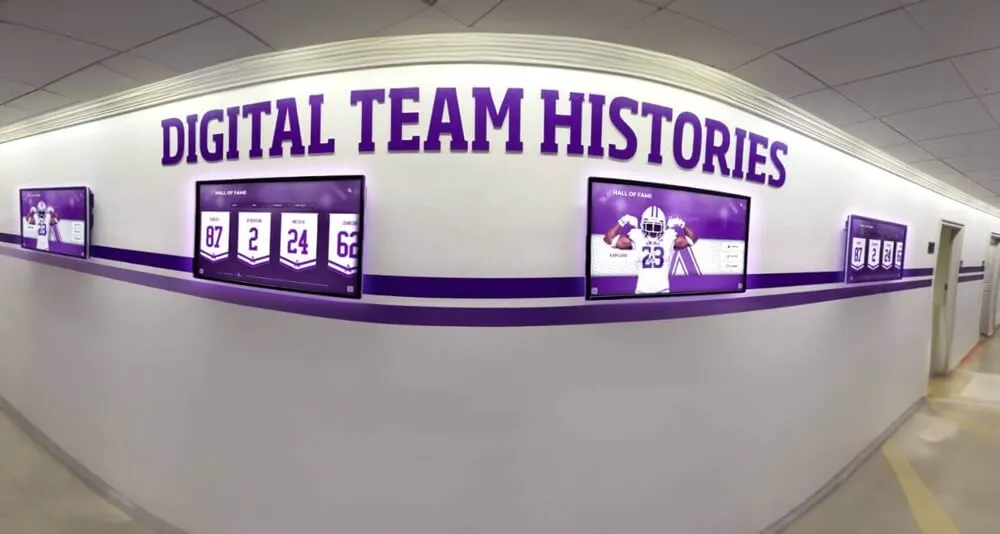
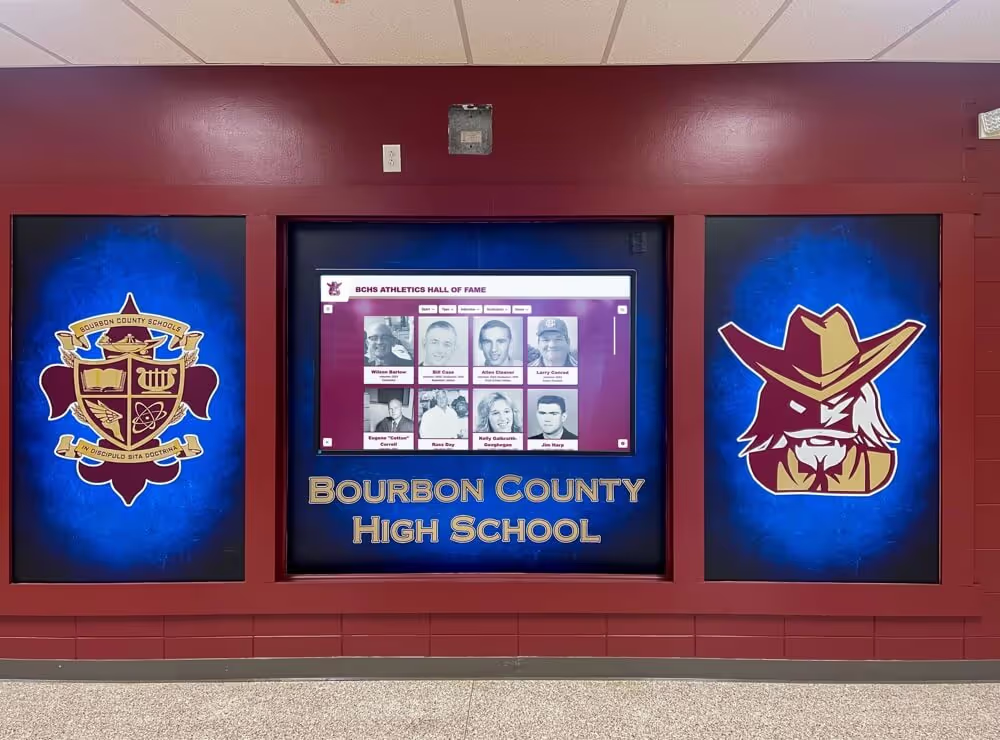
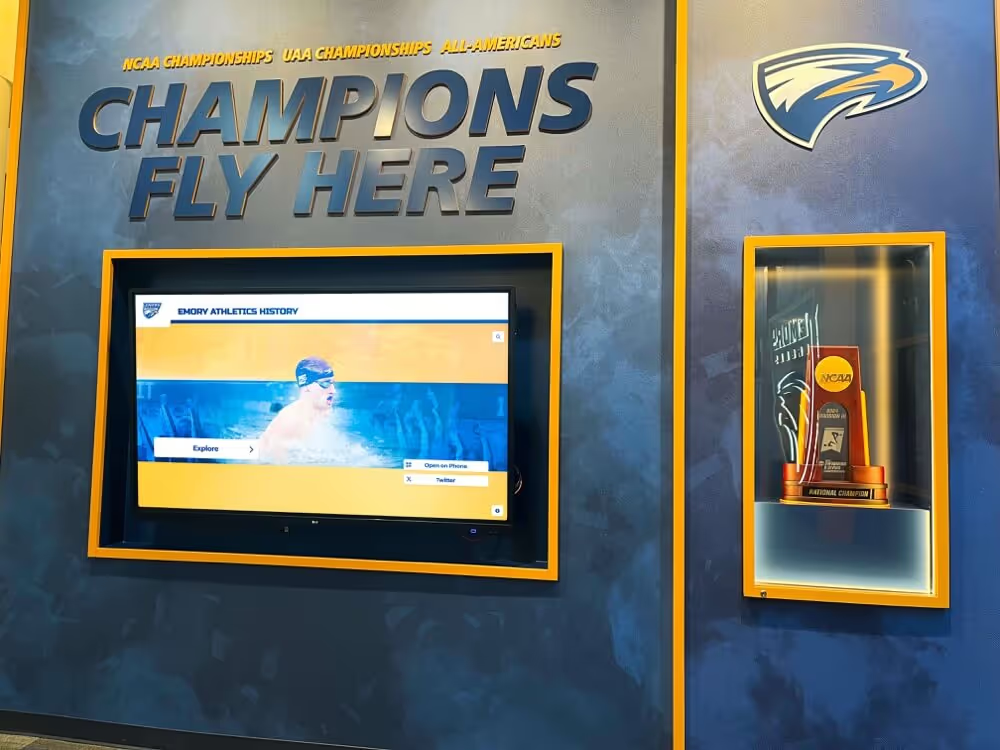
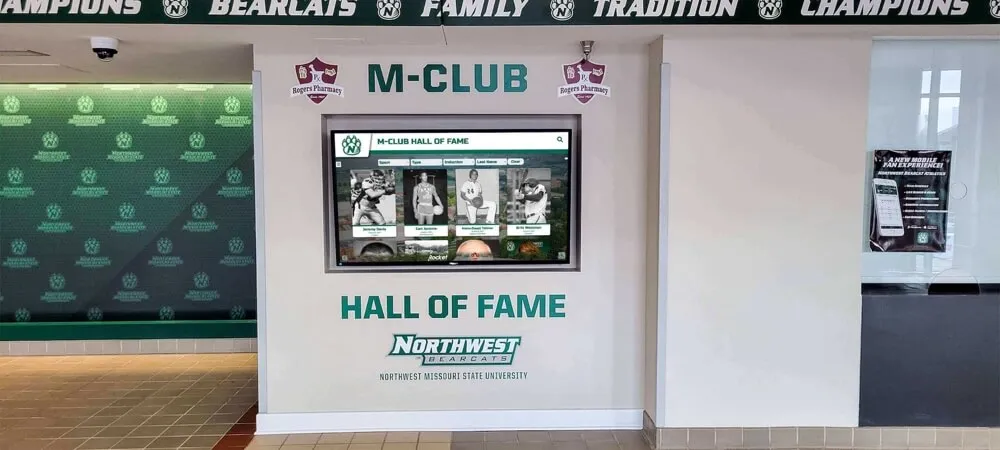
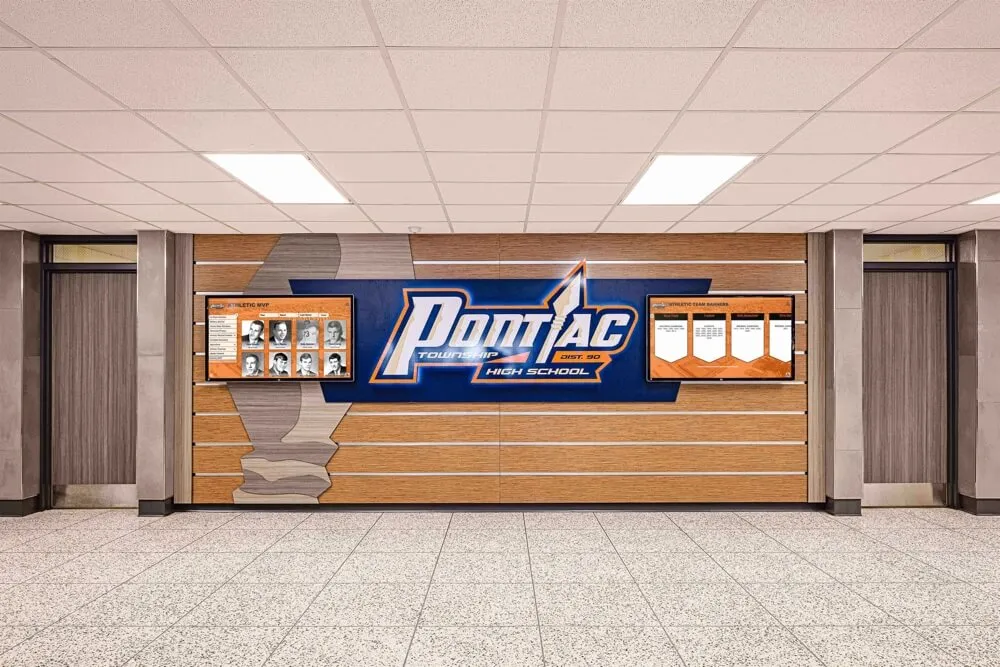
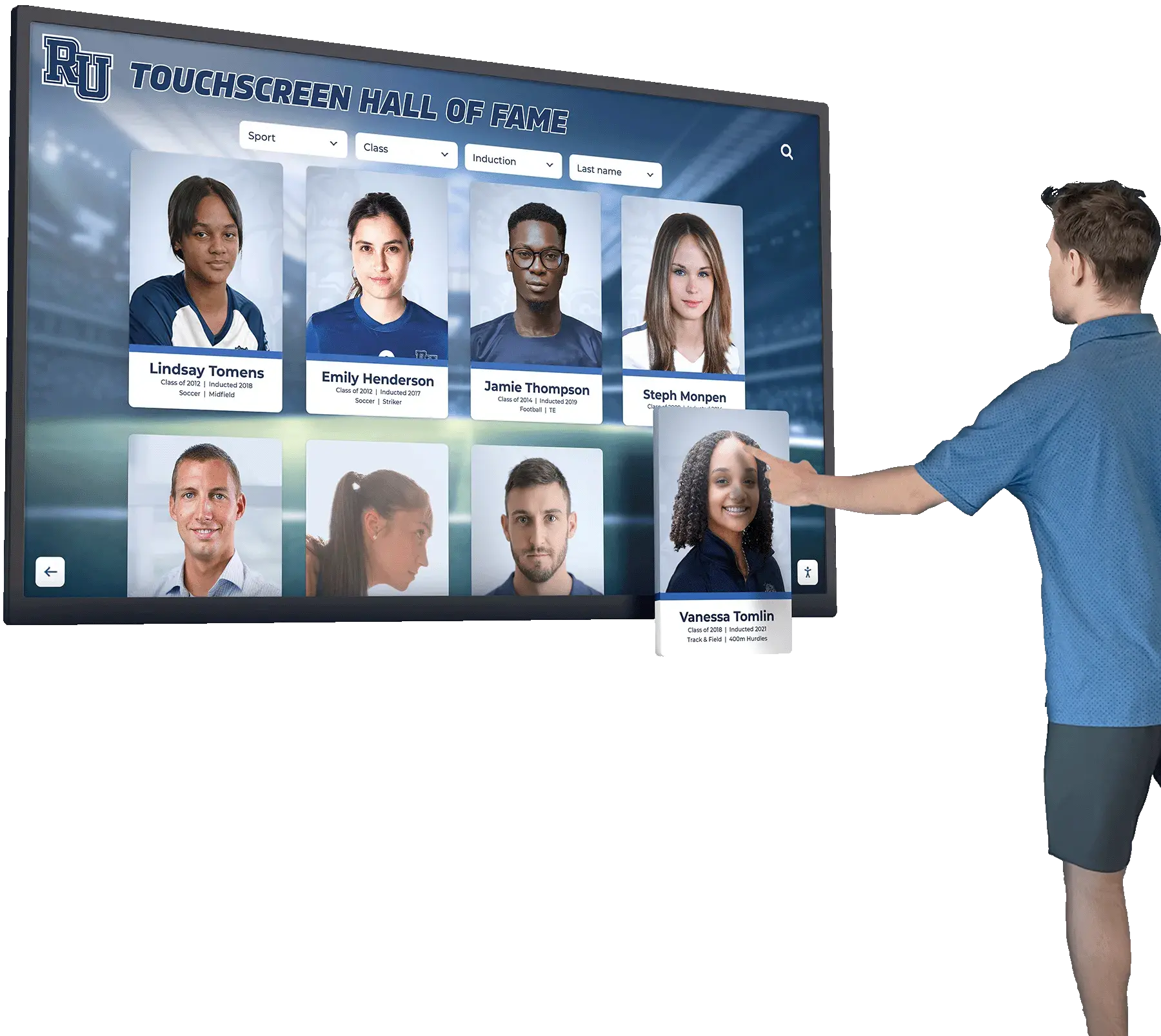
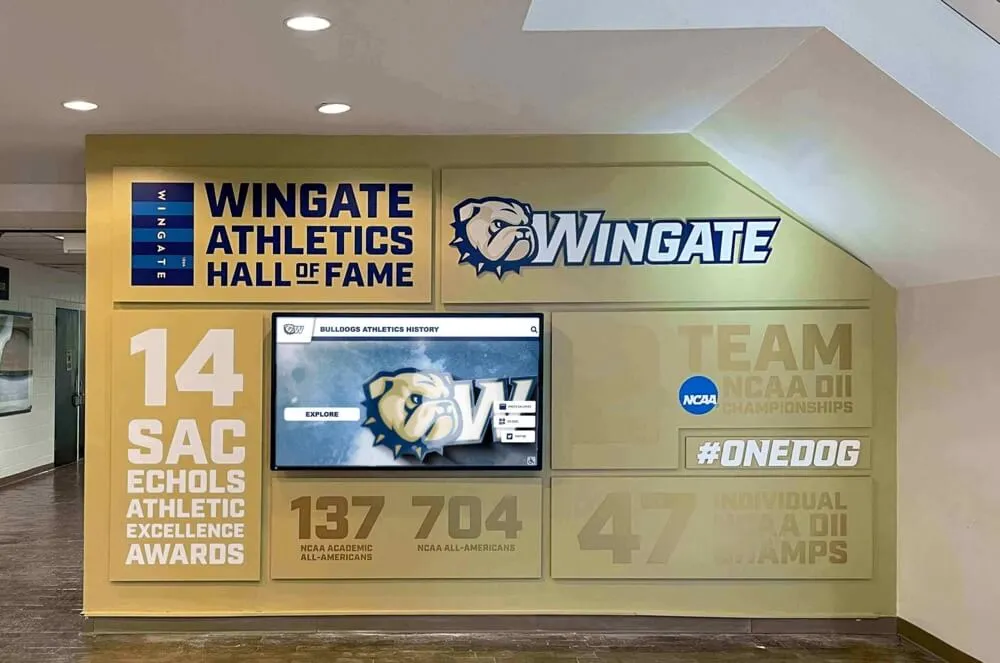
Digital hallway displays allow schools to showcase the complete depth of championship histories without the constraints of physical wall space
Touchscreen Systems as Physical-Digital Bridges
The most effective implementations don’t choose between physical banners and digital archives — they use both deliberately. Physical banners create emotional atmosphere and tradition. Digital systems carry everything that can’t fit on cloth hanging from rafters.
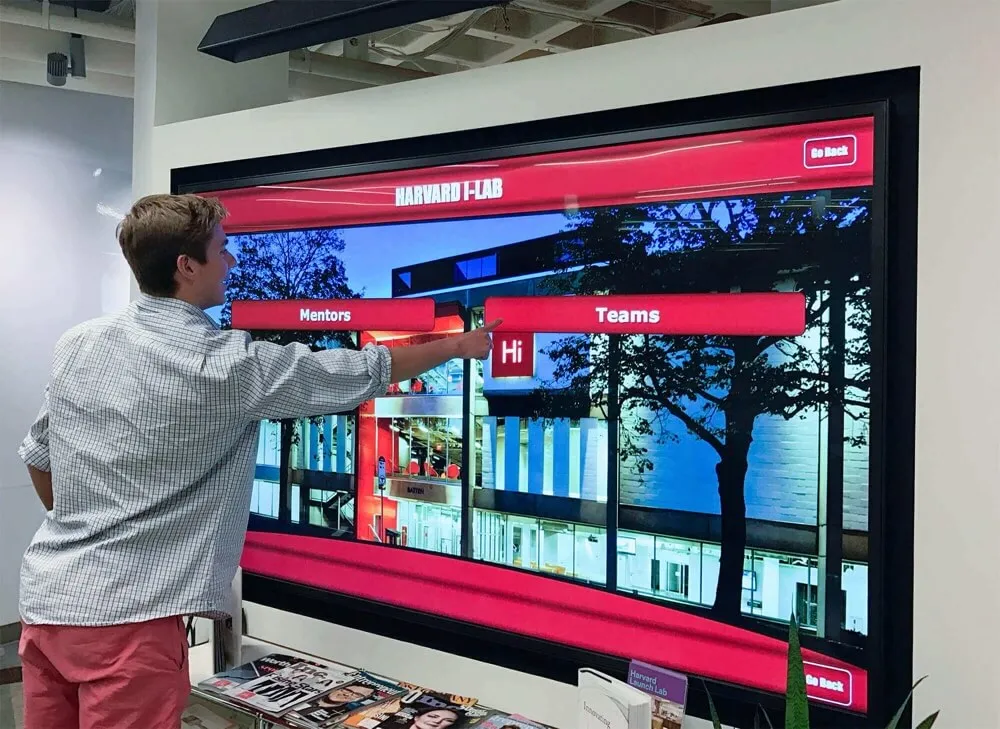
Interactive touchscreen displays positioned near physical banner installations serve as natural extensions of the physical recognition environment. A visitor standing in a gymnasium where 40 championship banners hang overhead can tap a touchscreen to see photos, rosters, and statistics from any of those championships. The screen doesn’t replace the banners; it adds depth that cloth and grommets can’t provide.
Touchscreen systems designed for this purpose allow:
- Browsing by sport, year, or coach so visitors navigate directly to championships they care about
- Athlete profile pages connected to championship seasons — so a student can search a grandparent’s name and see what they won and when
- Side-by-side season comparisons showing how consecutive championship teams relate to each other
- Automatic updating when new championships are added, without hardware changes or new banner orders
For a closer look at how digital recognition integrates with physical championship banner programs, digital banner recognition and championship banners covers how physical and digital systems complement each other in practice.
The gym-specific perspective on this integration is explored in championship banners for gyms and digital recognition approaches.
See How Schools Are Solving the Banner Space Problem
Rocket Alumni Solutions builds interactive touchscreen displays specifically for school athletic departments — digital platforms that preserve the complete championship record, including every banner you’ve ever hung and every title yet to come.
Digital Archive Access Beyond the Building
One underappreciated advantage of digital championship archives is remote access. Physical banners exist only for people standing in your gymnasium. A digital archive is accessible from anywhere.
Alumni who graduated decades ago can review the championship record from their senior year without driving back to campus. Parents of current athletes can show family members what this year’s championship means in the context of program history. Recruits considering your program can review the historical record before their first campus visit.
This accessibility multiplies the recognition value of every championship on record. A 1987 state title that currently lives as a faded banner visible only during home games becomes a searchable, shareable record that alumni anywhere can find.
The full potential of digital recognition for championship banner programs is outlined in championship banners and digital recognition solutions for schools.
Designing Your Championship Banner Display System
Whether you’re starting fresh or systematizing decades of accumulated recognition, a few design principles apply across both physical and digital approaches.
Establish Clear Visual Hierarchy
Not all championships carry equal weight. A state title earned against the full competitive field means more than a conference championship, which means more than a league title. Your display system should communicate this hierarchy clearly.
Recommended approach:
- Dedicate the most visible physical locations to state and national titles
- Use larger banner sizes or more prominent design elements for major titles
- In digital systems, feature major championships prominently on the landing screen while full records require a tap to explore
- In hallway or overflow displays, arrange sport sections with major titles nearest to the main gymnasium entrance
A display system that treats all championships equally inadvertently suggests they are equivalent. Visual hierarchy respects what’s genuinely significant.
Plan for Growth from Day One
Every display system — physical or digital — should be designed with growth in mind. Physical systems need predetermined expansion paths. Digital systems need content management workflows that allow adding new championships in minutes.
For physical systems: identify all potential banner locations across your facility before installing anything. Assign locations in advance rather than searching for open space after each new championship. Know which spaces are reserved for which sports, and which remain available for future expansion.
For digital systems: establish a data standard for championship records before adding the first entry. Decide which fields are required (sport, year, championship type, record) and which are optional (photos, video, full roster). A consistent data structure makes the archive navigable and ensures that adding championship number 100 is as straightforward as adding number one.
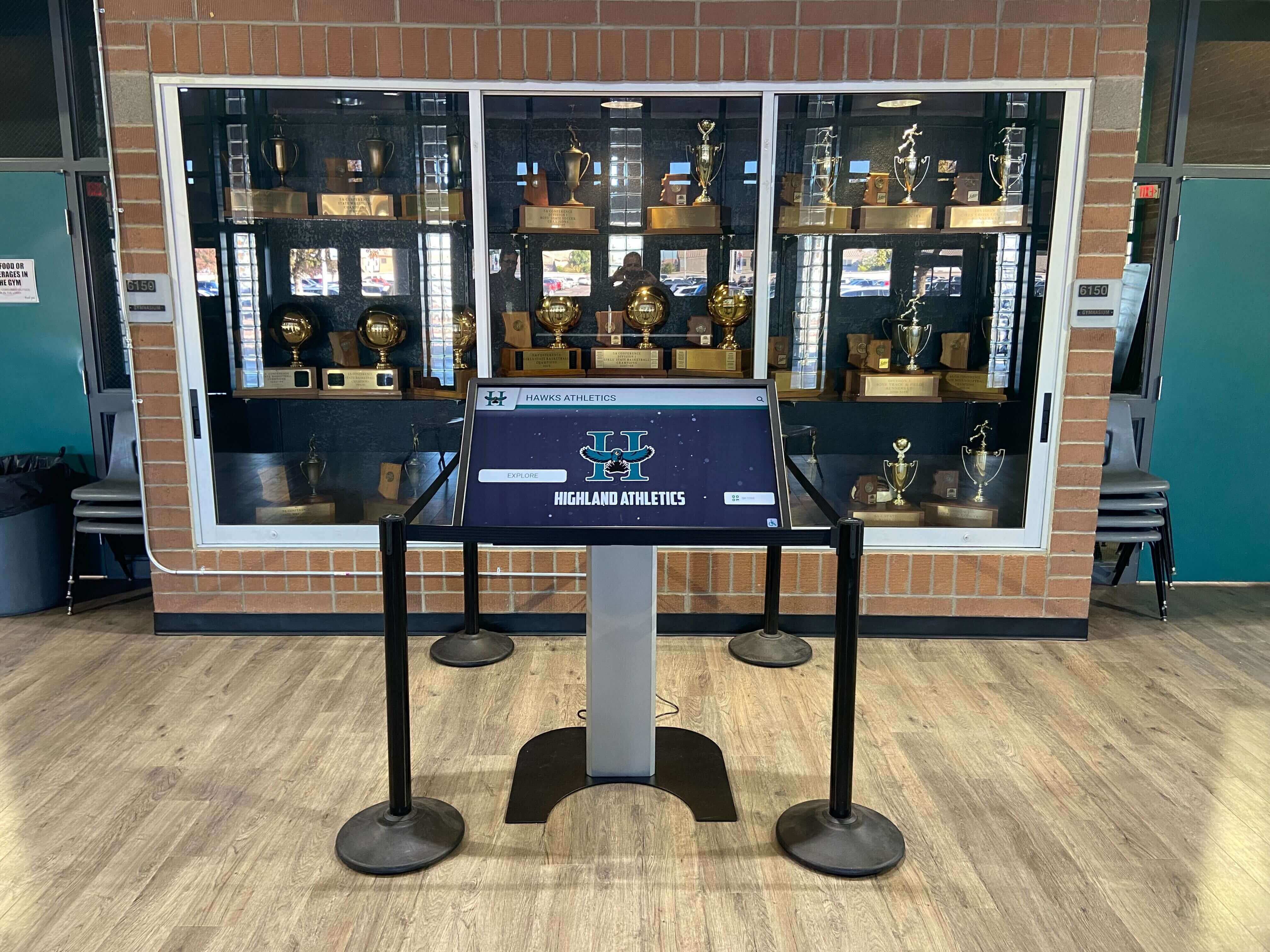
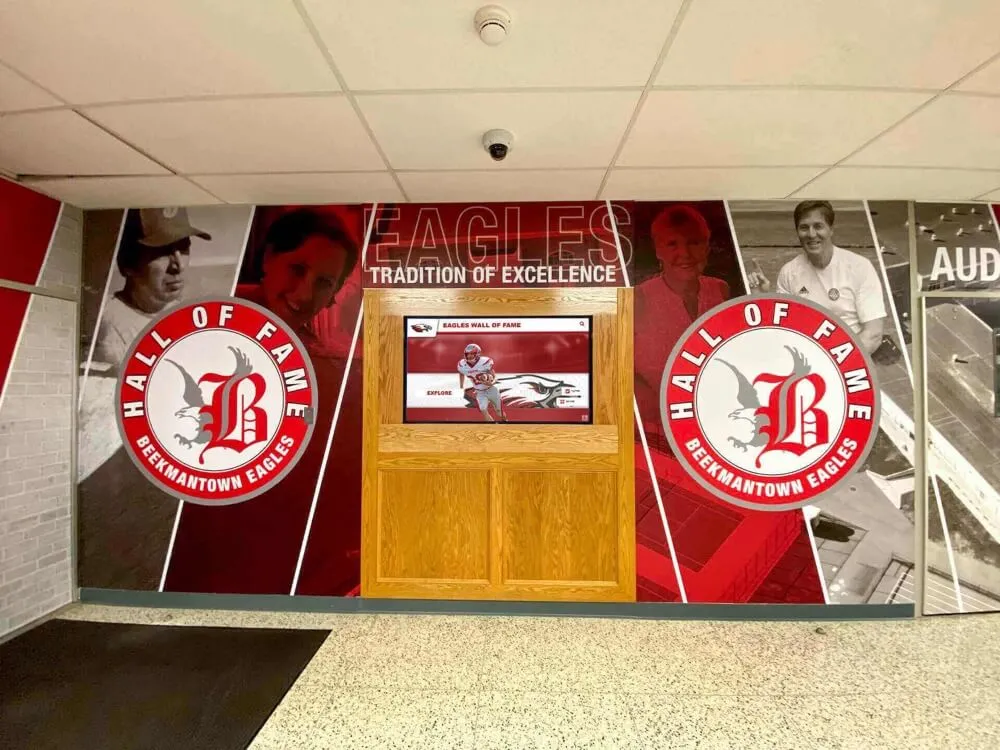
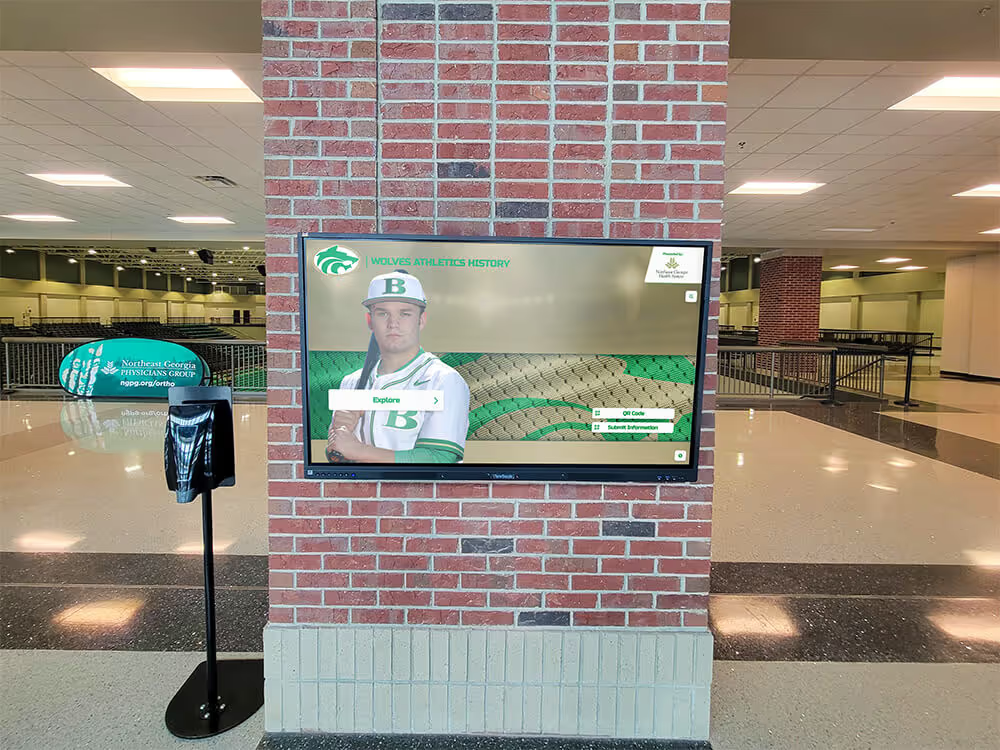
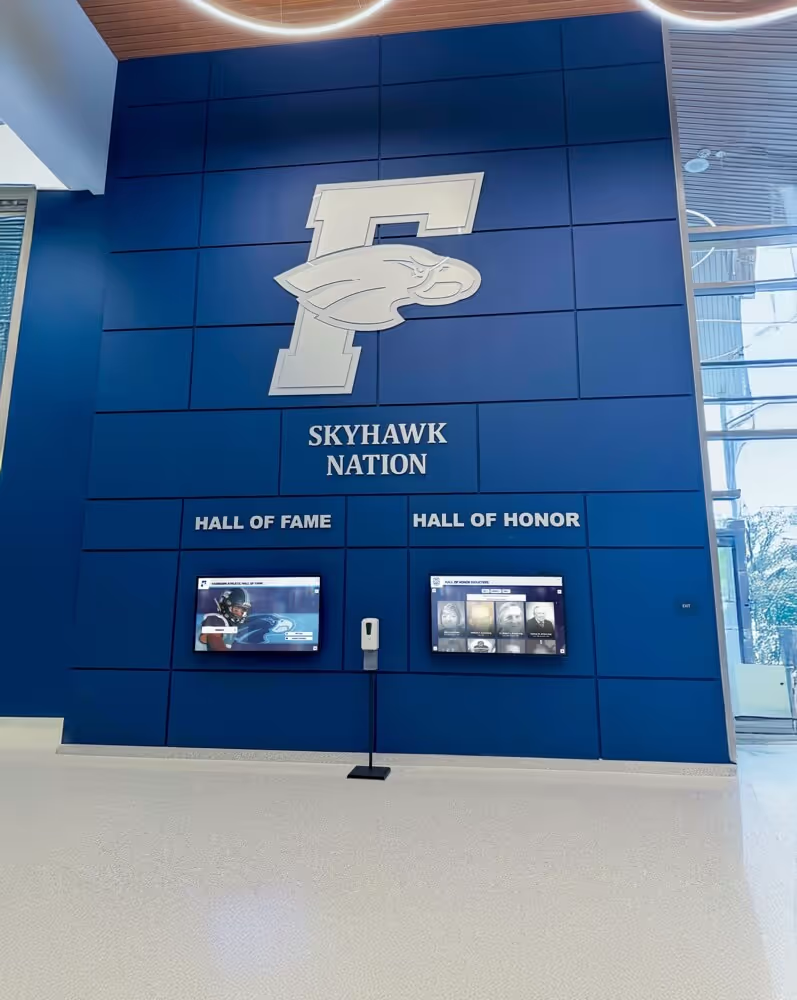
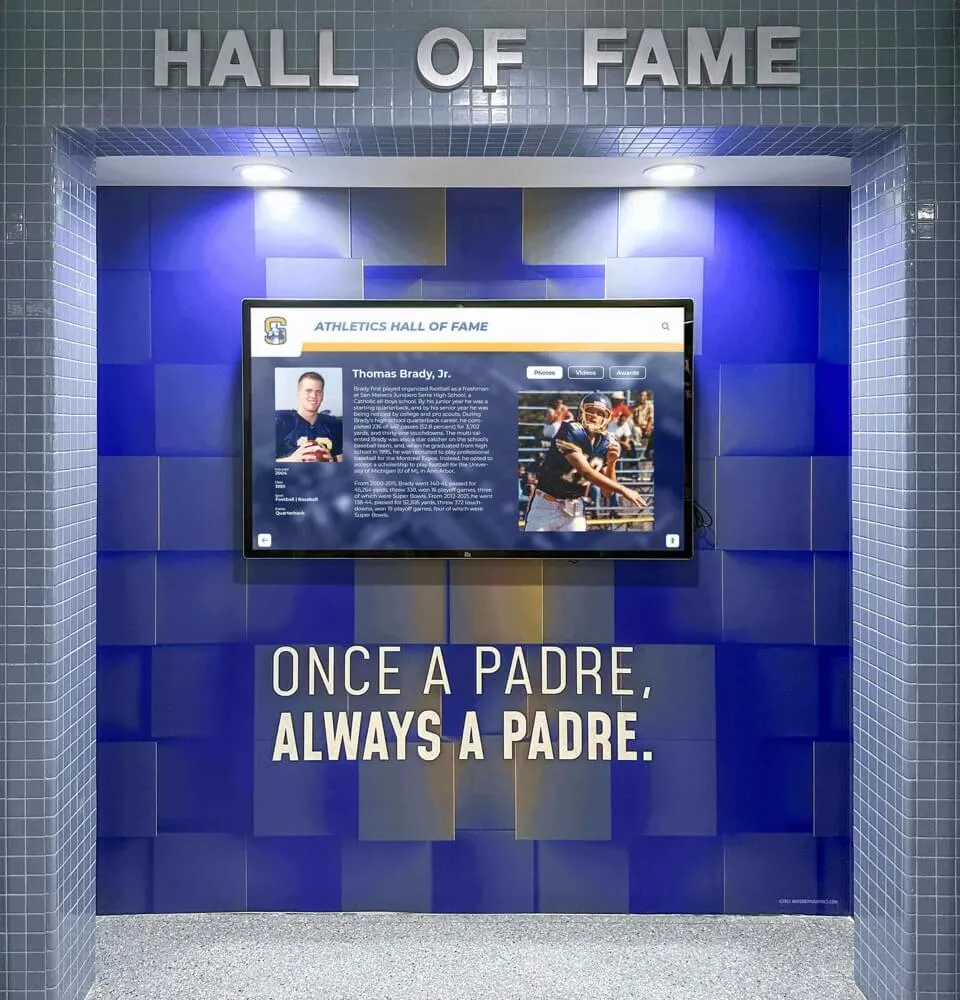
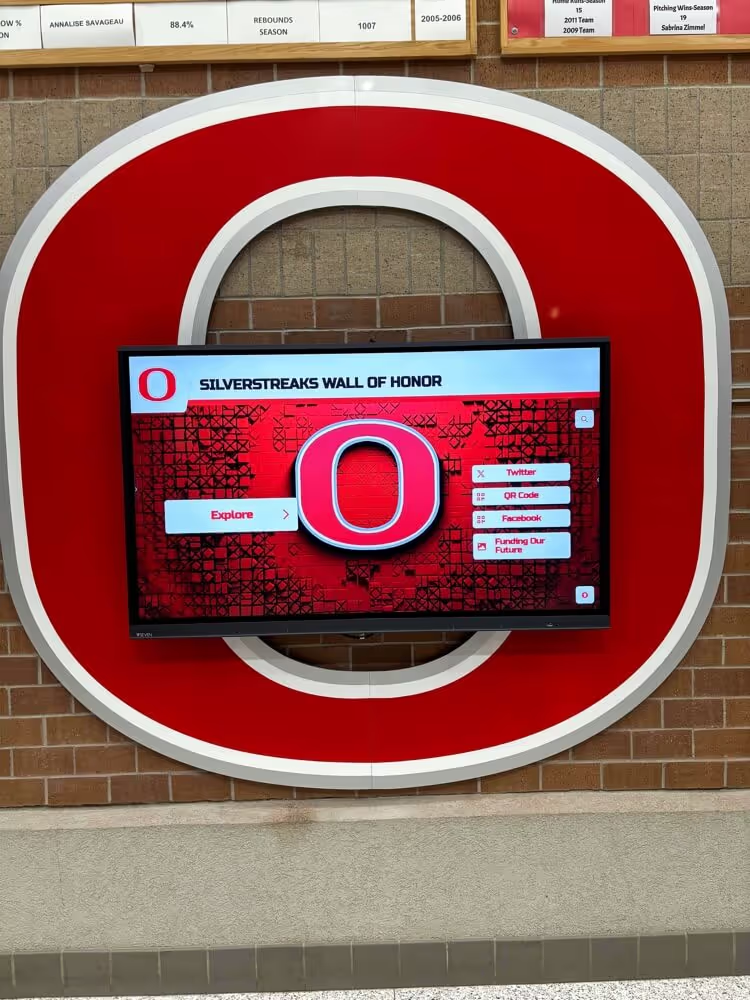
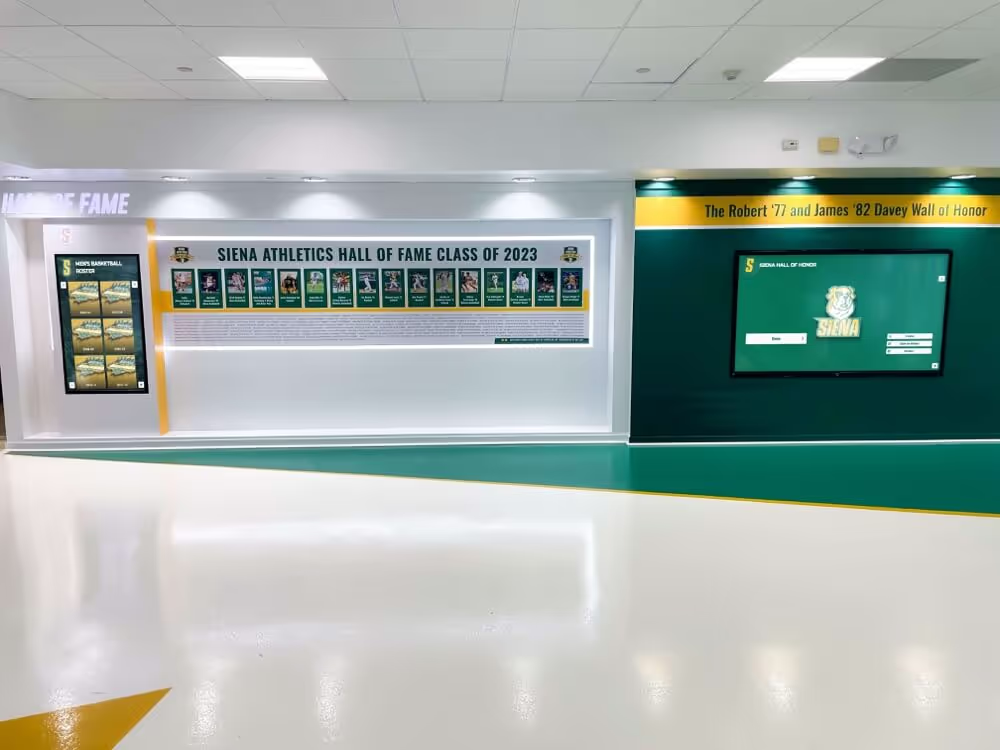
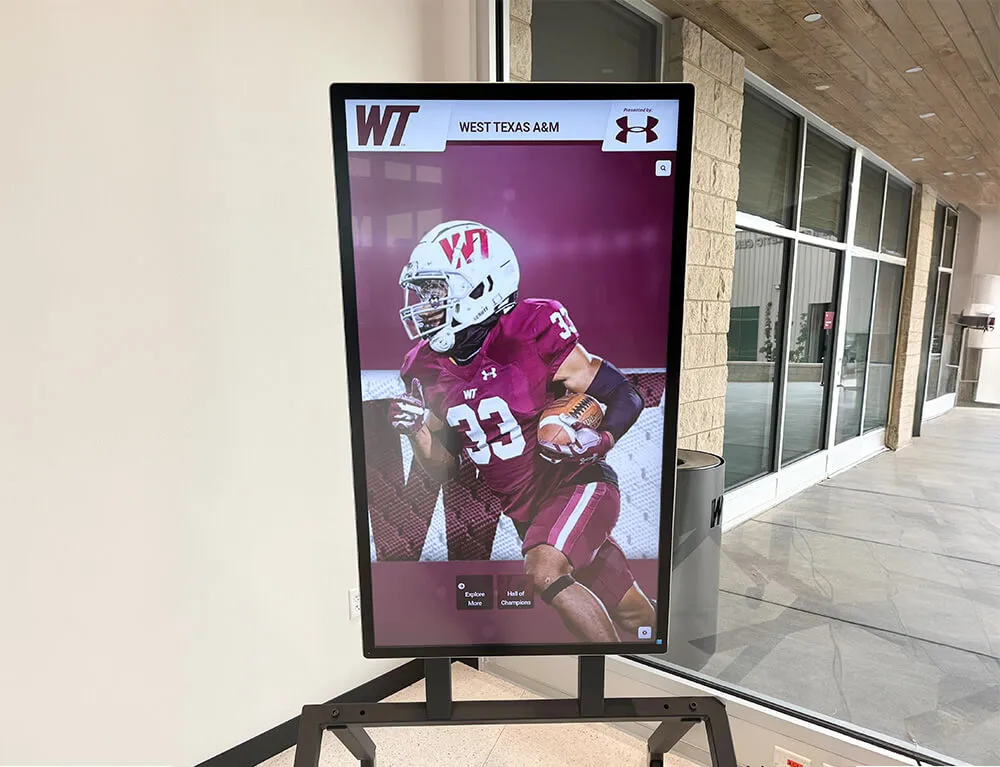
Touchscreen kiosks within trophy case environments bridge the physical tradition of championship display with unlimited digital depth and searchability
Involve Your Athletic Community
The most durable championship display systems are built with input from coaches, athletes, and alumni — not just facilities managers and administrators. A display that feels like an expression of athletic culture generates more pride and engagement than one that feels like a compliance exercise.
Practical ways to involve the athletic community:
- Survey coaches on which sports feel underrepresented in current displays
- Interview alumni athletes on what they wish had been preserved from their championship seasons
- Ask current students what they actually look at versus what exists purely for adult visitors
- Consult the most tenured coaching staff on historical context that isn’t captured anywhere in writing
This input often surfaces priorities that administrators wouldn’t have identified independently — a program with a remarkable consecutive-titles streak deserving special visual treatment, a coaching milestone worth honoring alongside team records, or an era of success that alumni still celebrate but younger students don’t know about.
A step-by-step approach to designing and ordering custom championship banners — including community engagement in the design process — is covered in how to design, order, and display custom championship banners for team victories.
Connecting Championship Banners to the Broader Recognition Environment
Championship banners don’t exist in isolation. They’re part of a larger athletic recognition ecosystem that includes trophies, plaques, record boards, hall of fame displays, and digital recognition systems. The strongest implementations treat all these elements as parts of a coherent whole.
Integration with Athletic Hall of Fame Programs
Schools with formal athletic hall of fame programs have a natural opportunity to connect individual recognition with team recognition. A hallway display that shows a hall of fame inductee’s profile alongside the championship banner from their title season creates context for both.
Digital systems handle this integration particularly well — an athlete profile page can link directly to team championship records they contributed to, and a championship season page can link to hall of fame inductees from that team. Navigation becomes cross-referential rather than linear, making it easy for visitors to follow connections across the historical record.
Record Board Integration
Championship banners tell you who won what. Record boards tell you how good they were. Both matter, and proximity matters — placing record boards near championship banner displays invites visitors to understand championships in the context of performance.
A gymnasium wall that displays championship banners on one side and individual and team records on the adjacent wall creates a complete picture of program excellence. Visitors understand not just that a program won, but what winning looked like statistically across different eras.
Seasonal Updates and Maintenance Schedules
Physical championship banner displays require periodic maintenance that most schools underinvest in. A simple annual audit addresses the most common deterioration issues:
- Check all mounting hardware for corrosion or loosening
- Inspect banner material for fading, fraying, or tearing
- Clean accumulated dust and debris from banner surfaces
- Photograph every banner in current condition for the digital archive
- Replace any banners that have deteriorated beyond legibility
Digital archives require different maintenance: ensuring new championships are added promptly after they’re won, verifying that photo and video links remain active, and periodically reviewing content for accuracy and completeness as coaching staff and historical records are updated.
A combination of physical maintenance discipline and regular digital updates ensures the championship recognition environment improves with time rather than slowly deteriorating into a collection of faded cloth and outdated records.
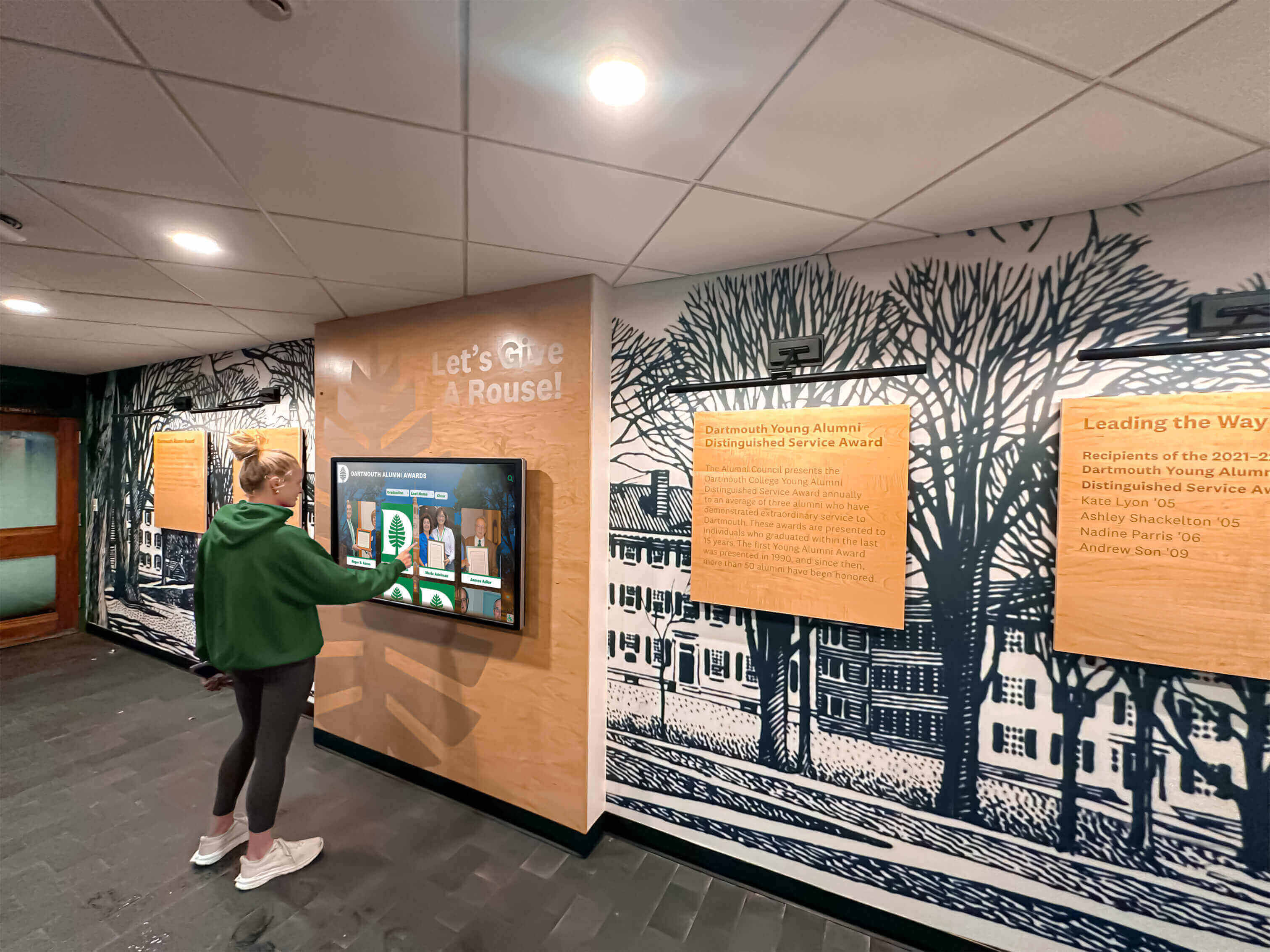
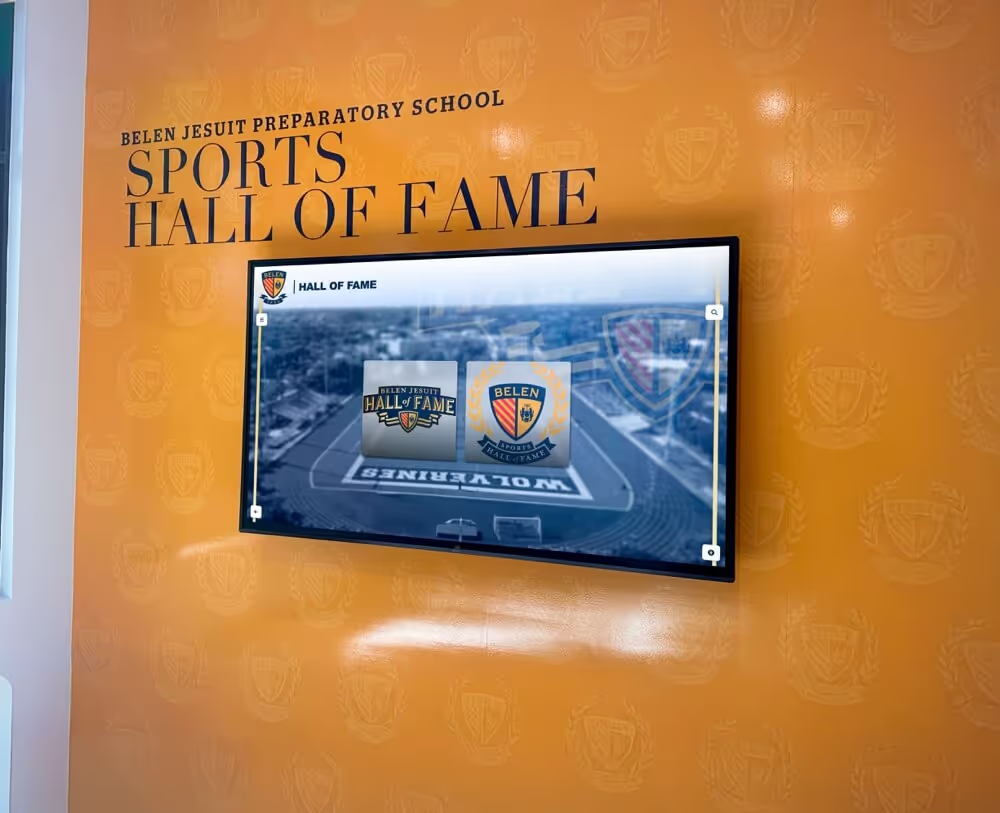
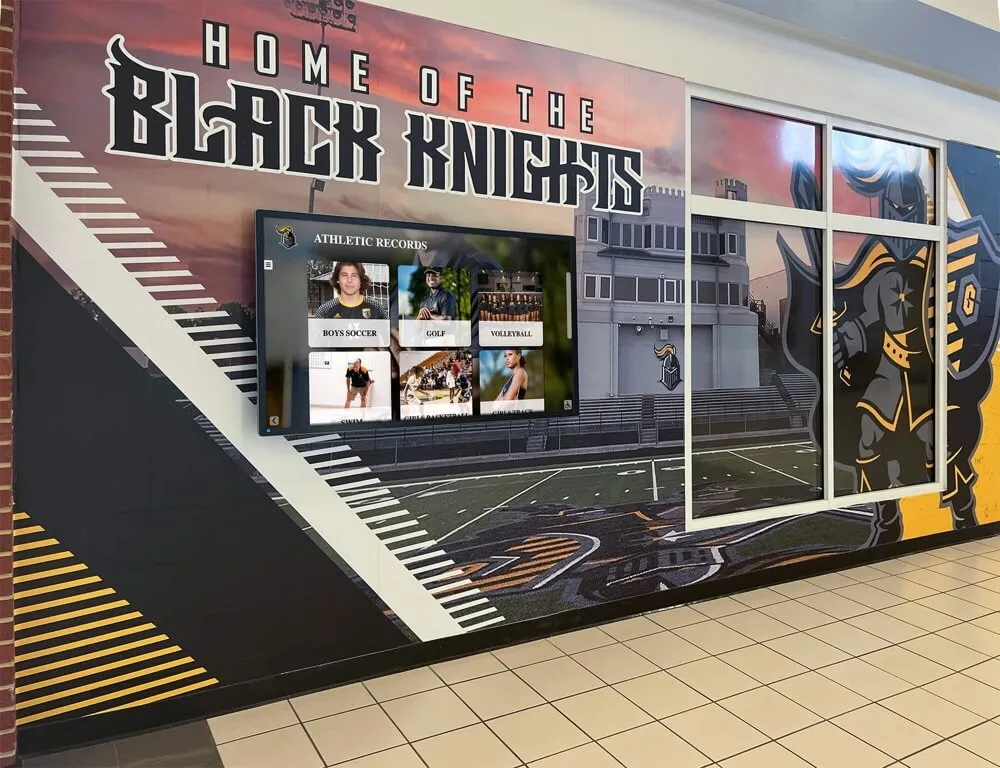
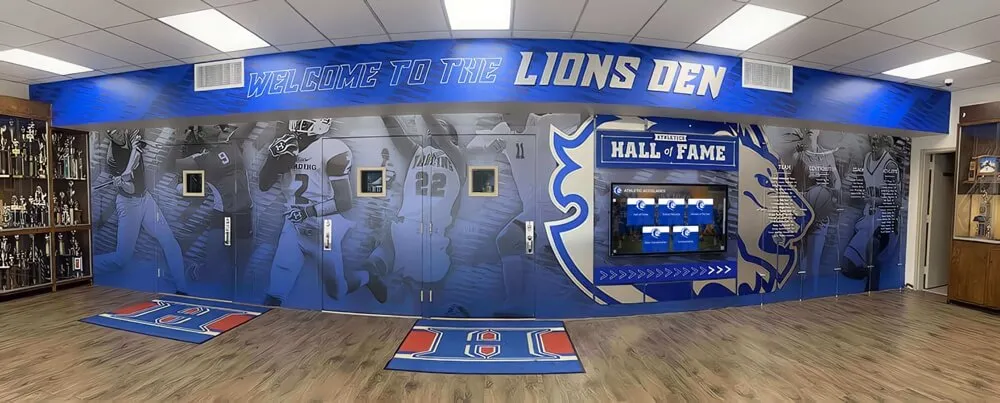
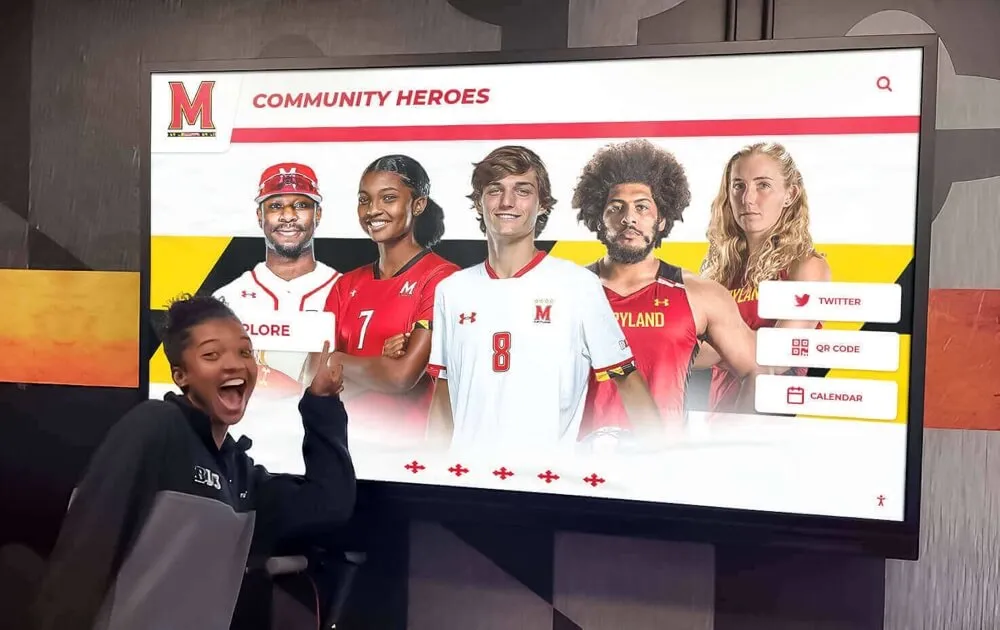
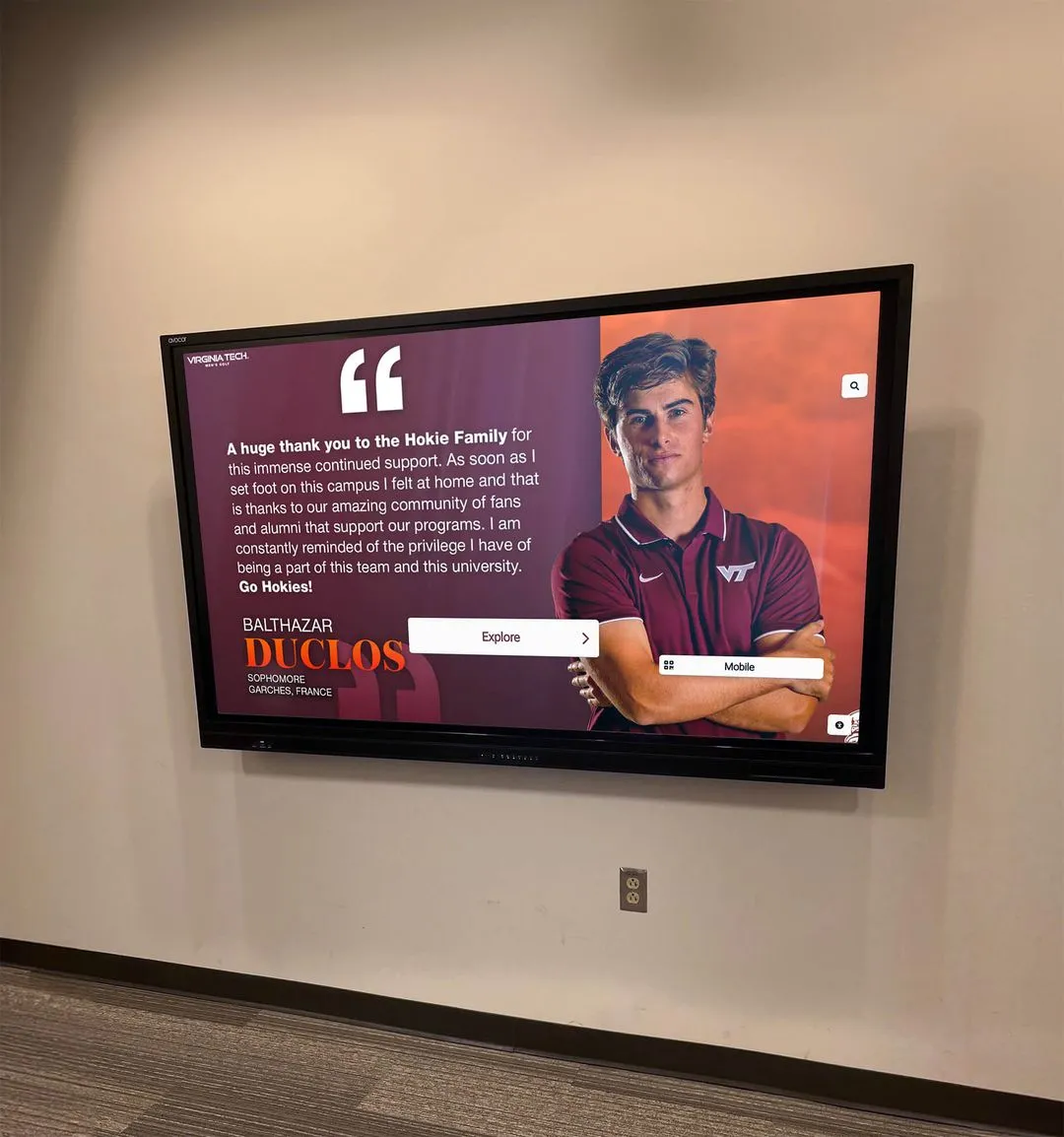
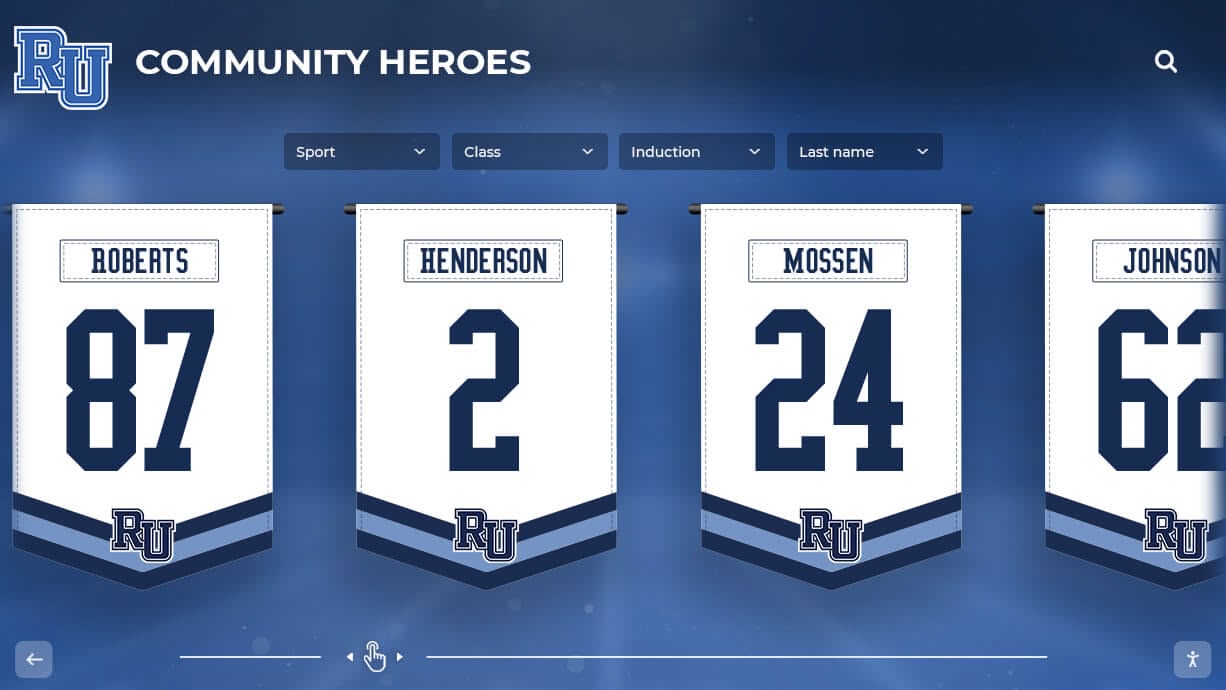
Students who can interact with digital championship archives develop a stronger connection to program history than those who can only observe static banners from a distance
The connection between ongoing maintenance and the broader challenge of managing gym wall space is explored further in championship banners for gyms — display considerations and design options.
Choosing the Right Solution for Your School’s Stage
Schools at different stages of their championship recognition journey need different solutions. A practical framework:
Early-stage programs (under 20 total championships across all sports): Focus on physical banners with a standardized template. The space problem is years away. Invest in quality materials and consistent design rather than digital systems you don’t yet need.
Mid-stage programs (20–60 championships): Physical banners remain the core, but digital archive development becomes worthwhile. Begin documenting the complete historical record — sport, year, championship type, roster — even if the digital presentation remains minimal. Creating the data now is far less work than recreating it later from institutional memory.
Mature programs (60+ championships, approaching wall capacity): Overflow planning becomes urgent. Evaluate physical expansion options alongside digital touchscreen systems. The investment in interactive digital recognition delivers compounding returns as the championship record continues growing.
Legacy programs (decades of sustained success, multiple sports): Digital archives are no longer optional — they’re the only viable solution for honoring the complete record. Physical banners remain for emotional and traditional reasons, but the depth of the program’s history lives digitally, accessible to anyone regardless of whether they can attend a home game.
Conclusion: A Championship Banner Display System That Grows With Your Program
The best championship banner display isn’t the most elaborate or the most expensive — it’s the one that continues working as the program grows. Physical banners create the emotional texture of athletic tradition: the sight of 40 banners hanging in a gymnasium on a Tuesday afternoon, nobody else around, communicates something important about a school’s athletic culture without a word spoken.
But physical banners alone can’t carry the full weight of a successful program’s history. Digital archives ensure that no championship disappears from institutional memory because a gym ran out of ceiling space. Interactive touchscreens invite current athletes, alumni, and visiting families to engage with that history actively rather than observing it passively from the bleachers.
Together, physical and digital elements create recognition environments worthy of the athletes who built them. If your school is approaching — or already past — the point where gym wall space is a constraint, the answer isn’t choosing between physical tradition and digital innovation. It’s building a system that uses both, deliberately and with a plan for everything that comes next.
Ready to Build a Championship Recognition System That Never Runs Out of Space?
Rocket Alumni Solutions designs interactive touchscreen displays for school athletic departments — systems that preserve every championship your programs have ever won, with photos, rosters, and statistics, accessible to anyone who walks through your doors or visits from anywhere in the world.