Athletic Timeline Wall: Building a Visual History of Your School's Sports Program
- Home /
- Blog Posts /
- Athletic Timeline Wall: Building a Visual History of Your School's Sports Program
The Easiest Touchscreen Solution




Live Example: Rocket Alumni Solutions Touchscreen Display
Interact with a live example (16:9 scaled 1920x1080 display). All content is automatically responsive to all screen sizes and orientations.
Walk into a well-designed athletic facility and there is usually a moment where the entire program’s history becomes visible at once. Championship years line up decade by decade. Coaching tenures bracket eras that felt distinct when they happened but now connect into a single arc. Faces of athletes who graduated 30 years apart appear side by side, sharing the same wall, the same school colors, the same identity. That moment—when the whole story of a sports program reveals itself in a single hallway walk—is what an athletic timeline wall makes possible.
This guide is about building that experience: how to gather, organize, and present an athletic program’s complete visual history so that every person who passes through the facility—current athletes, alumni returning for a game, recruits on a campus visit, parents walking their student to practice for the first time—immediately understands the depth of what came before and the legacy they’re now part of.
An athletic timeline wall isn’t just a recognition display. It’s a narrative infrastructure that answers questions visitors ask without always voicing them: Has this program won anything meaningful? Do athletes here get remembered? Is there a real tradition to be part of? A wall that answers those questions convincingly does more for recruiting, alumni giving, and daily school culture than any brochure or website ever could.

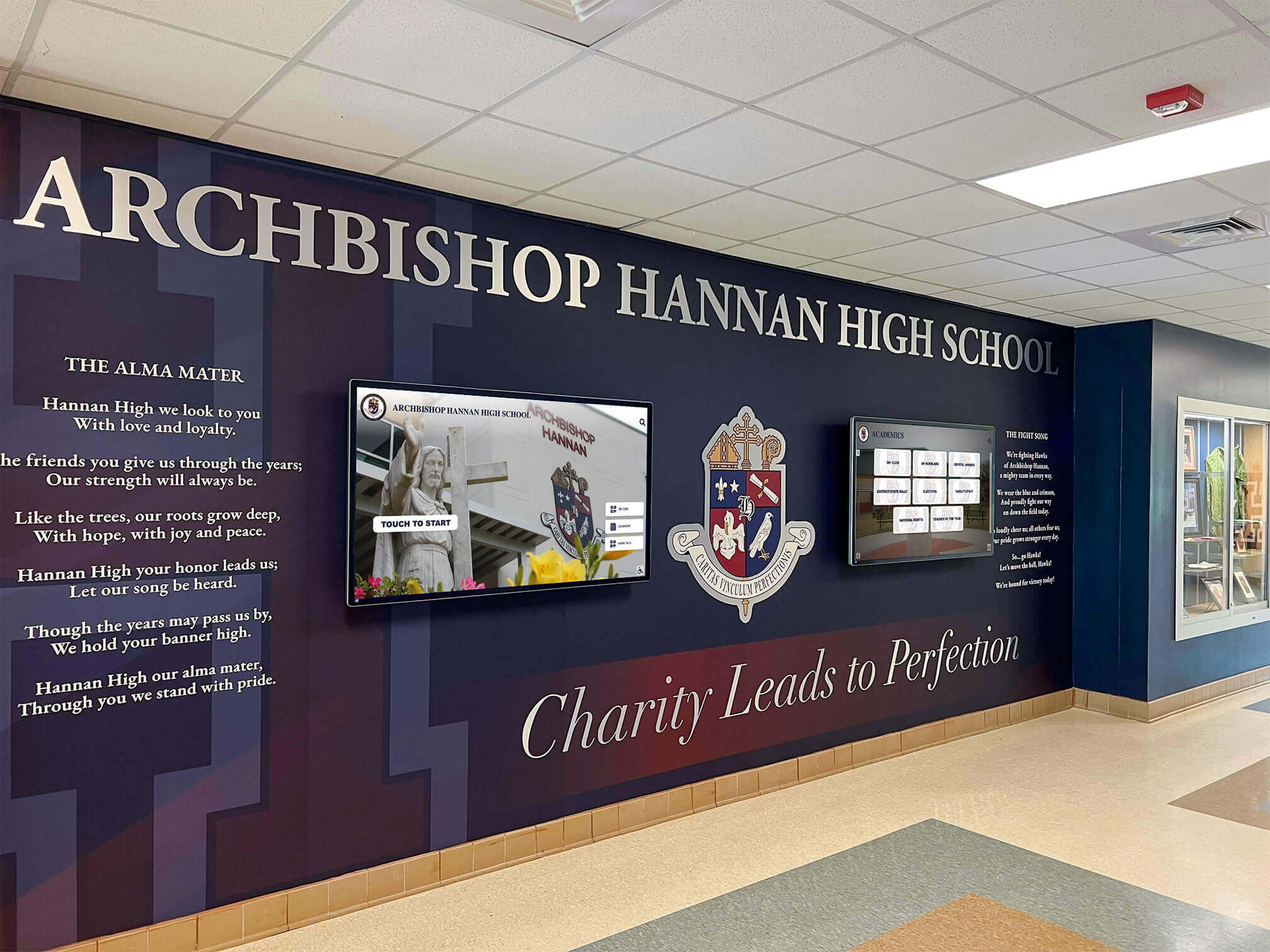
Schools that combine murals, physical signage, and digital screens create lobby environments where the entire program identity reads at a glance—exactly what a great athletic timeline wall achieves
What an Athletic Timeline Wall Captures That Other Displays Don’t
Standard athletic recognition displays—trophy cases, championship banners, hall of fame plaques—answer one question well: “Who were our best?” An athletic timeline wall answers a different and richer question: “How did this program become what it is?”
That distinction changes everything about how content is selected and presented. A trophy case curates greatness. A timeline documents continuity—including the years between championships that form the connective tissue of any real program. The 5-2 season after back-to-back state titles. The coaching transition that took three years to settle before producing the next championship run. The new aquatics facility that opened in 2004 and immediately transformed what the swimming program could accomplish. Those in-between moments are exactly what gives the breakthrough seasons their meaning.
For schools thinking through how physical displays and digital formats divide these storytelling responsibilities, the digital signage for schools complete guide covers how different display formats handle different types of institutional content—useful context for schools building their first comprehensive recognition environment.
The Era-by-Era Story: Content Categories for an Athletic Timeline Wall
Championship and Postseason Milestones
Championship seasons are the natural anchors of any athletic timeline wall—first state title, conference championship years, national tournament appearances. These entries tend to document themselves: trophies exist, photographs exist, newspaper coverage exists. The challenge with championship entries isn’t finding material; it’s choosing which details to highlight when the available documentation is rich.
For programs with extensive championship history, a video walkthrough of the timeline wall would linger on these entries longest—the camera naturally gravitates toward championship banners, trophy displays, and the faces of athletes who lifted the hardware. Building your documentation archive with this visual logic in mind means prioritizing high-quality photography from championship seasons over action-shot coverage of regular-season games.
Coaching Milestones and Program Eras
Long-tenured coaches define programs in ways that championship seasons alone don’t capture. A coach who won 300 games over 25 years created something larger than any individual season: a program culture, a coaching tree, a generation of athletes whose own approaches to competition were shaped by what they learned in that program. Athletic timeline walls that organize eras around coaching tenures—bracketing championship seasons within the careers that produced them—create narrative structure that pure win-loss chronology can’t achieve.
Individual Records and Recognition
State championship individual results, school records that stood for decades before being broken, academic all-state recognitions, athletes who went on to play at the next level—these entries give visitors specific people to connect with across the timeline. An athletic timeline wall without individual anchors reads as institutional rather than personal. Individual entries are what convert a general history display into the kind of wall that an alumnus stops in front of and says, “I played with that kid.”
The high school basketball alumni display guide covers how individual athlete documentation connects alumni identity to program history—an approach directly applicable to basketball within any multi-sport athletic timeline wall.
Program-Defining Moments Beyond Wins and Losses
Not every entry on an athletic timeline wall represents a championship. Programs are also defined by the year they added a sport, the capital campaign that funded a new athletic facility, the first year of Title IX compliance that doubled the number of varsity programs, the season that ended with a heartbreaking loss that the entire school still talks about. These context entries give the timeline its texture and help visitors understand why the program developed as it did.

University athletic halls of fame that layer murals and digital screens can accommodate decades of program history across multiple sports without overwhelming any single display element
Building the Era-by-Era Documentation: A Research Guide
The documentation phase of building an athletic timeline wall almost always takes longer than the design phase. Schools consistently underestimate this. A program with 60 years of history across 15 sports generates thousands of potential entries before any curation begins. Getting that material into organized, usable form requires deliberate research across multiple source types.
Yearbooks provide the most consistent year-by-year coverage, with photos, rosters, season records, and individual award documentation that official records often don’t capture in the same format. Yearbooks from the 1950s through the 1980s may be in physical form only, requiring scanning before they can be used in any digital display context.
The digitizing old yearbooks guide for hall of fame displays covers the full process of converting physical yearbook collections into digital archives—the foundational step for any school building an athletic timeline wall that extends more than two decades into the past.
Local newspapers often have more detailed game-by-game coverage and championship reporting than school archives, particularly for programs whose newspaper coverage was stronger than their own documentation. Many regional papers have digitized archives going back to the 1970s and 1980s. For earlier decades, microfilm at local libraries may be the primary source.
Coaching staff institutional memory is frequently the most efficient way to fill documentation gaps. Long-tenured coaches carry records, stories, and historical context that exist nowhere in writing. An interview with a retired coach who spent 20 years in the program is often worth more than a week of archive research.
Alumni networks surface photographs and personal records that institutional archives missed entirely. Reaching alumni through social media reunion groups, booster club networks, or formal alumni outreach consistently surfaces material—particularly photographs—from the eras that are hardest to document through official channels.
Static, Digital, or Interactive: What Visitors Actually Experience
The format of an athletic timeline wall shapes the visitor experience in ways that go beyond aesthetics. The format determines what questions the wall can answer, how long visitors engage, and how the display responds to the program’s ongoing history.
Static printed timelines provide permanent visual richness—a well-designed printed timeline with large-format photography and professional typography creates an immediate visual impact that screens rarely match in the same space. The trade-off is inflexibility. Adding new entries requires reprinting panels, and the design language that looks current in year one may feel dated in year ten.
Digital signage timelines solve the update problem but introduce hardware dependencies. A screen that fails during an alumni event creates a worse impression than a static display would. For schools navigating these trade-offs, the trophy case ideas and creative display guide covers how physical award presentation can complement digital elements in the same recognition environment.
Interactive touchscreen timelines offer the deepest visitor engagement and the most flexible content architecture. A visitor who graduated in 1988 can navigate directly to their era. A recruit visiting for the first time can explore the full history at their own pace. A parent watching their student play for the first time can find the program’s founding story before the game starts.
For schools selecting between interactive display platforms, the best digital showcase platforms for 2025 evaluates current options against the specific needs of athletic programs—useful context for schools moving beyond static displays.
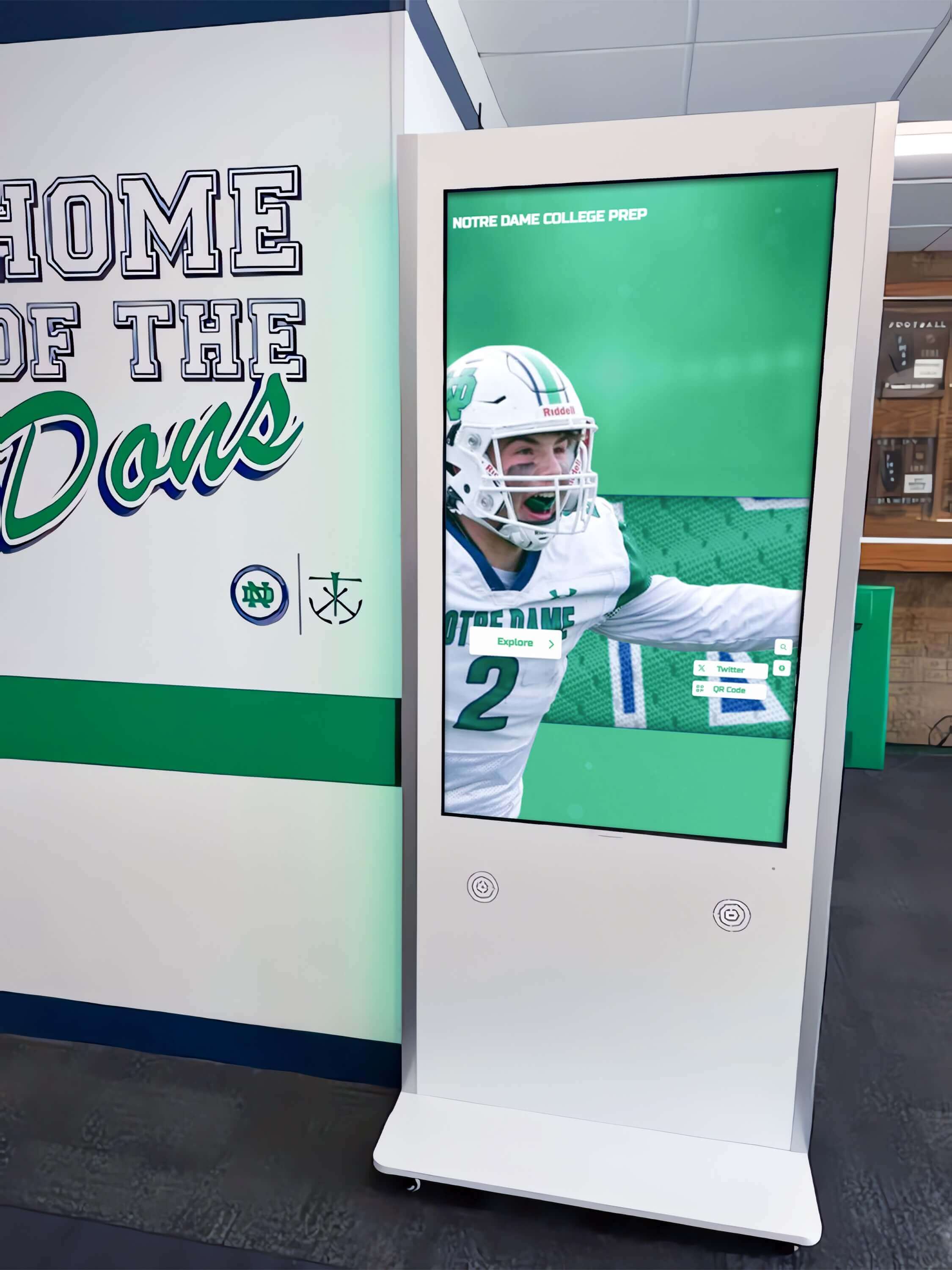
Dedicated interactive kiosks in athletic hallways allow visitors to navigate program history at their own depth and pace—an experience that static displays cannot replicate
Designing the Touchscreen Athletic Timeline Wall Experience
When an athletic timeline wall goes interactive, the design challenge shifts from layout to navigation. Visitors bring different starting points to the same display—a 1994 graduate wants to find their senior year immediately; a curious freshman wants to understand the program’s founding; a visiting team’s assistant coach is scanning for context about what kind of program they’re facing. The navigation needs to serve all of them without requiring any of them to read instructions.
Era-Based Navigation
Dividing the timeline into selectable decades or coaching eras allows visitors to skip directly to the period most relevant to them. This is the most universally intuitive navigation structure for athletic timelines because it mirrors how people already organize their memories: “I was here in the 80s” or “that was during Coach Miller’s era.”
Individual Athlete Profiles
Tapping a championship year or milestone entry opens depth content: full roster from that season, individual statistics, photographs, coaching notes, and connections to athletes whose careers spanned multiple years. This depth layer is what converts a timeline from a summary display to a genuine archive.
The design principles for touchscreen experiences that drive user engagement covers how touchscreen interface design decisions—menu hierarchy, tap zones, visual feedback—affect how long visitors engage with institutional history content. Those principles apply directly to athletic timeline navigation.
Video Integration
Championship game highlights, coach interview archives, alumni testimonials recorded at reunions—video content embedded in the timeline transforms it from a record of what happened into an experience of what it felt like. Current athletes watching a highlight reel from a team 30 years before them develop a relationship with the program’s legacy that no text-and-photo entry can achieve.
Cross-Sport Filtering
Multi-sport programs benefit from filtering that allows visitors to isolate specific sports from the full timeline. The swimming program’s alumni don’t need to navigate through football entries to find their history; a filter that surfaces only swimming milestones serves them directly. For high school programs with 15–20 varsity sports, this functionality transforms the athletic timeline wall from an architecture that privileges the largest programs into one that gives every sport its own navigable history.
For schools thinking through which hardware best supports these interaction types in a school facility environment, the best touchscreen displays for schools guide addresses the hardware considerations—screen size, touch technology, mounting options—that determine whether interactive navigation feels fluid or frustrating.
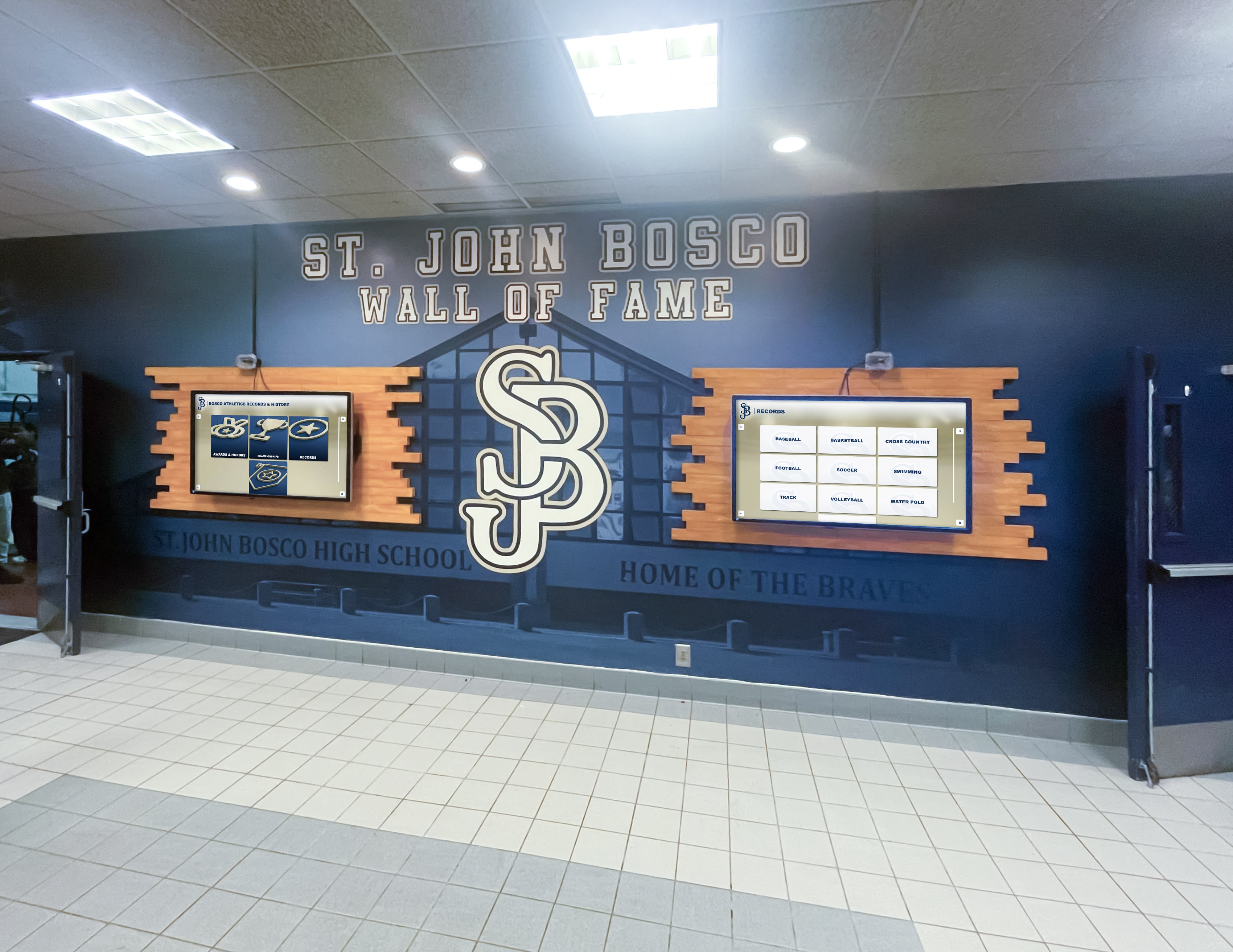
Multi-screen hallway configurations allow programs with deep athletic histories to distribute content across sports and eras without overwhelming any single display
Video Walkthrough: What the Camera Reveals About Athletic Timeline Walls
A video walkthrough of an athletic timeline wall shows things that still photography misses: the scale of the hallway, the sequence in which visitors encounter entries, the way a touchscreen responds to a finger tap, the moment an alumnus finds their name in the archive. These are the details that convert a skeptical administrator from “tell me about it” to “I understand what this is.”
Effective video documentation of an athletic timeline wall follows a predictable structure:
The hallway approach shot establishes context—the viewer understands how the wall fits within the athletic facility, how much wall space it occupies, how it reads from 20 feet away before visitors move in closer.
The era-by-era pan moves chronologically across the timeline from the program’s founding to the present, revealing how the visual design holds together across decades of documented history.
The interaction demonstration shows a hand navigating the touchscreen—tapping a championship year, opening an athlete profile, scrolling through a roster, playing an embedded highlight clip. This sequence answers the question that most viewers have but don’t ask: “How hard is it to use?”
The alumni reaction moment is the most powerful shot when it’s available—a person finding themselves in the archive, recognizing a teammate’s photo, reading a record they helped set. This shot communicates the emotional value of the display more effectively than any specification sheet.
For schools interested in how interactive touchscreen storytelling works specifically for athletic and recognition content, the interactive touch screen TV for schools recognition storytelling guide covers the content and production principles that make video demonstrations of recognition displays compelling rather than merely informational.
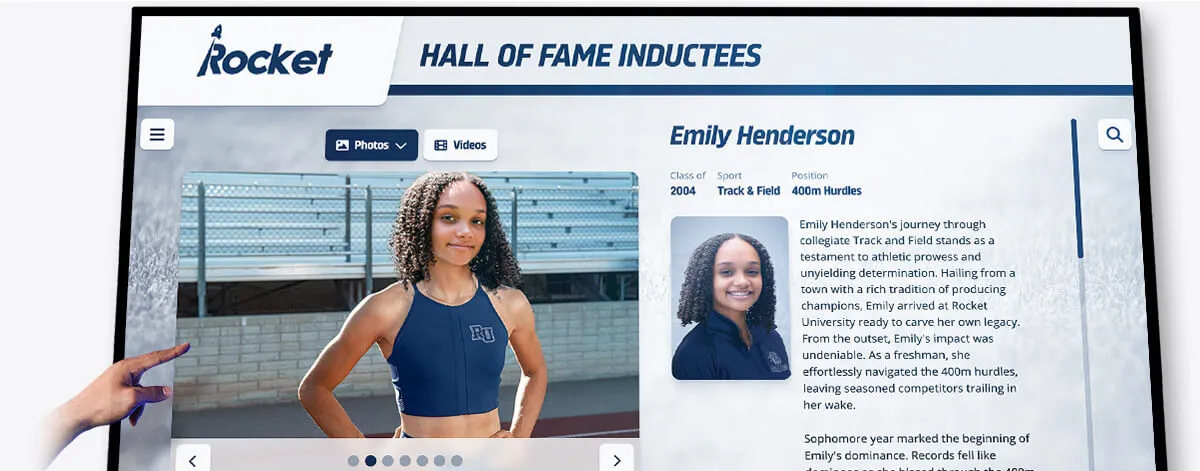
Individual athlete profiles accessible from the timeline give visitors names and faces to connect with across program history—and give alumni a personal stake in the display every time they visit
How Athletic Timeline Walls Serve Recruiting, Alumni, and Donors
Recruiting
A prospective student-athlete walking through a facility with a well-maintained athletic timeline wall receives a message that no recruiting pitch can deliver as directly: athletes who commit to this program get remembered here. The documentation on the wall demonstrates that the school values what its athletes accomplish—not just during championship seasons, but in every era of the program’s history.
Fall sports programs, where recruiting cycles and alumni events often overlap during the school year, benefit particularly from timeline walls that document their most competitive seasons. The high school fall sports championships guide covers championship recognition approaches that translate well to athletic timeline documentation for fall sports programs with significant postseason histories.
Alumni Engagement
The emotional power of an athletic timeline wall comes into full effect when alumni return. A graduate who played in the 1990s finds their championship team on the wall, sees their coach’s name in the coaching tenure section, recognizes teammates they haven’t thought about in decades. That moment generates the kind of institutional loyalty that drives annual giving, reunion attendance, and volunteer mentorship.
Schools that host events specifically oriented around the athletic timeline wall—alumni nights where former athletes are invited to navigate their era on the touchscreen, see their names in the archive, and share their memories with current student-athletes—report that the wall becomes a focal point for exactly the alumni-student connection that most programs aspire to but rarely achieve through formal programming.
Donor Recognition Integration
Athletic timeline walls that document the facility investments tied to each era—naming the capital campaign that funded the weight room renovated in 2010, acknowledging the donor family whose gift made the turf field possible in 2015—create a direct visual link between philanthropy and program history. Donors who see their contributions woven into the timeline’s narrative rather than acknowledged on a separate plaque experience a different relationship to the institution.
Building Your Athletic Timeline Wall with Rocket Alumni Solutions
Schools that want their athletic timeline wall to grow with the program—rather than requiring full redesigns every few years—increasingly choose interactive touchscreen platforms where the content is managed separately from the hardware. When a team wins a championship in November, the timeline updates before winter break. When a senior earns all-state recognition in the spring, her entry is added before graduation.
Rocket Alumni Solutions builds interactive touchscreen recognition systems designed specifically for school athletic programs. The platform supports era-based timeline navigation, individual athlete and team profiles, video content integration, and cross-sport filtering—the full architecture of a living athletic history archive. For schools with existing mural or banner displays they want to preserve, Rocket integrates as the digital depth layer that sits alongside the physical installation.
Explore how Rocket Alumni Solutions builds interactive athletic timelines.
Maintaining the Athletic Timeline Wall: The Update Cycle That Keeps It Alive
The most common failure mode for athletic timeline walls is becoming a beautiful time capsule—comprehensive through the year of installation, increasingly incomplete as seasons accumulate afterward. The display that ends at the most recent championship communicates something unintended: the program stopped caring about documentation at some point.
Preventing this requires building the update workflow into the initial installation plan rather than treating it as a future concern. The update cycle should be annual at minimum, tied to a specific calendar point—end of school year, start of fall sports season, annual athletic banquet—so the content steward knows exactly when additions are expected and what the documentation process requires.
The content steward role itself needs to be clearly assigned. In larger schools, this is typically an athletic director or communications staff member. In smaller schools, a designated booster club committee member often owns the documentation and update process. What matters is that someone has explicit responsibility for keeping the timeline current, with access to the content management system and a clear understanding of the entry criteria.
Conclusion: The Athletic Timeline Wall as a Living Program Document
The best athletic timeline walls aren’t retrospective displays. They’re living documents that grow in real time with the programs they represent. When the content management workflow is established, the documentation habits are in place, and the display is designed for ongoing updates rather than a single installation moment, the timeline becomes something genuinely rare in school recognition: a display that is always accurate, always current, and always expanding.
Every visitor who walks down that hallway—the recruit wondering whether to commit, the alumnus returning after 25 years, the freshman walking to practice for the first time—encounters the same message: this program has been building something for a long time, and what you’re doing right now is part of it.
That continuity is what separates a school with athletic memorabilia from a school with a sports legacy.
Ready to build an athletic timeline wall that grows with your program?
Rocket Alumni Solutions designs interactive touchscreen recognition systems for schools and universities—platforms that make your complete athletic history navigable, searchable, and always current. See what a touchscreen athletic timeline wall looks like in practice.
Live Example: Rocket Alumni Solutions Touchscreen Display
Interact with a live example (16:9 scaled 1920x1080 display). All content is automatically responsive to all screen sizes and orientations.