



Wow and flutter are pitch-instability artifacts introduced during recording or playback by a tape transport that does not move tape at a perfectly steady speed. Wow describes slow, cyclic pitch variations—typically at rates below six cycles per second—caused by gradual irregularities in the capstan motor or tape-hub tension. Flutter describes faster pitch variations in the range of six to approximately one hundred cycles per second, caused by mechanical vibration in the drive mechanism or uneven friction between the tape and the recording head. Both appear in digitized athletic archives as audio that sounds subtly unsteady—voices that drift in pitch, crowd noise that breathes unevenly, or recorded music that wobbles during ceremony introductions.
An athletic archive wow and flutter correction workflow is a defined sequence for detecting that pitch instability, measuring its severity, applying software correction in the correct order relative to other processing steps, and verifying the result before the recording reaches a touchscreen hall of fame display, a digital trophy case, or a public archive. This guide is written for athletic directors, school administrators, archives staff, facilities and IT teams, and recognition-program owners who are digitizing game tapes, interview recordings, and ceremony audio and need to produce files that sound stable and credible through modern display speakers.
This guide describes practical school-level audio archive workflows. Questions about professional preservation standards or institutional records obligations should be directed to a qualified audiovisual archivist or your district’s records officer.
Wow and flutter are among the least visually obvious defects in a digitized athletic recording. Unlike audio clipping—which shows as flat-topped peaks in any waveform view—pitch instability requires listening rather than looking. A recording that appears clean in a waveform display, with a healthy noise floor and no visible overloads, can still carry significant wow or flutter that makes it sound unsteady and distracting when played through the speakers of a lobby recognition kiosk or an interactive hallway display.
Schools that invest in digitizing their historic game tapes, play-by-play recordings, and hall-of-fame ceremony audio are right to invest in the correction step. A recording that captures a 1984 state championship game or a 1991 coaching retirement speech deserves the technical care that makes it genuinely listenable for the community that comes to experience it.

Historic game recordings and ceremony audio that reach interactive kiosk displays depend on a wow and flutter correction workflow applied before publication—pitch instability tolerable on consumer equipment in 1991 becomes prominently distracting through the full-range speakers of a modern lobby display
What Wow and Flutter Are: Concise Definitions
Wow
Wow is pitch variation at a slow rate—below approximately 6 Hz (six cycles per second). A single cycle of wow might span a half-second to several seconds, producing a gradual rise and fall in pitch that sounds like the recording is slowly warping.
Common mechanical sources of wow in tape-based recordings:
- Worn or irregular capstans: The capstan is the rotating shaft that drives the tape at a controlled speed. A capstan with mechanical irregularities rotates unevenly, producing cyclic speed changes that appear directly as pitch variation
- Dirty or hardened pinch rollers: The pinch roller presses the tape against the capstan. A worn or contaminated pinch roller allows slip, which translates to inconsistent tape speed
- Warped or deformed tape hubs: Off-center or warped supply and take-up reels introduce cyclic tension variation as the tape unwinds, affecting speed at the capstan
- Motor speed instability: The capstan motor’s own speed regulation, particularly in consumer-grade devices, produces wow at the motor’s rotation rate
In athletic archives, wow is most commonly encountered in:
- Consumer VHS recordings made on machines that were heavily used, stored improperly, or had not been serviced
- Audio cassette recordings of play-by-play commentary or coach interviews made on portable recorders
- U-matic (¾-inch) recordings stored in high-humidity conditions, causing oxide softening and irregular tension
- Open-reel recordings made on worn or poorly aligned machines
Flutter
Flutter is pitch variation at a faster rate—typically in the range of 6 to 100 Hz or higher. Rather than a slow warble, flutter produces a roughening or unsteadiness that can sound like a slight buzzing layered onto the program content. Severe flutter in voice recordings blurs consonants and makes speech harder to understand; in crowd audio, it creates a texture that sounds damaged rather than naturally dynamic.
Common sources of flutter:
- Mechanical vibration in the drive mechanism: Bearing wear, loose components, or external vibration transmitted to the tape transport
- Head-contact irregularities: The tape’s contact angle and pressure against the playback head varies if the head is worn, dirty, or misaligned
- Tape edge damage: Crinkled or wavy tape edges cause irregular tension across the tape width during playback
Wow and Flutter Together
Wow and flutter almost always appear together in a degraded tape recording—the mechanical problems that cause one typically cause the other. Most measurement standards (IEC 60386 / DIN 45507) express the result as a combined weighted RMS figure. In practice, distinguishing them matters primarily for diagnosis: a recording that sounds like it is breathing slowly has primarily wow; one that sounds rough or vibrating has primarily flutter. Correction tools address both.
How Wow and Flutter Sound in Athletic Archive Recordings
The perceptible character of wow and flutter depends on the content type:
| Content Type | How Wow Sounds | How Flutter Sounds |
|---|---|---|
| Play-by-play commentary | Announcer’s voice rises and falls in pitch over seconds; long vowels drift | Speech sounds rough or vibrating; consonants blur slightly |
| Crowd noise | Crowd audio has a “breathing” quality; applause peaks sound unsteady | Crowd noise has a textured, machine-like quality at peak moments |
| PA announcements and music | Musical pitches drift; recognizable melodies seem out of tune | Music sounds slightly distorted, as if played through a vibrating surface |
| Ceremony and banquet audio | Speaker’s voice wavers; sustained notes in background music are unstable | Room ambiance sounds rough; microphone-stand vibration is amplified |
| Coach or inductee interviews | Voice pitch varies slowly; emotional emphasis moments drift | Interview audio sounds like a degraded telephone connection |
| Whistle and buzzer sounds | Whistle pitch rises and falls; a constant tone becomes a slow slide | Whistle has a rough, vibrating character instead of a clean tone |
A practical test: find a section containing a musical note held for more than two seconds, or any constant-pitch tone—a referee’s whistle, a PA tone, a ceremonial bell. A stable recording holds that pitch without deviation. A recording with wow will have clearly audible pitch drift over the note’s duration. A recording with flutter will have a roughening that makes the note sound damaged.
When Wow and Flutter Correction Is—and Is Not—Needed
Correction is appropriate when:
- The recording was made on an analog tape format—VHS, Betamax, U-matic, audio cassette, open-reel—and shows audible pitch instability on listening review
- The pitch instability is caused by the recording or playback mechanism, not by a performer intentionally varying pitch (vibrato in a vocal performance, pitch bends in an instrument recording)
- The content has recognition value—a championship ceremony, a coach retirement speech, historic play-by-play—that makes the instability worth correcting rather than simply disclosing
- The recording will be published to a modern display system with full-range audio output, where pitch instability tolerable on consumer equipment in its original era becomes noticeably distracting
Correction is not appropriate when:
- The pitch variation is a performance characteristic of the content, not a transport defect (a vocalist’s vibrato, a period instrument’s natural pitch variation)
- The recording has already been corrected in a previous step, and re-applying correction would over-process the audio
- The source material is digital native (camcorder with digital recording, direct computer capture)—digital recording does not introduce wow and flutter
- The pitch instability is so severe that correction would require stretching the audio enough to introduce significant artifacts of its own—in this case, disclose the limitation in the archive record rather than creating a processed file that sounds worse than the original
When historic game footage and ceremony audio reach a public display, pitch instability that was barely noticeable on the original playback format becomes clearly audible through a modern display system's full-range speakers—correction before publication protects the recognition value of the content
Phase 1: Detection and Measurement
Detection is the first phase in an athletic archive wow and flutter correction workflow. The goal is to determine whether a given recording has audible pitch instability and, if so, how severe—information that determines whether correction is warranted and which tool settings will produce the best result.
Step 1: Listen Through the Full Recording
Before opening any waveform or spectral view, listen to the complete recording from beginning to end. This pass reveals:
- Whether pitch instability is present and where it is most noticeable
- Whether the instability is constant throughout or concentrated at specific timecodes (a partially worn tape, a section played with a different VCR, a reel change)
- Whether what sounds like wow or flutter might instead be a recording characteristic—an interview subject with natural pitch variation, or background music recorded on a slightly off-speed machine
- How the instability sounds relative to the content: whether it competes with the primary audio or remains in the background
Note the timecodes where instability is most audible. These sections become the test passages for correction verification.
Step 2: Apply a Reference Tone Test When Possible
If the recording contains a constant-pitch reference tone—a pilot tone at the start of a broadcast recording, a PA test tone before a ceremony, or a music track held at a single pitch—use that section to assess the pitch deviation directly. In any audio analysis tool:
- Isolate a 10–30 second segment containing the constant-pitch reference
- Apply pitch detection or spectrum analysis to the segment
- Observe how much the measured pitch varies around the nominal frequency over the measurement window
A well-maintained tape recording typically shows less than ±0.1% pitch deviation. Deviations of ±0.2% to ±0.5% are clearly audible in most content; deviations above ±0.5% produce obvious, persistent pitch instability that significantly affects intelligibility in speech recordings and makes musical content seem noticeably out of tune.
Step 3: Categorize the Severity
| Measured Deviation | Audibility | Correction Priority |
|---|---|---|
| Less than ±0.1% | Below the threshold of audibility for most listeners | Correction not typically needed |
| ±0.1%–0.2% | Audible in sustained pitches; less noticeable in speech | Correct if the recording is particularly significant |
| ±0.2%–0.5% | Clearly audible in speech and crowd audio; noticeably affects pitch of tonal content | Correction recommended before publication |
| Greater than ±0.5% | Prominently distracting; voice pitch varies enough to reduce intelligibility | Correction needed; verify result carefully; disclose any residual instability |
For recordings in the first category, document the finding and proceed to subsequent quality-control steps. For recordings in the second category and above, proceed to Phase 2.
Phase 2: The Correction Workflow
Software Tools for Wow and Flutter Correction
| Tool | Cost | Method | Best For |
|---|---|---|---|
| iZotope RX (RX 9 or later, standard tier) | Commercial | Dedicated Wow & Flutter module; spectral pitch-tracking | Ceremony recordings, interview recordings, any content where pitch accuracy matters most; highest quality output |
| Adobe Audition (with manual pitch automation) | Subscription | Pitch Bender effect with automation; manual or time-stretch | Moderate wow on recordings where the instability pattern can be estimated manually |
| Sound Forge Pro | Commercial | Time-stretch and pitch correction with automation | Recordings with relatively consistent instability at a known rate |
| Audacity (with Sliding Stretch) | Free | Effect → Pitch and Tempo → Sliding Stretch | Mild wow correction on recordings where a simple pitch adjustment brings pitch into range |
| Wave Corrector (PC) | Freeware (legacy) | Dedicated wow/flutter analysis and correction; designed for vinyl; works on tape-sourced recordings | Mild-to-moderate wow correction; effective for camcorder and cassette recordings |
FFmpeg asetrate filter | Free | Constant speed correction only | Recordings with a consistent overall speed error rather than dynamic wow |
For most school athletic archive applications, iZotope RX’s Wow & Flutter module is the recommended tool when the recording has significant pitch instability. For mild cases or when iZotope RX is not available, Audacity’s Sliding Stretch approach produces acceptable results on recordings with simple, low-rate wow.
Step-by-Step: iZotope RX Wow & Flutter Module
The iZotope RX Wow & Flutter module analyzes the recording’s pitch trajectory over time and applies compensating time-stretch to flatten pitch variations. It does not require a reference tone—it derives the nominal pitch from the program content itself.
- Open the recording in iZotope RX
- Select the full recording or only the section that shows instability (selecting a section is useful if only part of the recording is affected)
- Open Wow & Flutter from the Repair module list
- Set Rate to the estimated dominant rate of the instability observed during listening review:
- For slow, breathing-type wow: start at 0.5–2 Hz
- For moderate flutter: try 4–8 Hz
- If unsure: use Auto and let the module analyze the rate from the content
- Set Depth conservatively—start at 50% of the module’s maximum correction amount. Over-correction produces its own artifacts (a “stretching” quality in the audio during rapid pitch adjustment)
- Click Preview and compare the corrected audio to the original at the most instability-affected timecodes identified during detection
- Adjust Rate and Depth based on the preview:
- If pitch variation is still clearly audible: increase Depth by 20% and re-preview
- If the audio sounds “stretched” or watery during correction: decrease Depth by 20% and re-preview
- When the preview is satisfactory, apply the module and render the corrected file to a new filename—never overwrite the source
- Listen through the entire corrected file before archiving or continuing to subsequent processing steps
Step-by-Step: Audacity Sliding Stretch (No-Cost Alternative)
Audacity’s Sliding Stretch effect applies a time-varying stretch over a selected region. It is less precise than a dedicated wow/flutter module—it applies a predefined linear stretch rather than a pitch-tracking correction—but it is useful for recordings with clearly identifiable, consistent wow patterns.
- Open the recording in Audacity
- Identify a sustained passage where the wow pattern is most clearly audible—a long announcer vowel, a PA music segment
- Select the region with the most prominent instability
- Choose Effect → Pitch and Tempo → Sliding Stretch
- Set Initial Tempo Change and Final Tempo Change to the estimated correction required. For mild wow (±0.2%): use ±0.1–0.2. For moderate wow (±0.3–0.5%): use ±0.2–0.4
- Leave Initial Pitch Shift and Final Pitch Shift at 0 unless the recording has a consistent speed error in addition to wow
- Apply and listen to the corrected section against the original
- For multi-rate wow (different rates at different sections of the recording), process each section separately with the correction value appropriate to that section
Audacity’s approach works best on wow—the slow, cyclic variation. Flutter at rates above approximately 4 Hz is not practically addressable in Audacity without a dedicated audio restoration module.
Processing Order in the Archive Workflow
Wow and flutter correction belongs at a specific position in the digitization-to-display pipeline. Applying it at the wrong stage reduces the effectiveness of the correction and can interact unpredictably with other processing steps.
Correct order:
- Digitization — Capture from original media to a lossless format. No processing at this stage.
- Clipping review and correction — Identify audio overload artifacts before any pitch processing. Wow and flutter correction applies time-stretch, which can interact with existing clipping artifacts.
- Channel mapping and routing review — Confirm correct channel assignment before further processing.
- Wow and flutter correction (this guide) — Apply pitch stabilization.
- Noise reduction — Apply broadband and narrow-band noise reduction to the pitch-stabilized file.
- Loudness normalization — Measure and normalize integrated loudness after all tonal corrections are complete.
- Export and display compatibility verification — Deliver the corrected file in the format required by the recognition display system.
Applying wow and flutter correction before noise reduction matters because noise reduction changes the frequency balance of the recording. The reference pitch information the wow/flutter module uses to track pitch variation is more accurately identified from the unprocessed, pre-noise-reduction file.
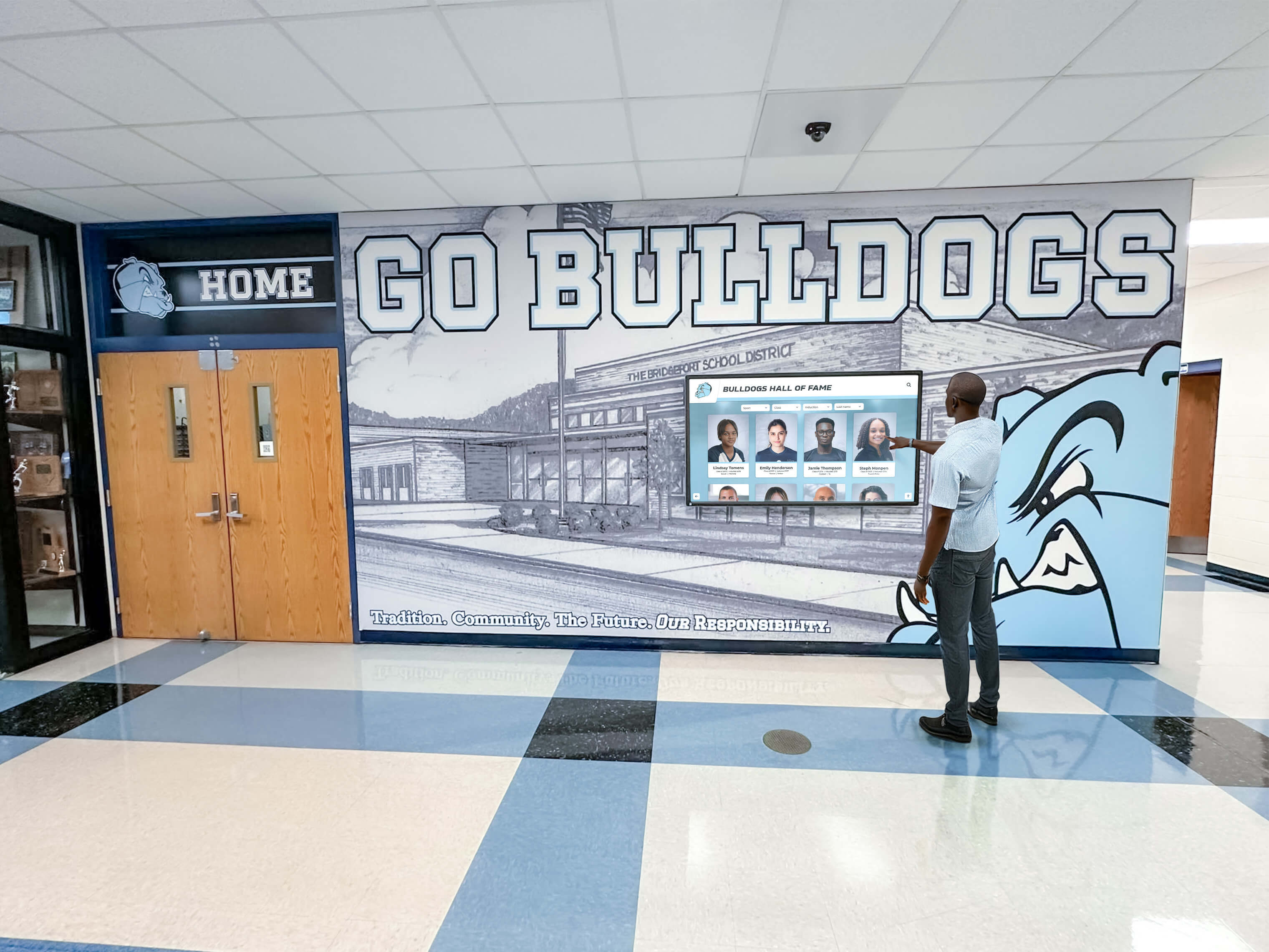
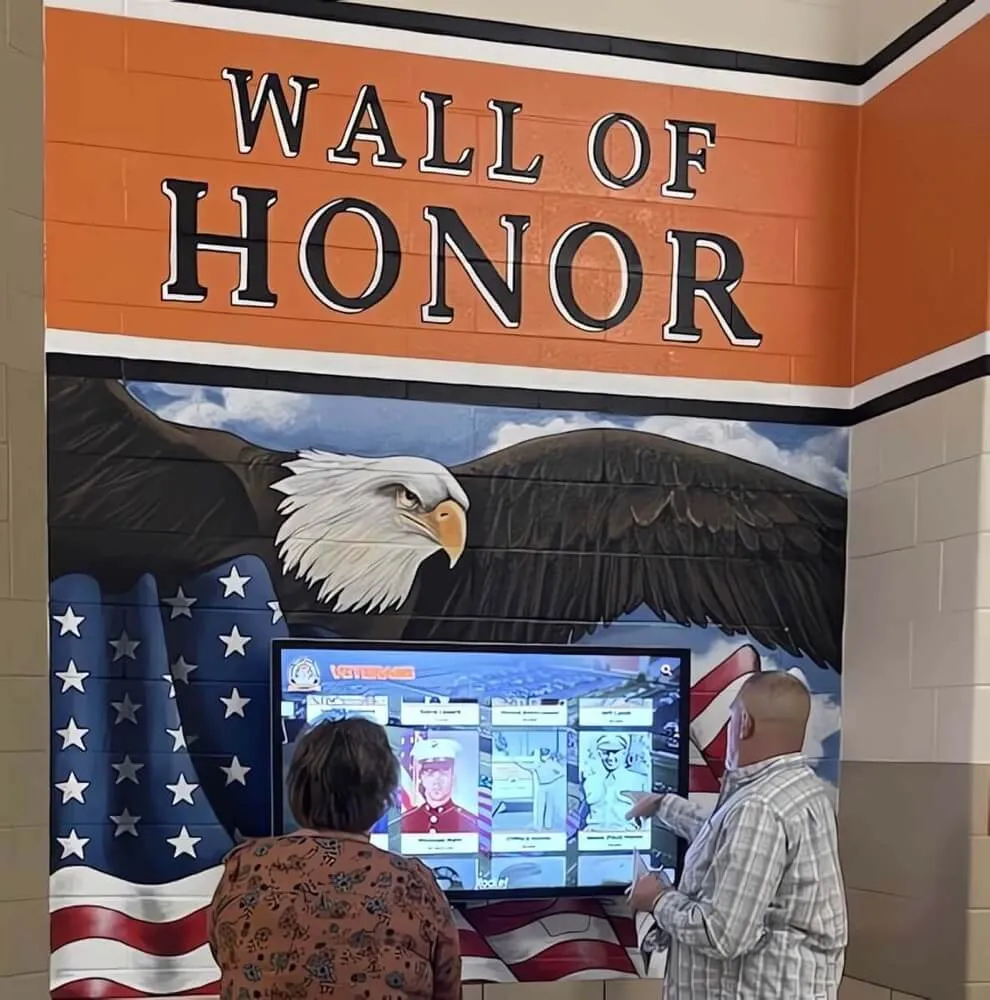
Historic recordings that reach interactive hall of fame displays are heard by students, families, and alumni in the same physical space as the athletic recognition they honor—pitch instability that makes those recordings sound damaged undermines the experience the display was built to create
Phase 3: Output Settings After Correction
Wow and flutter correction applies time-stretch to stabilize pitch. The quality of the output file depends on the export settings used at the delivery stage.
Lossless Intermediate Before Delivery Encode
Before converting to the display delivery format (typically AAC in an MP4 container), export the corrected audio to a lossless intermediate format—WAV or AIFF at 48 kHz, 24-bit. Time-stretch processing introduces small amounts of added noise that are preserved accurately in a lossless format. Converting directly from a lossy source through wow/flutter correction and then to another lossy delivery format stacks codec artifacts on top of correction artifacts, compounding audible damage.
Delivery Format Settings
| Setting | Value | Note |
|---|---|---|
| Container | MP4 (for video) or M4A / WAV (audio-only) | Match the format accepted by the recognition display platform |
| Audio codec | AAC at 192 kbps or higher | Do not use below 128 kbps on corrected recordings |
| Sample rate | 48 kHz | Standard for display and broadcast contexts; 44.1 kHz acceptable for audio-only archives |
| Bit depth | 24-bit for archive master; 16-bit for display derivative | Export 24-bit to archive storage; encode to 16-bit for delivery |
| True peak ceiling | -1.0 dBTP | Wow and flutter correction can slightly shift the dynamic balance; a ceiling prevents clipping during decode |
| Integrated loudness | -14 to -16 LUFS | Normalize after correction; the correction step changes effective loudness balance |
Quality-Control Checklist
Run this checklist for every recording that has undergone wow and flutter correction before logging it as archive-complete or uploading it to a recognition display.
Detection and Assessment
- Listened through the full recording before processing and identified the primary instability type (wow, flutter, or mixed)
- Noted timecodes of most prominent instability for use as test passages
- Confirmed the instability is a recording defect, not a performance characteristic of the content
- Assessed severity (below threshold / mild / moderate / significant) and documented the assessment in the archive record
Correction
- Created a working copy of the original digitized file before applying any processing
- Applied wow and flutter correction to the working copy, not the original
- Selected appropriate correction tool and settings for the instability severity observed
- Previewed corrected audio at the identified test passages before rendering
- Rendered the corrected file with a new filename that includes a processing indicator (e.g.,
1988_championship_WF_CORRECTED.wav) - Placed the original digitized file in archive storage; corrected file in a processing-stage folder
Verification
- Listened to the test passages in the corrected file and confirmed pitch is stable
- Listened to the full corrected file to confirm no new artifacts introduced by the correction
- Compared a one-minute section of the original and corrected versions at equal volume to confirm improvement without degradation
- Verified file duration is within ±1 second of the original (time-stretch correction should not meaningfully change overall duration)
Archive Log Entry
- Date and staff reviewer recorded
- Tool and version used for correction
- Settings applied (rate, depth, or method)
- Severity assessment and outcome recorded
- Any residual instability disclosed in the archive record
- File marked ready for subsequent processing steps: noise reduction, loudness normalization, export
Wow and Flutter by Recording Type
Different recording formats and content types in a school athletic archive present different profiles. The following recommendations apply the general workflow to the most commonly encountered content.
VHS Game Recordings (1980s–2000s)
VHS game recordings made on consumer-grade equipment are the most likely category to contain audible wow. Machines used for frequent recording of game footage—running through many tape hours per year—experienced capstan and pinch-roller wear that translated directly to pitch instability.
Typical profile: Low-rate wow at ±0.2%–0.4% in recordings from worn machines; often more pronounced in the last third of a long tape, where tension dynamics change as the supply reel empties
Recommended treatment: iZotope RX Wow & Flutter at Rate 0.5–2 Hz, Depth starting at 50%; verify against an announcer vowel or PA music segment that extends for at least two seconds
Caution: VHS crowd audio has naturally dynamic characteristics that should not be confused with wow. Crowd surges at a scoring moment change volume, not pitch. Wow changes pitch without necessarily changing volume—the distinction is audible in a sustained crowd roar held at constant energy.
Audio Cassette Play-by-Play and Commentary Recordings
Many schools from the 1980s and 1990s recorded sideline commentary, press-box radio feeds, and coach interviews on standard audio cassette. Consumer cassette mechanisms are more susceptible to wow and flutter than VHS transports and are particularly prone to degradation if stored improperly.
Typical profile: Moderate-to-significant wow and flutter; cassette recordings from cheap or heavily used recorders can show ±0.4%–0.8% or more
Recommended treatment: iZotope RX Wow & Flutter preferred; for mild cases, Audacity Sliding Stretch at conservative settings; document severe cases in the archive record and note any residual instability after correction
Caution: Cassette recordings often also have significant tape hiss—apply wow and flutter correction before noise reduction, in the processing order described in Phase 2
U-matic (¾-Inch) and Betacam Broadcast Recordings
Schools that received game recordings from local television stations or broadcast affiliates may have U-matic or Betacam source tapes in their archives. These professional formats were significantly more stable than consumer equipment, but improper storage—high humidity, temperature variation—can cause oxide softening that introduces subtle pitch instability during playback.
Typical profile: Mild wow at ±0.1%–0.2%; flutter less common but possible in tapes that were repeatedly played on machines with worn heads
Recommended treatment: Detection-first—many U-matic and Betacam recordings will fall below the audibility threshold. If correction is needed, apply at conservative settings and verify carefully; broadcast audio is often the highest-quality content in a school’s archive, and over-correction degrades the best material.
Ceremony, Banquet, and Induction Audio
Recordings of hall-of-fame induction ceremonies, athletic banquets, and award nights are often the most historically significant audio in a school’s archive—and often the recordings most likely to have been made on consumer equipment without regard to technical quality. A portable cassette recorder or a consumer camcorder’s built-in microphone was a common solution for documenting these events.
Typical profile: Wow and flutter from the recording device combined with room resonance, PA system bleed, and crowd ambiance; the speaker’s voice and the remarks being made are the primary information to preserve
Recommended treatment: Apply detection carefully to distinguish mechanical pitch instability from natural pitch variation in speech. Human speech has inherent inflection; correct only clear wow artifacts, not expressive pitch variation. iZotope RX’s Wow & Flutter module with conservative settings (Depth at 30–50%) and careful preview comparison produces the best results.
Schools building recognition archives that include ceremony audio should understand how that audio connects to the larger recognition program. The academic history archiving guidance at digitalwarming.net provides a framework for how schools document and preserve institutional history across media types—principles that apply directly to athletic ceremony recordings representing moments of significant institutional achievement.

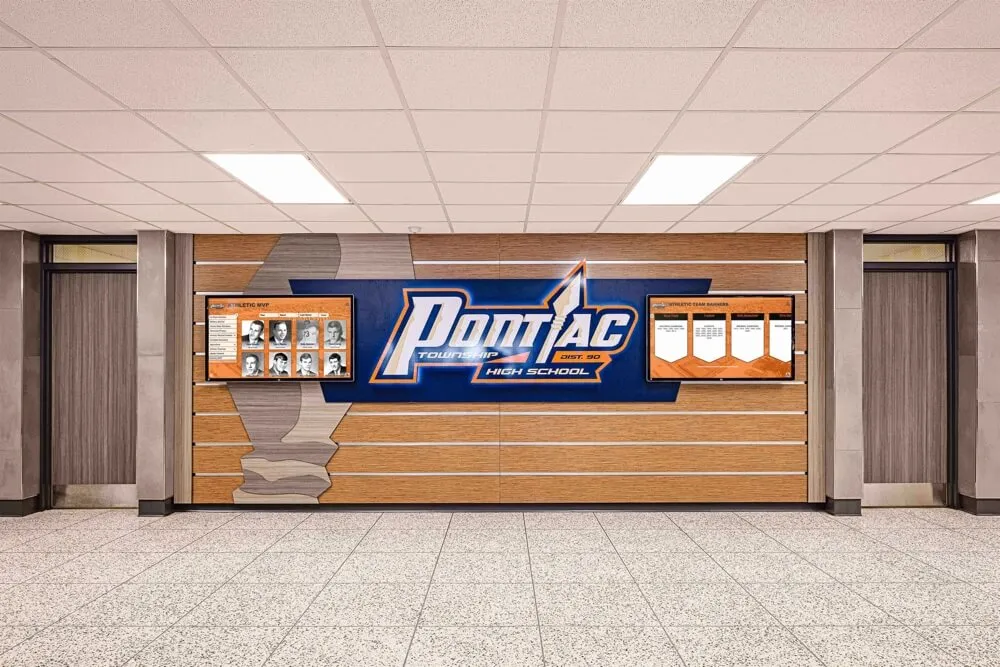
Recognition displays integrated into school hallways represent athletic history to the entire school community—the audio quality of historic recordings accessible through these displays communicates how the program values its own history
Common Mistakes in Wow and Flutter Correction
Over-correcting at the expense of audio naturalness: Wow correction applies time-stretch. At high correction depths, the stretching process itself introduces artifacts—a “watery” or slightly synthetic quality to voices—that can be more distracting than the original mild pitch instability. Conservative correction that reduces audible wow without introducing stretch artifacts is a better outcome than aggressive correction that eliminates every trace of pitch variation at the cost of unnatural voice quality.
Attempting to correct flutter manually in a standard DAW: Flutter at rates above approximately 4 Hz cannot be practically corrected by hand. Manual time-based editing to address flutter-rate variations produces audible edit discontinuities worse than the original artifact. If flutter is the primary problem and a dedicated correction module is not available, it is better to disclose the limitation in the archive record than to attempt correction with tools not designed for the task.
Applying correction at the wrong stage in the pipeline: Wow and flutter correction applied after noise reduction is less effective because the noise reduction process has already smoothed some of the frequency information the correction module uses to track pitch. Always apply wow and flutter correction before noise reduction.
Not preserving the original file: The original digitized file—even with audible wow and flutter—is the authoritative archive record. A correction tool that introduces artifacts, or misconfigured settings, can produce output worse than the original. Without the unprocessed original in storage, there is no recovery path. Always keep the original and save corrections to a separate file.
Using constant-speed correction for dynamic wow: A constant speed adjustment corrects a recording captured at consistently wrong speed—a tape running slightly slow or fast throughout. Dynamic wow is not a constant speed error; it is a varying speed error. A constant-speed correction applied to a recording with dynamic wow fixes the average speed but leaves the pitch variation intact.
Connecting Corrected Audio to a Recognition Display
Wow and flutter correction is a technical step in service of a practical goal: making a historic game tape or ceremony recording audible and engaging on a modern display. Schools that carry out this workflow and then publish the corrected audio to a touchscreen recognition system achieve something meaningful—they make records that would otherwise be uncomfortable to listen to into genuine recognition assets that visitors experience rather than endure.
Historic audio that stabilizes a coach’s retirement remarks, a hall-of-fame ceremony address, or the play-by-play of a championship game reaches the students, families, and alumni who encounter it on a lobby display as something real and alive—not as a technically damaged artifact from a different era.
Programs building towards formal athletic hall of fame structures benefit from reviewing how recognition programs are organized for public display. The senior class awards display guide at halloffame-online.com describes how schools approach organizing recognition content by category and priority—a framework that informs which historic audio recordings are most important to correct first and which represent the program’s most significant recognition milestones.
For programs developing comprehensive recognition archives that include audio alongside photos, athlete profiles, and records boards, the school yearbook digitization guidance at digitalyearbook.org covers how schools approach preserving visual history—the same preservation discipline applied to printed records applies to audio and video archives, and the platform that will display corrected audio should be evaluated as part of the same planning process.

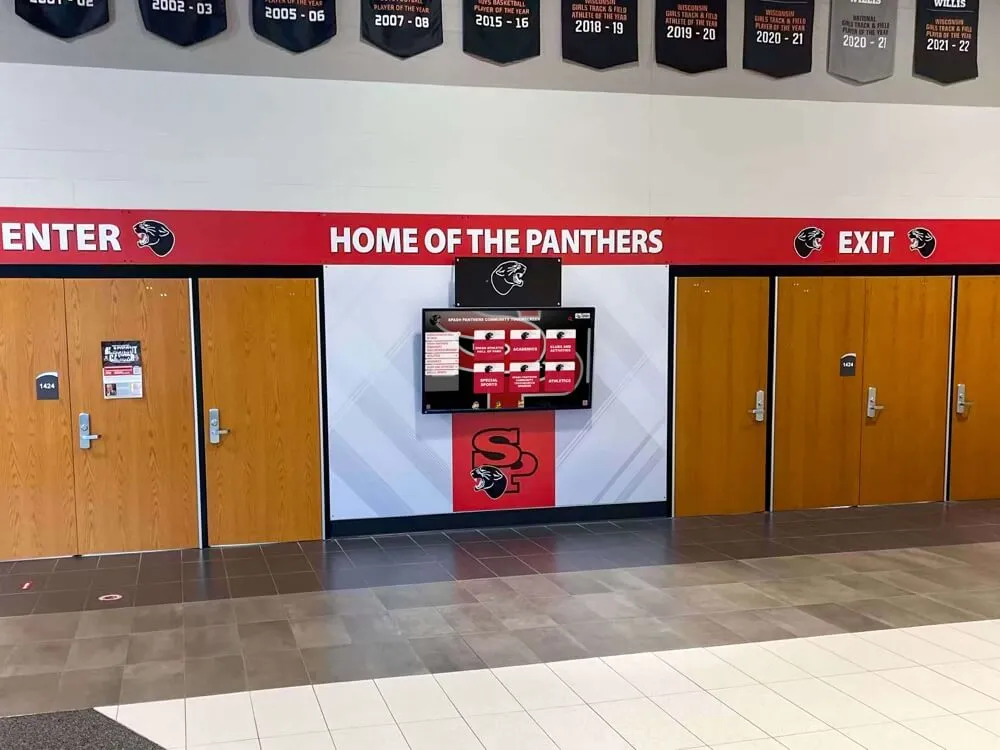
Interactive recognition displays that surface historic audio alongside athlete profiles and records boards depend on audio that is intelligible, stable, and engaging—wow and flutter correction is the step that makes tape-era recordings meet that standard
For programs building recognition displays that honor diverse contributions—athletes, coaches, and community members who shaped the program’s history—the student awards and recognition ideas at awardsdisplay.com offers perspective on how schools think about honoring achievement across categories, including which historical records and audio moments deserve priority attention in the correction workflow.
For programs evaluating how to structure team recognition within a digital display, the team recognition award categories at best-touchscreen.com covers how recognition content is organized for interactive display—useful context for understanding where corrected game audio fits within a broader recognition architecture.
Schools coordinating recognition display content across formats should review how digital display systems handle diverse content types and how content fields are structured for public-facing displays—context that informs how corrected audio files are labeled and organized before upload.
See how corrected historic audio performs on a live recognition display — request a demo
Frequently Asked Questions
Q: How can I tell whether our historic tapes have wow and flutter without specialized measurement equipment?
The most reliable low-tech test is the sustained-pitch test described in Phase 1: find a section containing a constant-pitch tone, a long announcer vowel, or a sustained musical note, and listen for pitch drift over its duration. A PA test tone, a referee whistle, or a held chord in pre-game or post-game ceremony music all work for this purpose. If the pitch drifts clearly upward or downward over a second or two and then returns—or if the tone sounds roughened or vibrating—wow and flutter are present. If the sustained pitch sounds stable and clear, the recording is likely within acceptable limits for most recognition display applications.
Q: Can we correct wow and flutter in a file that was already exported to MP3 or AAC?
Correction is possible but limited by the quality of the compressed source. Lossy codecs introduce their own artifacts—pre-echo, quantization noise, high-frequency smearing—that interact with time-stretch correction in ways that can produce additional artifacts in the output. If the original lossless digitized file is available, use it as the source. If only a compressed version exists, apply correction at conservative settings and compare carefully with the original before archiving the result. Document in the archive record that the corrected file was derived from a compressed source.
Q: Our play-by-play recordings from the 1980s have both wow and tape hiss. Should we correct wow first, or address the hiss first?
Correct wow and flutter first, then apply noise reduction. Noise reduction algorithms analyze the frequency content of the recording to build a noise profile and apply spectral subtraction. If you apply noise reduction before wow correction, the noise reduction has already altered the frequency balance—changing the relationship between signal and noise floor in ways that affect how the correction module tracks pitch. Starting with the lossless digitized source and applying corrections in the correct order (clipping review → wow/flutter → noise reduction → loudness → export) produces the cleanest chain of corrections with the fewest interactions between steps.
Q: We have a championship game recording from 1977 that has significant wow—pitches drift noticeably during some passages. Is it worth correcting?
It is worth attempting correction, with realistic expectations. iZotope RX’s Wow & Flutter module can address pitch deviations well above what is typical in most archive recordings. At corrections of this magnitude, there is a risk of audible stretch artifacts—particularly in complex polyphonic content like crowd audio—but voice content (play-by-play, ceremony remarks, coach comments) typically survives aggressive correction better than music. Apply the correction, listen carefully for stretch artifacts, and if the result is meaningfully better than the original, document the correction level achieved in the archive record and publish the corrected file with a quality disclosure. A significantly improved file—even one with some residual instability—is more useful as a recognition asset than the uncorrected original.
Q: How do we know when to stop correcting and accept that a recording has some wow?
Stop correcting when the tool’s output at any depth setting introduces artifacts that are as distracting as the original instability—or when the audio begins to sound unnatural in ways not present in the original. The goal is improvement toward intelligibility and stability, not perfection. A recording that reduces wow from ±0.4% to ±0.1% is a meaningfully improved archive asset even if it still shows subtle instability in the most demanding listening conditions. Disclose any residual limitation in the archive metadata and mark the file as archive-ready. The original is preserved if re-processing becomes practical with future tools.
Q: Can we re-digitize a tape to get a cleaner starting file rather than correcting the existing digitized version?
In many cases, yes—and this is worth considering for the most historically significant recordings. Wow and flutter in a digitized file comes partly from the playback machine used during digitization, not only from the tape itself. A tape played on a well-maintained, calibrated machine with a clean capstan and pinch roller will show significantly less wow and flutter than the same tape played on a worn consumer machine. If the original tape is available and in reasonable condition, re-digitizing it on better playback equipment—or having it digitized by a professional A/V preservation service—can produce a cleaner source file that requires less correction. The yearbook digitization services resource at digitalyearbook.org discusses how schools approach professional digitization services for preservation projects—the same vendors often handle audiovisual media alongside paper records.
Q: We have a large archive of tapes to process. How do we prioritize the wow and flutter correction workflow?
Prioritize by recognition significance and by scheduled display use: hall-of-fame induction ceremony recordings first, state and regional championship game audio second, championship season play-by-play and highlights third, regular-season recordings fourth. Within each tier, prioritize the oldest content—the 1972 ceremony recording is more historically unique and more likely to deteriorate further than the 1998 footage. Recordings that are scheduled to appear in a new display, recognition event, or public archive launch should receive correction in time to complete the full quality-control pipeline—including noise reduction and loudness normalization—before the publication date.
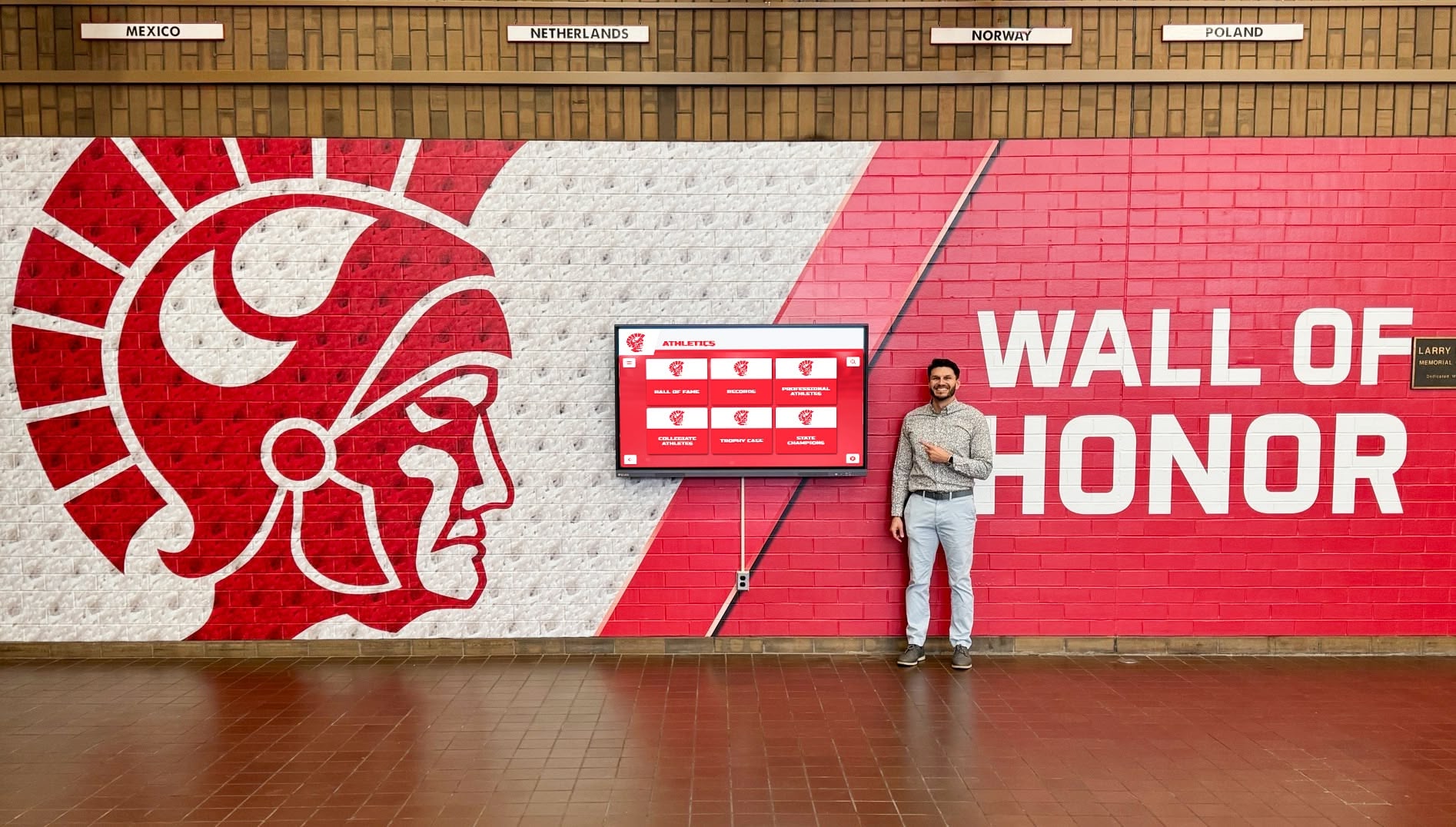
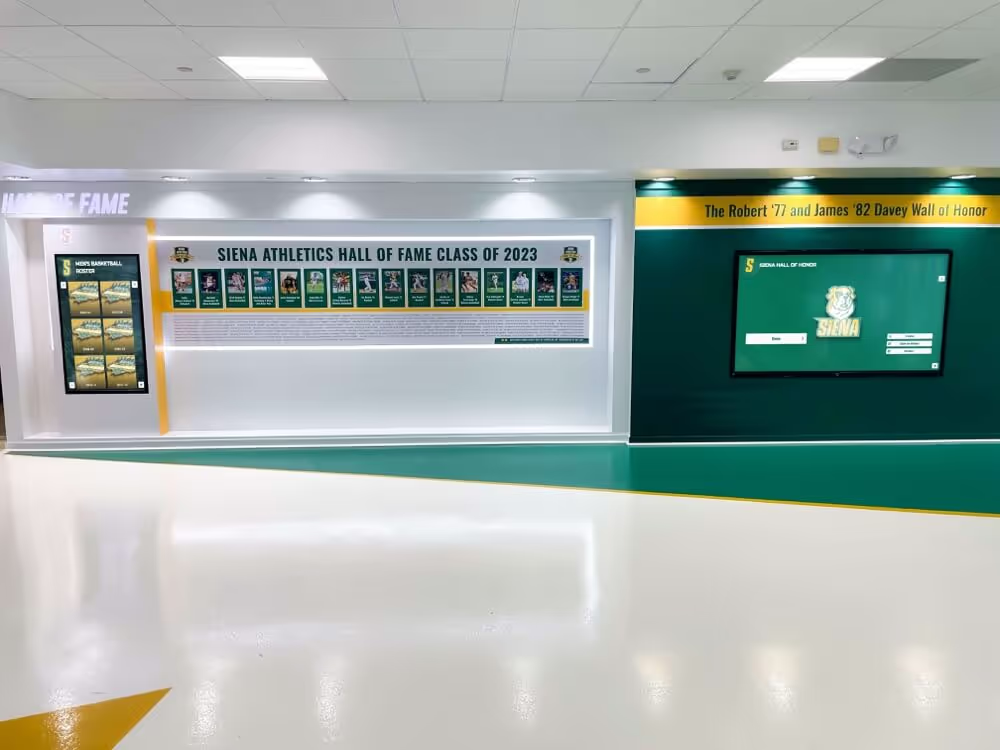
Recognition displays give a school's athletic history a public presence in the building's daily life—the audio quality of historic recordings accessible through those displays communicates how the program values the coaches, athletes, and moments it honors
Maintaining a Consistent Correction Standard Across the Archive
A wow and flutter correction workflow applied to a single batch of tapes does not create a consistent archive unless it becomes the standard for every new batch that enters the processing pipeline. The most effective archives apply correction systematically—every tape, every season, every recording type—rather than selectively based on which recordings seem most problematic on first listen.
Building the workflow into standard operating procedure requires documenting it clearly enough that a new archives staff member or volunteer can follow it without extensive training. The correction settings, the tool chain, and the quality-control checklist should be written into the archive’s processing documentation. When staff changes occur—a common reality in school athletics—the documented procedure preserves the institutional knowledge behind the standard.
Periodic archive review items specific to wow and flutter:
- Confirm that newly acquired tapes—donations from alumni, boosters, or community members—receive the same detection and correction review as internally held recordings before entering the archive
- Verify that recordings published to a recognition display prior to implementing a correction workflow are reviewed and re-processed if they contain audible instability
- When the archive is migrated to a new display platform, re-verify a sample of audio files to confirm that platform re-encoding has not introduced new artifacts
- Update the designated correction reviewer when staff changes occur, and document the tool settings and pipeline in onboarding materials so knowledge is not lost with personnel transitions
The recordings in a school athletic archive are irreplaceable. A state championship broadcast from 1986, a retiring coach’s remarks at an athletic banquet in 1993, a hall-of-fame induction ceremony from 2002—none of these can be re-recorded if they are degraded beyond use by an unmanaged pitch instability problem or a poorly executed processing pass. The wow and flutter correction workflow in this guide represents the standard of care that makes those recordings genuinely usable—and the care applied now is the reason they will still be usable in twenty years.
Rocket Alumni Solutions builds touchscreen hall of fame displays, digital archives, and interactive recognition systems that give athletic programs a permanent, organized home for historic audio, video, athlete profiles, and championship records. If your program is working through a digitization and correction project and wants to see how properly processed historic game audio performs on a live recognition display—alongside athlete cards, photo archives, and records boards—request a live demo and walk through the full archive-to-display workflow.